
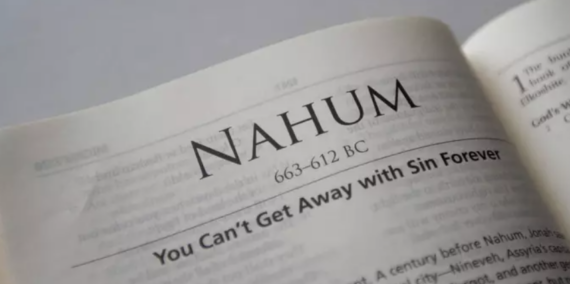
God’s Character in Nahum
Jonah and Nahum
God reveals His character to us in many ways: in the things He says, in the messages He inspires Bible authors to write, in what He does, and in the people and physical realities of His Creation.






Our June theme edition focused on Jonah’s message. Since Jonah and Nahum both brought prophetic messages from God to the Assyrian residents of Nineveh what Jonah reveals about God’s character forms part of the context for what He later reveals about Himself in Nahum.
God sent Jonah to Nineveh with a sentence of judgment, “Yet forty days and Nineveh will be overthrown” (Jonah 3:4). This short statement reveals two things about God: the severity of His judgment and the abundance of His mercy and grace.
Because of His sovereign power, God’s overthrow would be total. While Jonah did not explicitly command the residents of Nineveh to repent, they had 40 days in which to respond to God’s pronouncement. And so they did. By sincere repentance, they became recipients of God’s mercy which spared them from His wrath; for the moment.
God expressed his mercy and compassion in action and words. He spared the residents of Nineveh and their animals, their livelihood. He said, “And should I not have compassion on Nineveh, the great city in which there are more than 120,000 persons who do not know the difference between their right and left hand, as well as many animals?” (4:11). In light of God’s actions, His question expects an affirmative answer.
In summary, God showed how seriously He takes sin, and His mercy and grace in saving the sailors, Jonah, the Ninevites and their animals.
Nahum, Nineveh and Judah
While the Ninevites repented at Jonah’s message they had relapsed by the time of Nahum who came with God’s irreversible message of judgment. By Nahum’s time Nineveh had become the “bloody city, full of lies and pillage” (3:1) whose people were guilty of “harlotries” and “sorceries” (3:4).
As in Jonah, God reveals His character through His justice, judgment and by His grace and mercy in Nahum; this time His final judgment on Nineveh and His grace and mercy in the future of Judah. God distinguishes between His enemies and His allies. His patience has limits. He vindicates those who obey Him.
2 A jealous and avenging God is the LORD; The LORD is avenging and wrathful. The LORD takes vengeance on His adversaries, And He reserves wrath for His enemies.
God’s jealousy is different than human jealousy. His jealousy is holy and righteous for His eternal purposes. He does not want anything coming between Himself and His people and the Spirit He has invested in them: “He jealously desires the Spirit which He has made to dwell in us” (James 4:5).
His vengeance is just, grounded on complete knowledge of what is due His enemies: “Never take your own revenge, beloved, but leave room for the wrath of God, for it is written, “‘Vengeance is mine, I will repay,’ says the Lord” (Romans 12:19; Deuteronomy 32:35).
The Lord is patient, and all powerful. He is in complete control of His power and anger, exercising His justice and wrath in line with His justice and complete knowledge of the guilt and the outcome. Here in Nahum God illustrates all of this with illustrations for Nineveh from His power over His Creation:
3 The LORD is slow to anger and great in power, And the LORD will by no means leave the guilty unpunished. In whirlwind and storm is His way, And clouds are the dust beneath His feet. 4 He rebukes the sea and makes it dry; He dries up all the rivers. Bashan and Carmel wither; The blossoms of Lebanon wither. 5 Mountains quake because of Him, And the hills dissolve; Indeed the earth is upheaved by His presence, The world and all the inhabitants in it. 6 Who can stand before His indignation? Who can endure the burning of His anger? His wrath is poured out like fire, And the rocks are broken up by Him.
There is a wonderful recurring theme in the Old Testament that Nahum includes on God’s character, often said in challenging situations where His people need to know His goodness and loving kindness,
“Give thanks to the LORD, for He is good, His loving kindness endures forever.”
(Psalm 106:1; 107:1; 118:1, 29; 136:1ff; 1 Chronicles 16:34)
7 The LORD is good, A stronghold in the day of trouble, And He knows those who take refuge in Him.
God is wholly good. This is a profound reality. Everything good in the universe originates in Him. No one would want to be anywhere near an all powerful being who was not good.
God’s goodness encompasses those who come to Him for shelter from the storms of life. By contrast for His enemies and Nineveh,
8 But with an overflowing flood, He will make a complete end of its site, And will pursue His enemies into darkness.
By plotting against God’s people, Nineveh had plotted against Him and would not succeed, neither would any other who tried the same,
9 Whatever you devise against the LORD, He will make a complete end of it. Distress will not rise up twice. 10 Like tangled thorns, And like those who are drunken with their drink, They are consumed As stubble completely withered. 11 From you has gone forth One who plotted evil against the LORD,
A wicked counselor.
12 Thus says the LORD, “Though they are at full strength and likewise many, Even so, they will be cut off and pass away. Though I have afflicted you, I will afflict you no longer. 13 “So now, I will break his yoke bar from upon you, And I will tear off your shackles.” 14 The LORD has issued a command concerning you: “Your name will no longer be perpetuated. I will cut off idol and image From the house of your gods. I will prepare your grave, For you are contemptible.”
By contrast, God pronounces good news for His people of Judah, and ultimately His people of all ages as He works for their redemption and vindication:
15 Behold, on the mountains the feet of him who brings good news, Who announces peace! Celebrate your feasts, O Judah; Pay your vows. For never again will the wicked one pass through you; He is cut off completely. 2:1 The one who scatters has come up against you. Man the fortress, watch the road; Strengthen your back, summon all your strength. 2 For the LORD will restore the splendour of Jacob Like the splendour of Israel, Even though devastators have devastated them And destroyed their vine branches. God is the Lord of Both Old and New Testaments
God, Father, Son and Holy Spirit, is eternal. All three are present in Scripture from Genesis 1 to Revelation 22. Through Jesus, the eternal and incarnate Word, “all things came into being” (John 1:3). We see the same attributes of God in both Testaments, the same contrasts of His judgment and grace. By His choice through the unfolding of His eternal purpose of redemption God’s justice, grace and mercy all meet at the cross and empty tomb of Christ, the central event of time and eternity.
Many people, however, see the “God of the Old Testament” as starkly different from “the God of the New Testament.” As Leslie Williams succinctly said in his class on Nahum, “Their biggest problem as we sit down and begin to study and learn about Christ is not really a problem with Christ, but rather God. They believe that God is kind of a hateful guy. Generally speaking it’s not an educated understanding of Bible. They see that God of the Old Testament is different from Jesus of the New Testament.”
Close examination of the New Testament reveals the full range of God’s character, justice and grace, manifest in Jesus, God incarnate. There are countless examples, but space will allow for two important ones from Matthew. Notice John the Baptist’s apocalyptic vision of the risen Christ and His just separation of the righteous and the wicked, right at the beginning of the New Testament in the Gospel of Matthew chapter 3, before Jesus has spoken a single word in His ministry which begins in Matthew 4,
“And His winnowing fork is in His hand, and He will thoroughly clear His threshing floor; and He will gather His wheat into the barn, but He will burn up the chaff with unquenchable fire” (Matthew 3:12).
Again, notice the contrast following Jesus’ scathing words of judgment for the unbelieving cities of Chorazin, Bethsaida and Capernaum in Matthew 11:20–24, where He has these tender words about His character and His care for the humble obedient in Matthew 11:28–30,
“Come to Me, all who are weary and heavy-laden, and I will give you rest. 29 Take My yoke upon you, and learn from Me, for I am gentle and humble in heart; and ‘you shall find rest for your souls’ (Jeremiah 6:16). 30 For My yoke is easy, and My load is light.”
In Jonah, Nahum, and throughout both the Old and New Testaments, God reveals the dimensions of His character so comprehensively that we may have a completely balanced understanding of who He is so we, in turn, may know, love and obey Him with confidence.
Nahum is relevant for every generation, including ours, assuring believers and marginalized subjugated people and world leaders that though world powers live contrary to God’s powers for a while, He is very aware of what they are doing and how they are living. They are ultimately accountable to Him and will face His judgment even when they have served His purposes for a while as in the case of Babylon which followed Assyria. Those who love and obey Him, on the other hand, will know Him, His goodness, grace and mercy, to be a stronghold in the day of trouble here on earth, and will ultimately know the splendour of eternal life in His presence.
Waterloo ON