
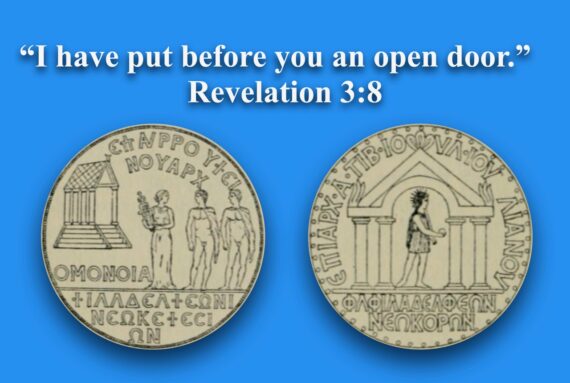
Revelation 3:7–13
Part 2 (Part 1 is available in the July issue)
Continuing our look at Jesus’ greeting to His people in Philadelphia, He went on to say, “‘He who is holy, who is true, who has the key of David, who opens and no one will shut, and who shuts and no one opens, says this:’”






Here again as we’ve seen in His other letters, the characteristics of Jesus in John’s vision of Him in 1:12–16, relate to the character of His people to whom He writes and the life issues they face. The Philadelphians are true to Him while living holy lives in an area open with opportunities to take the gospel to people in the east.
This is the first appearance of the important word “holy” in Revelation. The root of our word holy is hagios. You may have heard of the Hagia Sophia in Istanbul Turkey, (1st century Anatolia). Hagia Sophia means holy wisdom.
From this root word, Christians are best known in Scripture as “holy ones.” Some translations render hagios as “saints” from the French translation of the Latin sanctus. This is unfortunate because the word “saint” does not convey the full meaning of holiness. Further, it has lead to the distinction of a select group of people whereas all of God’s people are “saints,” better understood as His holy ones.
To be holy means to be entirely set apart, separate, sanctified, dedicated, consecrated, sacred. God is purely holy. HIs angels and His people are holy, entirely dedicated to Him and His service. God’s holy people are exclusively His to serve His purposes.
In Revelation 6:9–10, God’s early martyrs also recognized Him has holy and true,
“When the Lamb broke the fifth seal, I saw underneath the altar the souls of those who had been slain because of the word of God, and because of the testimony which they hadmaintained; 10 and they cried out with a loud voice, saying, “How long, O Lord, holy and true, will You refrain from judging and avenging our blood on those who dwell on the earth?”
Thinking of 6:9 here we remember 1:9 where John tells us that He “was on the island called Patmos because of the word of God and the testimony of Jesus.”Truth is a beautiful word we know as the lovely woman’s name Althea. It embodies that which is real, true, trustworthy, genuine, authentic, especially of God who is real in contrast to other “deities” that are not real.
We read about the key of David only here and in Isaiah 22. In the time of Hezekiah during Sennacherib’s invasion and his harassment of Judah, Hezekiah, fortified cities and “Eliakim son of Hilkiah was over the household” (2 Kings 18:37; Isaiah 36:3). In Isaiah 22:21 to 23 we read,
21 And I will clothe him with your tunic, And tie your sash securely about him. I will entrust him with your authority, And he will become a father to the inhabitants of Jerusalem and to the house of Judah. 22 “Then I will set the key of the house of David on his shoulder, When he opens no one will shut, When he shuts no one will open. 23 “I will drive him like a peg in a firm place, And he will become a throne of glory to his father’s house.
Jesus is the eternal King whom God promised would sit on the throne of David. As Eliakim consoled who got into the king’s house, the key of David is emblematic of Jesus’ authority and control in all realms – and – who gets into God’s house. As we know from John’s Gospel Jesus has gone to prepare a place for us in His Father’s house where there are many rooms (John 14:1–8). God decides who enters. From Matthew 16:19 we know Jesus has the “‘keys of the Kingdom.’” From Revelation 1:18 we know that Jesus has “‘the keys of death and Hades.’”Jesus expresses His authoritative use of the key of David in beautiful symmetry: He is the One “‘who opens and no one will shut, and who shuts and no one opens.’” When Jesus opens or shuts doors of the kingdom, His decisions are final.
2. Jesus’ Commendation Part 1
In the first of several times He will do so, Jesus first commends the Philadelphian Christians in verse 8a,
“‘I know your works.’”
As in His letter to Smyrna, Jesus has no convicting rebuke for His people in Philadelphia. He recognizes their works as He does in four other churches: Ephesus, Thyatira, Sardis and Laodicea. These works are good in Philadelphia and Thyatira but they are lacking in Ephesus, Sardis and Laodicea.
3. Jesus’ Promises Part 1
In verse 8b Jesus promises the Philadelphians, “‘Behold, I have put before you an open door which no one can shut…’” God has given profound spiritual and metaphorical meaning to doors in Scripture.
In John’s Gospel Jesus tells us He is the door of His sheep, chapter John 10:7– 10, “So Jesus said to them again, ‘Truly, truly, I say to you, I am the door of the sheep. 8 All who came before Me are thieves and robbers, but the sheep did not hear them. 9 I am the door; if anyone enters through Me, he will be saved, and will go in and out and find pasture. 10 The thief comes only to steal and kill and destroy; I came that they may have life, and have it abundantly.’”
Another important meaning of door in Scripture relates directly to Philadelphia as a missionary city to the east. Writing to the Corinthians from Ephesus in 1 Corinthians 16:8–9, Paul said, “But I will remain in Ephesus until Pentecost; 9 for a wide door for effective service has opened to me, and there are many adversaries.”
God opens doors for the good news of Jesus’ death, burial and resurrection. With the open door comes opposition from God’s enemies as we see in Philadelphia. We can pray for God to open doors as Paul asked His people to do in 2 Corinthians 4:2–4,
“Devote yourselves to prayer, keeping alert in it with an attitude of thanksgiving; 3 praying at the same time for us as well, that God will open up to us a door for the word, so that we may speak forth the mystery of Christ, for which I have also been imprisoned; 4 that I may make it clear in the way I ought to speak.”
Here in Revelation, Jesus literally says that He has “‘given before you a door having been opened.’” Profoundly Jesus’ two verbs for giving us a door having been opened are both in the perfect tense! You may remember the perfect tense expresses a past action with an abiding results. The door Jesus gave the Philadelphians and us is still open.
4. Jesus’ Commendation Part 2
Jesus’ reason for entrusting them with this gift of an open door comes in His second commendation in verse 8c, “‘because you have a little power, and have kept My word, and have not denied My name.’”
Jesus’ gift of the open door is a standing gift based upon the Philadelphians’ works, the little but effective power they have, and the three things they have triumphed in doing: 1) keeping My Word, 2) not denying My name and 3) keeping the Word of My perseverance in their hearts.
Their Thyatiran brothers and sisters were tempted to deny Jesus to remain guild members to make a living. The Philadelphians had been true to Jesus’ name and Word.
The root of little power is micro dunamis, “small” plus our word for “dynamite.” They may have had only a little power but they used it effectively. The importance of the poor widow’s gift in God’s eyes did not depend on its size but upon the gift of her whole heart to Him.
The open door means many things. The door to God’s presence, His kingdom, His temple, His service, open so they may carry the gospel east into Phrygia. We may ask what is our Phrygia What open doors exist where we are through which God would like us to carry the gospel? When God opens a door for us, let’s go through it!
5. Jesus’ Promise Part 2
Jesus gives His second promise in verse 9,
‘“Behold, I will cause those of the synagogue of Satan, who say that they are Jews and are not, but lie—I will make them come and bow down at your feet, and make them know that I have loved you.’”
You remember the “synagogue of Satan” from Smyrna!
Philadelphia and Smyrna are the only two churches to whom Jesus gives no convicting rebuke but they are both harassed by those of the synagogue of Satan. Those are gathered together of the accuser. They are gathered together of Satan. They lie about themselves because the accuser is the father of lies. This is another truth unique to John here in Revelation and his Gospel chapter 8:44. As Paul says a Jew in God’s eyes is one who is so inwardly rather than outwardly.
Jesus promises something incredible to the Philadelphians. He will make these Jews bow down and worship at their feet. This would be a complete reversal of expectations for Jewish people. They were God’s chosen people, a light to the Gentiles, a people to whom pagans would cling and bow down. We see their perspective in Isaiah 45:14, 49:7, 23
45:14 Thus says the LORD, “The products of Egypt and the merchandise of Cush, And the Sabeans, men of stature, Will come over to you and will be yours; They will walk behind you, they will come over in chains And will bow down to you; They will make supplication to you: ‘Surely, God is with you, and there is none else, No other God.’”
49:7 Thus says the LORD, the Redeemer of Israel and its Holy One, To the despised One, To the One abhorred by the nation, To the Servant of rulers, “Kings will see and arise, Princes will also bow down, Because of the LORD who is faithful, the Holy One of Israel who has chosen You.” 49:23 “Kings will be your guardians, And their princesses your nurses. They will bow down to you with their faces to the earth, And lick the dust of your feet; And you will know that I am the LORD;
Those who hopefully wait for Me will not be put to shame. 60:14 “The sons of those who afflicted you will come bowing to you, And all those who despised you will bow themselves at the soles of your feet; And they will call you the city of the LORD,
The Zion of the Holy One of Israel.”
The root word Jesus uses means to worship, to revere, do obeisance, to incline one’s face to the ground, to bow oneself before someone as an act of reverence, to prostrate oneself before another. To Greeks and Persians it could include to kiss the feet or the hem of a garment. It is to express in attitude or gestures one’s complete dependence on or submission to a high authority figure. In the case of human beings, “by this act they are to be recognized as belonging to a superhuman realm.”
Revelation has much to say about who we are to worship: God and the Lamb,
“and he said with a loud voice, “Fear God, and give Him glory, because the hour of His judgment has come; worship Him who made the heaven and the earth and sea and springs of waters.”(Revelation 14:7)
“Who will not fear, O Lord, and glorify Your name? For You alone are holy; For all the nations will come and worship before You, For Your righteous acts have been revealed.” (Revelation 15:4)
The positive outcome for Christians in Philadelphia is that the Jews who were persecuting them will know that Jesus loves the humble who believe in Him with the benevolent gracious love of God.
To Be Continued…