
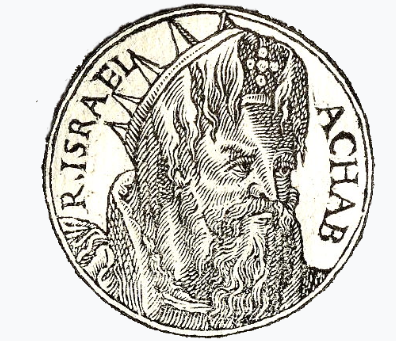
Text: 1st Kings 22:34-35
You hear all the time, “he was in the wrong place at the wrong time”. The thing that comes through loud and clear is that life is governed by chance and ‘stuff just happens’. At the end of King Ahab’s life, the bible records an event that seems to confirm just that. It is found in 1st Kings 22:34 and goes like this:
“Now a certain man drew his bow at random and struck the king of Israel in a joint of the armour.






What are the odds? What are the odds that a random shot would find its way to Ahab? What was the chance that it would hit him in a joint in his armour and prove fatal? The odds seem so small, that ‘down under’ they say, “no worries mate”.
Was this just a case of bad luck? Should have stopped for a second cup of coffee,or stayed in bed? Was there more to the story? How did choice and chance combine to bring about Ahab’s downfall? Or was chance involved at all? What is the story behind the story?
As a young man, Ahab married a pagan woman named Jezebel. He married outside of Israel and against God’s will. He did it in part to form an economic and military alliance with her father who was king of Phoenicia. And to please her, Ahab built a temple to the Phoenician gods of Baal and Asherah. He added to God’s displeasure over pagan worship at Dan and Bethel by bringing more idolatry into his capital city.
We soon find out that Jezebel was ruthless. After Elijah destroyed 400 prophets of Baal, she promised to kill him. She put a price on his head and the prophet ran for his life (I Ki.: 18-19). He became so depressed that he asked God to take his life. But God would not hear of it and put him back to work. Some years later, when Naboth refused to sell his vineyard to Ahab, Jezebel told Ahab to stop acting like a baby and to man up. She had Naboth killed and gave his property to Ahab (Ch. 21). Elijah caught up to Ahab in that vineyard and accused him as an accessory to murder,saying
“Have you murdered and also taken possession?”‘ `Thus says the LORD, “In the place where the dogs licked up the blood of Naboth the dogs will lick up your blood, even yours.”
Behold, I will bring evil upon you, and will utterly sweep you away, and will cut off from Ahab every male, both bond and free in Israel; and I will make your house like the house of Jeroboam the son of Nebat, and like the house of Baasha the son of Ahijah, because of the provocation with which you have provoked Me to anger, and because you have made Israel sin.”
And then, recognizing Jezebel’s part in all of this, Elijah also said “Of Jezebel also has the LORD spoken, saying, `The dogs will eat Jezebel in the district of Jezreel.’
With God, all sin is provocation. It is high-handed rebellion. God held the king to a higher standard, since the nation followed his lead. So while the courts looked the other way, God did not and promised that Ahab and Jezebel would pay.
The writer explains why,in verse 25
Surely there was no one like Ahab who sold himself to do evil in the sight of the LORD, because Jezebel his wife incited him. He acted very abominably in following idols, according to all that the Amorites had done, whom the LORD cast out before the sons of Israel (21:25)
His wife taught him how to sin and he did it with all his might. “He sold himself to do evil” (I Ki.: 21:25). He was a bought man. He was evil and loved it. He loved it until that day when Elijah met him in Naboth’s vineyard and informed him that he was “a dead man walking”.
Imagine – if God said that to you? That you were condemned to die and it was coming any day now. Would you shake your fist in His face? Or would you get down on your knees?
To Ahab’s credit, he took the words to heart. He believed God. He tore his clothes as a sign of a torn heart. He fasted, he wore coarse clothes and he went about like a man on death-row
It seems that for the first time in his life, Ahab finally got it. God’s word smacked him in the head. He was an evil man who knew that he was evil. He was staring death in the face,and standing before a holy God.
I have to admit that I’m surprised at Ahab. I’m surprised that he repented and didn’t think that he had it in him. And I’m also surprised at God,who said to Elijah: “Do you see how Ahab has humbled himself before Me? Because he has humbled himself before Me, I will not bring the evil in his days, but I will bring the evil upon his house in his son’s days.”
Ahab wasn’t faking it. He really did repent and God accepted that. And for a while Ahab was a changed man. But as we come to our text, the story takes another twist.
Three years had passed since the end of chapter 21. During that time, you have to wonder what Ahab was thinking? Was he walking on egg shells? Wondering if he would wake up in the morning? Or did he think that perhaps, God had forgotten? That the crisis was over and I am good to go.
Was that it? Was Elijah mistaken? Did God just forgive and forget?
We don’t know exactly what went through his mind, but we do know that during those three years, he went back to his old ways. A new life with God did not take the place of the old one. He did not get rid of the golden calves at Dan and Bethel. His heart became hard again, perhaps hardened just a little bit more.
But then, the same thing can happen to us. At some point, we may realize that we stand condemned before God. We may repent. And then, given enough time, we may also repent of our repentance. We might think, I over-reacted. I was so worried, but it was all for nothing. Looks like I’m off the hook.
It is important to ask: what does the patience of God mean? Is it an acquittal? Has God forgotten or gotten over our sin? Is he okay with it – now?
The answer is,NO. The passing of time by itself, does not undo our sin. God’s patience is an opportunity for us to make repentance permanent. A chance to replace sinful lives with Godly ones.
So,three years later, Ahab was back to where he’d been,once again, a man who’d sold himself to do evil. But there is a sense in which even that was not true, because a person can never really just go back. Let me suggest that Ahab was actually further away from God than he had ever been. For when he repented, his heart had been touched. He really had turned toward God but then he had turned away again.
Here is how that works: each time that we go back to a sinful way of life, it gets harder to repent. We become more and more cynical, and less sincere. And we take God less seriously, since He seems to keep letting us get away with it. So Ahab was back in the future, to his past. Older but no wiser, sinful and cynical.
The setting for 1st kings 22 then is this. God had defeated the armies of Syria, but Ahab had let Ben-Hadad live and even made a covenant with him. So God told Ahab that he would lose his own life because he had allowed a man to live, whom the Lord had devoted to destruction. And as for that covenant, either Ben-Hadad had retaken the city of Ramoth-Gilead, or he had never given it back in the first place
Ahab wanted it back, even if just as a matter of pride. So he arranged for the king of Judah to help him. It turns out that Jehoshaphat’s son Jehoram had married Ahab’s daughter – Athaliah, so this combined effort was all in the family.
Ahab was ready to march but Jehoshaphat wanted to hear from God. Ahab said “no problem, let me call the 400 prophets that I have on the payroll”. Ahab put the question to them, “do we go to fight or do we stay home?” Do we liberate Ramoth Gilead or do we leave it with the Syrians? And all the prophets said: “Go up, for the Lord will give it into the hand of the king.”
Now you’d think that that would be good enough. 400 prophets were for it and none opposed. How often does that happen? It happens 100% of the time, when the prophets are bought and paid for and when they know what the king wants to hear. Prophets who sell their services, don’t often, tell the truth.
Did you know that churches can hire them too? And if that happens, someone needs to stand up and ask: “Is there not yet a prophet of the Lord that we may inquire of him?” Can’t we find someone who will tell us what God says?
Consider Ahab’s answer: “There is yet one man by whom we may inquire of the LORD, but I hate him, because he does not prophesy good concerning me, but evil. He is Micaiah son of Imlah.”
Do you see how Ahab’s mind worked? He didn’t like for any man, even a man-of-God, to tell him that what he was doing was wrong. So he had deliberately not invited him to speak. There was no place in Ahab’s court for even a single dissenting voice. Ahab didn’t want to hear from God. He wanted to live as he saw fit and for God to mind his own business.
That’s what he wanted. The last thing that Ahab wanted, was the truth. He wanted to conquer the Syrians, but he wasn’t interested in conquering sin
Jehoshaphat did care. He wanted to hear from God. And since Ahab needed the man’s army, he grudgingly agreed.
When the king’s men went for Micaiah they told him that he had better agree with the other prophets.
When he walked in and Ahab asked him “Micaiah, shall we go to Ramoth-gilead to battle, or shall we refrain?”, Micaiah said “Go up and succeed, and the Lord will give it into the hand of the king.”
Maybe it was the tone of voice, or his posture. Perhaps he mimicked the other prophets. But whatever it was, Ahab wasn’t satisfied. Having gone to the trouble of sending for a real prophet, he wanted to know what was actually going to happen
So he said to Micaiah: “How many times must I adjure you to speak to me nothing but the truth in the name of the LORD ?” In other words, As God is your witness,tell me what God said”
Well okay then, here it is:
“I saw all Israel Scattered on the mountains, Like sheep which have no shepherd. And the LORD said, `These have no master. Let each of them return to his house in peace.’
Ahab, if you go up to battle, you’re not coming back. Israel will have no master,but she will have peace. Talk about crashing the party. You can feel the air go out of the room and all eyes are on Ahab
To be fair, there are several things that he could have done. He could have repented again, in front of everyone. He could have humbled himself in the sight of God and a Godly king. He could have thanked Jehoshaphat for pointing him to God. And he could have honoured Micaiah for saving his life.
Or he could have done what he did. ” Then the king of Israel said to Jehoshaphat, “Did I not tell you that he would not prophesy good concerning me, but evil?” “I told you so!” He’s got it in for me,and I’m not going to take it anymore.
Ahab looked at Micaiah, but didn’t see God standing beside him. His fight was with God and not the man of God.
Verses 19-23 give us a rare glimpse into the spirit world. We learn that not everything that happens on earth is the will of God. Not even everything that happens in the spirit world is the will of God. Even there, there are truthful messengers and deceiving spirits, and these two worlds are intimately connected .
When we reject the word of God, we are just asking to be deceived. We buddy up to rebellious spirits, who tell us whatever we want to hear. This passage opens our eyes to a spiritual reality that God wants us to know about.
So it was that when God asked the spirits,. ‘Who will entice Ahab to go up and fall at Ramoth-gilead? .. there was no shortage of volunteers. Ahab had chosen sides a long time ago. So God allowed a deceiving spirit to fill the king’s mind with lies. He spoke through the 400 prophets and who formed the majority. And then, just to be fair, God told Ahab what was going on behind the scenes
But Ahab not listening. He was beyond reason,and ranted against the Man of God. Micaiah might be right, but I am not going to lose face. I’m the king and I call the shots. Nobody tells me what to do. His heart hardened once again. It was hardened in a man who was spiritually dead and a ‘dead man walking’.
Despite all that Ahab knew to be right and true, this is what he did. He put chains on Micaiah and gave instructions to ‘feed him bread & water’, promising to deal with him when he got back.
And then to outsmart God, he dressed up like a common soldier – not like a king. He didn’t want a bull’s eye on his back. He got Jehoshaphat to wear his royal robes, and went into battle anyway.
Which brings us to that moment when, “a certain man drew his bow at random and struck the king of Israel in a joint of the armour”.
What do you think? Was it chance or choice?
If ever there was a guided missile, this was it. The man drew his bow at random, but God guided the arrow. Somewhere down deep inside, Ahab knew it was coming
It took Ahab all day to die. Here is the thing: he didn’t call 911 or rush to see the doctor. He watched the battle, propped up in his chariot,as his life drained away.
I wonder what he thought about? Did he consider turning back to God one last time? Did he look toward heaven and admit “God, you were right!”. Did it hit him – that he had done this to himself. Did he fill out pink slips for the 400 prophets? After all, he got what he paid for.
Ahab saved face – but lost his life. He died just like God said that he would, but at least he died proud.
He died proud because he had sold himself to do evil.
It’s okay to die proud, if you boast in the Lord. But if you die, proud of living your life ‘your way’ – then you are well and truly on your own in eternity.
You should also know that God does not want that for you. He takes no pleasure in the death of the wicked. He wants to forgive each of us through the blood of Jesus. And for us to live as a child of his.
But like Ahab, we really only have today to make up our minds. We all have an appointment with death and there is a bow, not drawn at random, that cannot miss.
What happens next is up to us. There is a choice that takes chance out of the equation. Faith in Jesus and obedience to his will, today and everyday.
Barrie, ON