
Text: Revelation 5
The setting for John’s vision in our passage is found in the previous chapter, whose message is, that all of Heaven is the throne room of God. In that room John saw the throne of God in all of its radiant glory. Around it were 24 thrones with 24 elders clothed in white and crowned with gold.
He saw 7 flaming torches representing the Holy Spirit and looked across a shimmering sea that whose appearance was like crystal clear glass.




In the center and around the throne of God there appeared four living beings. They were covered in eyes both front and behind and each had six wings. Isaiah and Ezekiel had seen them before. The first was like a lion, the second was like a bull, the third had the face of a man while the fourth was like an eagle.
Heaven was filled with the Glory of God. Lightning and thunder pealed from God’s throne and God’s presence shone like a rainbow with bright hues of red and green. 7 lamps – the Spirit of God added his own majesty to the scene.
As all of the beings raised their voices in praise, the 24 elders removed their crowns and fell face-down before God while the living creatures declared his holiness, power and eternal nature.
The scene reminds us that God alone is eternal, and without Him, no one else and nothing else would exist. In his wisdom and by his power He has called them into being, sustained them by his providence and redeemed them in love.
But how has it come about that some who were once sinners have become worthy to enter the presence of the one who is both holy and of ultimate worth? That is what chapter 5 is all about.
At this point, the prophet’s attention was drawn to a scroll that God held in his right hand. It was no ordinary document. The fact that God held onto it is our first hint. It is the property of Almighty God. The writing is his as are the things to come which form its contents. Written upon, front and back, it is full and final, rolled up and sealed with 7 seals
Ancient documents were sealed by dripping wax along the edge of a rolled scroll and impressing a seal into the soft wax before it hardened. The seal did three things:
- It bore the insignia of its owner – it told everyone who it belonged to.
- It assured the person who received it that the document was genuine
- And it guaranteed that the contents had not been tampered with.
The symbolism is clear. Seven seals is a way of saying that this document was completely sealed. There was no way into the contents except through the seals. The fact that it was covered front and back with writing tells us that this revelation is both final and complete. Nothing had been left out or needed to be added. Rev.22:18-19 warns against all additions and deletions.
But what exactly is the scroll itself? What are the contents? Is it a will? Roman wills were sealed with seven seals. Is this the imagery that was intended? It is true that the New Testament as a whole is Christ’s will for the church. But the book of Revelation by itself hardly qualifies.
Let me suggest another way to understand what the scroll is. If you have read on into chapter six, then you know what happens when each of these seals are broken. When the first seal is broken, a rider with a crown, seated on a white horse came out to conquer. At the breaking of the second seal, a rider on a red horse comes out and is given a sword to take away peace on earth. With the third seal, a third horse…and so on. It seems fairly plain to us that the contents of the scroll are the rest of the book of Revelation. (chapters 6-22)
As John’s vision unfolded, he saw a strong angel who issued a challenge. He cried out in a loud voice “who is worthy to open the book and to break it’s seals?”
Now the question might be somewhat lost on us, until we realize that worthiness has to do with power and authority. In heaven, it also has to do with moral purity and spiritual holiness. So
the one who opened the document took responsibility for the contents, having acquired the power to bring each event to pass.
We are not told how long the question was allowed to hang there. We are not told if the praise that surrounded the throne fell silent. But as John waited, and waited…no one stepped forward. No one in heaven took up the challenge. None of the angels came forward, nor did the 4 living beings, not the elders or even the archangel. Likewise, no-one on earth was worthy. None of the saints alive in John’s day were deemed worthy. Furthermore, no one in the Hadean realm – the place of the dead was worthy. Not Moses or Elijah, Abraham or Daniel, and neither Peter nor Paul. Absolutely no one came forward or spoke up.
When this really sank in, John wept bitterly. The word for weeping is the same one that Luke used to describe Jesus when he wept or wailed over the lost state of Jerusalem. (Lk.19:41)
As a prophet of God, John was in deep anguish. Here before him was God’s message for the church on earth and it was sealed up. How could he know it or share it? How could he tell others about what was still to come regarding redemption and judgment?
In distress and anguish, John wept. The text says “he wept greatly”.
Perhaps we should ask: what would it take for us to do the same? Do we share John’s sorrow for the church left in ignorance? Do we long to know the will of God and to look into his word? Do we have the blood of the prophets flowing in our veins? Do we have a message from God that won’t let us alone until we share it with others?
That is how John felt. He needed the message to do his job. Unlike John in that moment, we do have God’s completed revelation, and God has given us a job to do. May we share John’s sorrow for things of eternal consequence.
Just when it seemed that no one could be found – that no one was worthy, the answer appeared and it put an end to weeping. One of the elders spoke up and told him to stop it, saying “…behold the Lion that is from the tribe of Judah, the Root of David has overcome so as to open the book and the seven seals”
There is no question about who the lion is. When Jacob blessed his son Judah, he called him a “lion’s whelp” and prophesied that he would rule over his brothers. (Gen. 49:8-12) The prophet Isaiah spoke of the coming “root of Jesse” (11:1,10). Jesse was David’s father. At the time that Isaiah wrote, David was already dead. But from the stock of Jesse and David, the messiah was to come. Jesus descended from King David on both his father’s de and his mother’s. The root out of David is Jesus Christ.
It occurs to us then that the exalted Son of God has his redemptive roots in time and space. And while he rules in heaven, he is the same person who was born of Mary and who grew up in Nazareth. History counts for something, just as the death of Jesus Christ counts for all eternity.
The lion of Judah and the root of David has overcome and he is worthy. He has won a victory over temptation to sin and over death. And he shares that victory with all who belong to Him.
Verses 6-14 give us four reasons why Jesus is worthy. Warren Wiersby puts it this way:
Christ is worthy:
Because of who He is vs. 5-7
Because of where He is vs. 6
Because of what He does vs. 8-10
Because of what he has vs. 11-14
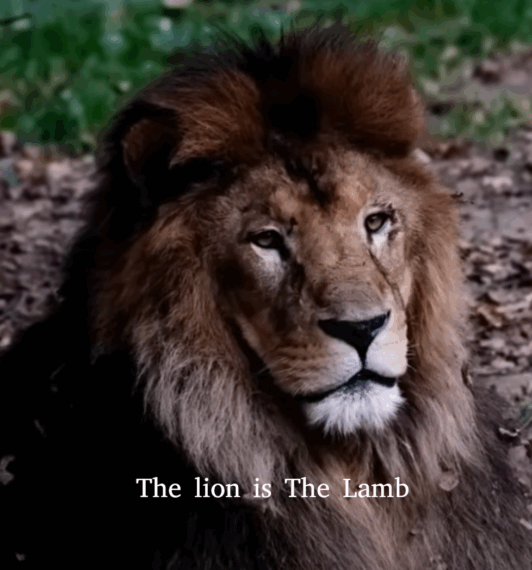
Imagine John’s surprise, for when he turned to see a lion… out stepped a lamb. The contrast could not have been greater. In fact – the word for lamb is ‘arnion’ which means “little lamb”. Instead of a big strong lion, he saw a bundle of fleece on wobbly legs.
Not only that, but there is a gaping wound on its neck – it’s been slain. It has been slaughtered and sacrificed. The verb (sphazo) suggests a violent death. But though it had died, it was back up and standing. It looks like it had been slain because it had, but it didn’t stay dead.
Once again, the scriptures do not keep us guessing. The lamb is Jesus.
- Isaiah compared him to a lamb who remained silent – even in death.
- John the Baptist called him “the lamb of God who takes away the sin of the world”. (John 1:29)
- Peter says that all Christians have been redeemed “…with precious blood, as of a lamb unblemished and spotless, the blood of Christ” (1st Pet.1:18-19)
- And Paul wrote that “Christ our Passover has been slain” (1Cor. 5:7)
Now the lamb that John saw was far from ordinary and definitely not helpless. He had seven horns and seven eyes. The horns stand for power. The Lamb of God is the Son of God. He is all powerful, and having seven eyes, is all seeing and all knowing
In Revelation, the seven eyes are the seven Spirits of God. As we have seen earlier in the book, the seven spirits of God represent the Holy Spirit. The fact that they belong to the Lamb means that there is a close relationship between the two. While Jesus rules in heaven, he has sent the Holy Spirit on a mission to the earth. And through the administration of God’s Spirit, there is nothing that Jesus does not see or know. Jesus promised his apostles that he would send the Holy Spirit to them from heaven. He kept his promise beginning on the day of Pentecost. The Holy Spirit has also been promised to all Christians and he lives inside of each one of us.
The lion is a lamb. This is wisdom from God. The world understands a clenched fist, but God used a pierced hand. His ways are above our ways, and his thoughts above our thoughts. What passes for wisdom among us is foolishness to Him.
So it is the lamb that is worthy, which is evident by what he does. He came and took the book out of the right hand of the one seated on the throne. The verb tense in this verse indicates that this had already taken place. In other words, we should read: the lamb came and has taken the book
Daniel 7:13-14 pictures something similar. In that passage, someone that looked like a man came up to the Ancient of Days and was presented before him. This is what Daniel wrote:
“And to him was given dominion, glory and a kingdom that all the peoples, nations and men of every language might serve Him. His dominion is an everlasting dominion which will not pass away and his kingdom is one that will not be destroyed”
Many are convinced that these are depictions of the same scene. The son of Man who receives an everlasting kingdom is the Lamb of God who does so because he alone is worthy.
As the lamb took the book from the hand of God, the four living creatures and the 24 elders broke out in praise and thanksgiving to the lamb. We all know that only God is worthy of worship, so it follows therefore that the lamb is God.
All of the created beings in heaven fell down and worshipped the lamb. The elders are pictured with harps or lyres in their hands and golden bowls filled with incense. These objects are symbolic and not literal. John explains that the bowls and incense are the prayers of the saints. The harps or lyres are symbols of song and praise. Neither set a precedent for the use of musical instruments or of incense in our worship.
But there is something that is worth imitating. They sang a new song…a song praising the lamb. They said: “Worthy are you to take the book and to break its seals; for you were slain, and purchased for God with your blood men from every tribe, tongue and people and nation. (Vs. 9)
Before Jesus died on the cross, this song could not be sung. Before the cross, the kingdom of God was closed to sinful men and women. Before the cross, our blood was on our own heads. But the blood of Jesus Christ has brought the kingdom of heaven down to earth and opened the only door through which we may enter.
The new song marks a turning point in history. It is a time, after which everything is changed.
Salvation from sin is now universal and offered to every tribe or family group, every tongue or linguistic group, every people or social group and to every nation or ethnic group. Now and until the end of time…the gospel is for everyone.
Verse 10 suggests that in God’s kingdom, there is unity in the midst of diversity.
- Jesus has made all these people into one kingdom.
- He has raised our status and made us priests
- And he has caused us to reign with him
Many ancient manuscripts use the first person in verse 10. So they read
“you have made us to be a kingdom and priests to our God and we will
reign upon the earth”
In other words…in John’s day Christians were already reigning with Jesus. This was a statement of fact and not just a future promise. The problem was, that Christians were being killed in the arenas. They were being executed for refusing to worship Caesar. Everywhere and in every place, they were persecuted for their faith. John was in exile on the island of Patmos and many Christians had gone into hiding. It sure didn’t look as if Christ was on the throne.
So, in what sense then were, and are, Christians reigning?
Jesus was reminding the church that “looks can be deceiving”. Chapter four has God on the throne and at the center of the Cosmos. And chapter five assures us that Jesus is victorious and that he now reigns.
Yet, in light of that “in what sense do Christians reign with him?”
- To begin with, we are in his kingdom. We are part of the only eternal kingdom that exists. And as citizens of that realm, we will live forever in the presence of God.
- God is our father and we are part of his royal family. This is a real spiritual fact and Christ is now our elder brother.
- Christ is on the throne and we are in Christ. As Paul put it in his letter to the Ephesians, “he has seated us with him in the heavenly places in Christ Jesus” (Eph.2:6)
- And since we have been saved, death no longer reigns over us. We are now alive forever more in our relationship with God. Physical death simply ushers us into his immediate presence. We are already priests in his kingdom (1st Pet.2:5-9) and are in this way already reigning on earth.
For these reasons and more, all heaven breaks out into praise for the Lamb…and that song includes praise for God the Father and for the Lamb. Revelation 5:11-14
Perhaps what we have here is a fleeting picture of what heaven will be like. John saw the throne room of God filled with angels. There were thousands multiplied by thousands, suggesting that all the angels of God were present. They joined the 24 elders and the 4 living beings in praise and adoration which rose in volume and intensity as John looked on. They cried out saying “ “worthy is the lamb that was slain to receive power and riches and wisdom and might and honour and glory and blessing”.
If you are counting…you’ve noticed seven things in that praise. The seven are made up of four divine attributes and 3 devotional attitudes to declare how it is that the lamb is worthy.
John used the definite article. To Christ is due the Power, the Wisdom, the Riches and the Might. These are things that belong only to God – but then the lamb is God. Power is an expression of might. The power is God’s omnipotence. Might is power whether or not it is used. The might of God is his infinite potential. The riches are God’s riches which now include a redeemed Humanity. The lamb has added us to the riches of God. And the Wisdom is God’s wisdom.
Because of these, we owe him the honour and the glory and the blessing. The hosts of heaven honour the Lamb – how much more should we. The word for glory is doxa from which we get the word ‘doxology’. A doxology is a song of praise or of glory. These are the kinds of songs that the lamb is worthy to receive.
The word for blessing is eulogia – from which we get eulogy. A eulogy is ‘a good word’ When we eulogize someone we recount much that was good about them. When we bless Christ, we recount all his goodness and praise him for it.
The Lamb of God is worthy of complete praise, a seven fold – seven faceted one. The Lamb of God is God and is worthy to be worshipped.
In Verse 13, heaven’s praises are turned toward both the Lamb of God and to God the Father. Not only that, but the heavenly host is joined by all other created beings. All those alive on earth and those alive in the Hadean realm join in praise to God
Together, this universal host sang: “To him who sits on the throne and to the Lamb, be the blessing and the honour and the glory and the dominion forever and ever”. And all the while, the four living creatures kept saying “amen”, and the 24 elders fell down and worshipped.
Many years ago, Tillit Teddlie put some of these thoughts into the words of a song. I think he captured what this text is saying.
Worthy of praise is Christ our redeemer
Worthy of wisdom glory and power
Worthy of all our soul’s adoration
Worthy art thou! Worthy art Thou
Worthy of riches blessings and honour
Worthy of wisdom glory and power
Worthy of earth and heaven’s thanksgiving
Worthy art Thou! Worthy art Thou!
As our redeemer and God, Christ is worthy and will receive praise and honour and blessing and power forever and ever. The question is, will we be there to praise him? He alone died for your sin and mine. But unless we put Him on in baptism as an act of faith, his death is of no benefit to us. He is worthy and offers to share the benefits of it…with all wo are in Christ.
Barrie ON