
If you were to look at the history of the Old Testament—stepping into ancient Canaan, Babylon, or Egypt—you would find a world teeming with false gods. The Israelites were constantly surrounded by a dense landscape of polytheistic deities. There was Baal, the god of the storm, fertility, and the economy. There was Asherah, the goddess of comfort and domestic prosperity. And there was Molech, the god who demanded the ultimate sacrifice for national security and future wealth.
To our modern, “highly educated minds”, these ancient practices seem almost comical. We read about a man cutting down a cedar tree, using half of it to bake his bread and warm his hands, and carving the other half into an idol, bowing down to it and saying, “Save me, for you are my god!” (Isaiah 44:17). And we snicker. We think to ourselves, ‘How could they be so primitive? How could anyone trust a mute, blind piece of wood or stone to govern their life?’
Because we don’t worship statues anymore, we think we have outgrown idolatry. But idolatry never really disappears; it only changes its form.



Today, we are witnessing the birth of a new pantheon. We don’t carve it out of cedar or cast it in bronze. We build it out of silicon, train it on petabytes of human data, and house it in massive cloud servers. We call it Artificial Intelligence.
Now, we here know that technology itself is not inherently sinful. Technology can used for good or evil; the ability to write code, analyze data, and build complex algorithms is a reflection of the creative intelligence God gave to humanity. But there is a dangerous line, where a tool transforms into an idol.
Historically, whenever humanity builds something that promises to do what only God can do, we don’t just use it; we begin to worship it. We look to it for validation, for provision and for identity.
This morning we are going to look at the ancient false gods of the Bible and see how they have returned in the 21st century. These old altars haven’t been torn down; they’ve just become a smartphone in your pocket.
I actually gave a sermon back in 2017 about Artificial Intelligence called, “The Way of the Future”, which at the time was a religion started by some in Silicon Valley in 2015 that worshiped a synthetic “God-head” of AI. That was back when AI was a niche subject and application, now just 9 short years later AI is so ingrained in society and evolving so fast that society is actually in danger of destruction by its own creation.
Let’s look first at the one of the most famous antagonists of the Old Testament: Baal.
Why was Baal such a temptation for the Israelites? Baal was the Canaanite god of thunderstorms, rain, and agriculture. In an agrarian society, rain meant everything. Rain meant your crops grew, your cattle thrived and you didn’t starve. Baal was essentially the god of the economy, predictability, and resources.
When the Israelites turned to Baal, they weren’t necessarily looking to reject Yahweh entirely; they were trying to hedge their bets. Yahweh was the God who required holiness, justice, and faith. But Baal? Baal promised an algorithm: You give me this sacrifice, and I will guarantee your harvest. Baal promised control over an uncertain world.
Look at how we treat technology and advanced automation today. We live in an incredibly fragile world—volatile markets, unpredictable geopolitical shifts and personal financial troubles. And where do we turn to find absolute security? We turn to predictive algorithms.
We have algorithmic trading bots managing our economies. We have AI data models tracking our habits, predicting market trends, and promising to optimize every single square inch of our lives—from corporate supply chains to our personal caloric intake.
We have succumbed to the belief that if we just gather enough data and feed it into a powerful enough system, we can eliminate human vulnerability. We can predict the future. We can control the storm.
But listen to the warning of the scriptures. Jeremiah 14:22 asks: “Do any of the worthless idols of the nations bring rain? Do the skies themselves send down showers? No, it is you, Lord our God. Therefore our hope is in you, for you are the one who does all this.”
When we place our ultimate faith in technological systems to secure our future, we are building a digital Baal. We are seeking a transactional guarantee of prosperity that bypasses trust in the living God. Just a few months ago Jay Manimtim was here teaching the Wednesday night class and the thing he said that stuck with me was as Christians we shouldn’t fall into the practice of treating God as a transactional relationship; in other words as sinners we have a insurmountable debt, Jesus paid the debt on the cross giving us a way out. We accept this by believing, confessing His name and being baptized. Then we show up for worship most Sundays and give of our means and then we are done for the rest of the week; that is transactional. But God wants a genuine, daily relationship with Him, which is really only fair considering we expect God to be available to us 24/7.
The second deity we see paired constantly with Baal in scripture is Asherah. Asherah was a goddess associated with the home, sensuality, comfort, and domestic peace. Her worship happened at “high places” and “sacred poles”—spaces of immediate emotional and physical gratification. Asherah worship didn’t require long, painful journeys to Jerusalem; it was local, accessible, and focused on making life feel good, comfortable, and validated.
Enter the modern smartphone and the customized AI algorithms that govern our daily existence.
Think about what modern consumer technology promises us: absolute personalization and easy comfort. The algorithms of social media, digital assistants, and personalized feeds are engineered to learn exactly what you like, what makes you feel safe, and what validates your existing biases.
Mark Zuckerberg famously noted that AI could eventually surpass real friends by learning your preferences and being more perfectly attuned to your emotional needs. Think about how frightening that is. We are creating digital companions, generative AI chatbots, designed to act as romantic partners, therapists, and friends.
People are pouring their hearts out to software because software doesn’t argue back. Software doesn’t require forgiveness. Software offers the illusion of relationship without the costly sacrifice of real human community.
This is the modern high place of Asherah: a tech-driven bubble of total convenience and instant gratification where you are the centre of the universe. These algorithms are designed to learn the user so the answers it gives you are leaning in a way that it thinks will scratch you itching ears. The algorithm serves you, praises you, and coddles you.
Psalm 115:4-8 describes these idols perfectly:
“Their idols are silver and gold, made by human hands. They have mouths, but cannot speak, eyes, but cannot see. They have ears, but cannot hear… Those who make them will be like them, and so will all who trust in them.”
When we substitute the messiness of God-honouring relationships and the discipline of seeking comfort in Christ for the quick dopamine hit of a screen, we are bowing at the ancient pole of convenience.
When Moses stood before Pharaoh, he wasn’t just fighting a political leader; he was confronting a theological superpower. Egypt prided itself on its secret knowledge, its sorcerers, and its magicians who could manipulate signs and symbols to interpret dreams and project power. The gods of Egypt were gods of esoteric knowledge and hidden wisdom.
Humanity has always lusted after secret knowledge. We want to know things we aren’t supposed to know, and we want those answers now. That was the fall of man in the beginning, wanting to have the mind and knowledge that God possesses.
Today, we look at large language models and advanced AI networks with a sense of awe that borders on religious reverence. In Silicon Valley, tech executives and scientists have literally coined the term “God-like AI“ to describe a hypothetical artificial general intelligence that can learn, develop, and solve any problem entirely without human supervision.
Think about how we interact with these tools. When we have a deep life question, a moral dilemma, or a crisis of direction, what is our first instinct? It used to be to fall on our knees in prayer, or to open the Word of God, or to seek counsel from a preacher or an elder in the faith.
Now, our first instinct is to type it into a search bar or prompt an AI chatbot: “What should I do with my life? How do I fix my marriage? What is the meaning of suffering?”
We treat the black-box web of neural networks as if they work like the Urim and Thummim – returning divine oracles of absolute truth. But as tech developers themselves admit, these systems “hallucinate”; they lie, they are shaped by human bias, while their internal logic is often hidden even from their own creators.
When we attribute omniscience to software, we forget the words of Colossians 2:3, which tells us that in Christ “are hidden all the treasures of wisdom and knowledge.”
A machine can process data, but it cannot possess wisdom. Wisdom is a moral and spiritual attribute that flows from the fear of and reverence for the Lord (Proverbs 9:10). AI can give you a statistical summary of human thoughts, but it cannot give you the mind of God.
If you trace all of these parallels back to their absolute root, we find ourselves back in the middle of a garden, looking at a serpent and a tree. What was the original temptation that caused humanity to fall? It wasn’t a desire to do something ugly or grotesque. The temptation was to become your own god and in the process: “Your eyes will be opened, and you will be like God, knowing good and evil.”(Genesis 3:5).
Idolatry is never really about the object itself. Idolatry is about the human ego trying to ascend to the throne of God. We build idols because we want to play God. We want to create life, we want to possess all knowledge, and we want to escape human limitations.
The attitude of rebellion against God and personal aggrandizement was first in Satan and typified by the rulers of Babylon.
Isaiah put it this way in 14:12-14,
“How you are fallen from heaven, O Day Star, son of Dawn! How you are cut down to the ground, you who laid the nations low! You said in your heart, ‘I will ascend to heaven; above the stars of God, I will set my throne on high; I will sit on the mount of assembly in the far reaches of the north; I will ascend above the heights of the clouds; I will make myself like the Most High.’
The word of God helps us to avoid this temptation. It reminds us that we are flesh and our time on earth is short. We are not God nor will we ever be. We cannot create God…he created us. And anything that we we create will less than what he has made us to be and will transform us to be, for eternity.
Let us therefore love God and not this world or the things of this world, as we read in 1 John 2:15-17,
“Do not love the world or anything in the world. If anyone loves the world, love for the Father is not in them. For everything in the world—the lust of the flesh, the lust of the eyes, and the pride of life—comes not from the Father but from the world. The world and its desires pass away, but whoever does the will of God lives forever.
I was watching a video last week of a young minister who was talking about the Christian response to this new technology. He made the following three suggestions about how to best navigate it.
- Have a clear understanding of your own personal identity and mission in this world…like the Israelites who held onto their faith while in Babylonian captivity. Though retrained in Babylon’s literature, language and culture and given Babylonian names, they worshipped the Lord, and honoured his Name. Romans 12:2 repeats this principle saying: “Do not conform to the pattern of this world, but be transformed by the renewing of your mind. Then you will be able to test and approve what God’s will is—his good, pleasing and perfect will.”
- Understand these technology tools, how they work and how they are affecting society. Any tool can be used to accomplish good or evil. The devil is still scheming and can use the scale of this technology to even greater effect. So we need to be informed and heed Paul’s warning in 2 Corinthians 2:11, “in order that Satan might not outwit us. For we are not unaware of his schemes.”
- The last step is simply to stay consecrated in prayer. We remember the words in James 4:8, Come near to God and he will come near to you. Wash your hands, you sinners, and purify your hearts, you double-minded.
The tech industry is explicit about the ambition of the next step of AI and that is trans-humanism….using technology to merge human consciousness with AI, to cure death, to achieve technological immortality. We are attempting to build a new Tower of Babel, reaching into the heavens, saying, “Let us make a name for ourselves.” Genesis 11:4, in other words, a greater separation from the living God.
But here is the tragedy of idolatry, whether ancient or modern. Whatever you worship, you eventually become a servant to. If you worship the Canaanite god of fertility and the economy, you end up sacrificing your children to maintain your lifestyle.
If you worship the digital gods of convenience, efficiency, and optimization, you slowly sacrifice your humanity. You stop praying because you want an instantaneous answer from an app. We become passive, distracted, anxious, and lonely—isolated staring into glowing screens, waiting for a piece of code to tell us who we are.
So, how do we live as faithful Christians in this new world? Do we throw away our phones, smash our computers, and move out into the wilderness?
Not at all.
We remember the apostle Paul who walked right into Athens, a city completely filled with idol. He didn’t run away in fear. He looked at their altars, he understood their culture, and he used that moment to proclaim the one true God who cannot be contained in temples made by human hands in Acts 17.
He explained that world in the context of God’s creation, saying: “And he made from one man every nation of mankind to live on all the face of the earth, having determined allotted periods and the boundaries of their dwelling place, that they should seek God, and perhaps feel their way toward him and find him. Yet he is actually not far from each one of us,”
Technology is a wonderful servant, but a terrible god. We can use AI to translate the Bible into unreached languages faster than ever before. We can use data processing to discover life-saving medical treatments. But we must respect God’s allotted boundaries for our dwelling place and His proper dwelling place is within our hearts.
Draw a line between data and divine wisdom and guard your intimacy with God. A machine can process words, but it does not have a soul. In Romans 1:30 the apostle Paul describes the world in rebellion against God and sums up its collective activity as “inventors of evil”. 2000 years later man is still inventing new ways of committing evil.
Any new technology has potential use for good or evil. We cannot control how others use it, but we can put it to use in the service of the gospel.
In the meantime, we are still made in the image of God. We are flesh and blood and spirit. No machine, no matter how lifelike or advanced, possesses the breath of God. Your worth, your identity, and your future are securely held, not in a tech company’s data centre, but in the open and loving hands of Jesus Christ.
Unlike those who carved the idols of old, at least some of the creators of AI are warning us of impending danger. Top executives at Open AI and Anthropic have been privately gaming out response scenarios for a catastrophic AI-driven Cyber attack that could possibly hit as early as 2027. Reports indicate that industry insiders and frontier AI executives are actively preparing for the fallout—including a massive political and public revolt—should a major AI event disrupt critical infrastructure like banking, power, or water supplies.
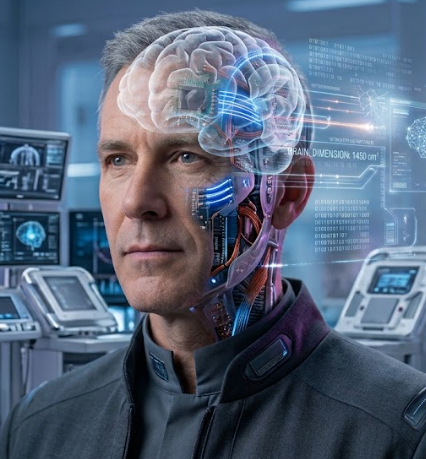
I touched briefly on the on the term “trans humanism” and that is one of the next steps in this technology, which presents much more serious implications for the Christian in the coming years. Because it is not just an idol, it is the ultimate version of a human attempting to make themselves into a god.
Trans humanism is rooted in a rejection of our created and subservient state. It is a refusal to accept that we are dependent upon a Creator. It treats finitude, aging, sickness and death as design flaws to be engineered away. Trans humanism aims for evolutionary transformation. It sets out not so much to heal the body as it does to transcend it. Our biological body is just flawed, and like all outdated hardware, in need of an upgrade. Trans humanists speak openly about achieving technological immortality, either by halting cellular aging or, eventually, by “uploading” human consciousness into a digital cloud.
When a person seeks to merge their mind with technology to achieve a form of omniscience, or to conquer death through nanotechnology they are attempting to seize the eternal attributes of God…at least until the next power outage.
These attempts are sinful before God, for they deny that God has created us, that he sustains us and will one day remove the cosmos from existence. It makes mortality the problem and prolonged existence the solution. It replaces the cross of Jesus Christ with the laboratory.
But the bible makes it clear that sin is the problem and death is the penalty. We cannot solve the problem of sin by trying to roll back or delay the penalty. It is an attempt to cure a symptom instead of the problem. Aging and death are not the problem. Rebellion against God is the problem and it cannot be fixed by a hardware upgrade or a software patch.
Let us remember the ultimate fate of all idols. 1 Samuel 5 gives us some early hints:
The Philistines captured the Ark of God and placed it in the temple of their god, Dagon. They left it overnight. When they woke up the next morning, the statue of Dagon had fallen face down on the ground before the Ark of the Lord. They picked it up, set it back up, and went to bed. The next morning, Dagon was fallen again, but this time his head and hands were broken off.
“Gods” made by human hands, need humans hands to keep them standing. The God who is eternal does not. He will will bring every false god, whether metal or stone, silicon and microchips…to an end. He is the one who holds us in his hands, and offers to share eternity with us.
Let us trust instead in the one who made us and who is King of Kings and Lord of Lords.
Barrie ON