
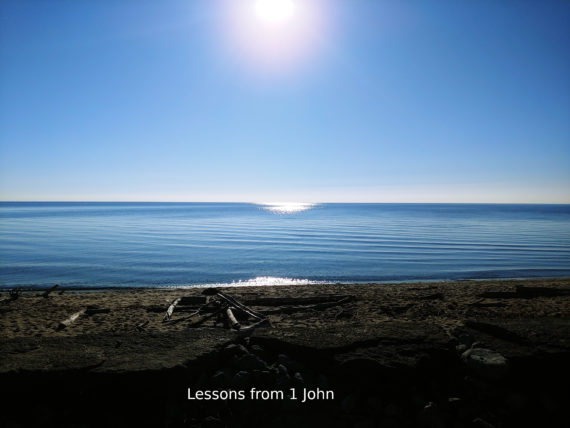
Text: 1 John 4:7-21
This article is the seventh in a series drawn from the book of 1 John. The previous articles appeared in earlier issues of the Gospel Herald during 2025. These articles are adapted from Bible class lessons and revised for publication, each focusing on a specific section of John’s letter. By the series’ end, we will have covered the entire book.
Summary of I John 1:1-4:6







In the first century, John wrote to Christians confronting a dangerous heresy called Gnosticism. At its core, this teaching claimed that Spirit was wholly good while matter—including our physical bodies—was entirely evil. Salvation, according to the Gnostics, came only when the spirit could escape the prison of flesh. From this flowed two particularly troubling, anti-Christian conclusions: first, that Jesus, as the Son of God, could not have truly become human, since Spirit and Flesh could never unite; and second, that how we live in our bodies does not matter, because flesh is already corrupt.
John answers these distortions not with clever arguments, but by returning to the foundational truths of the faith. He insists that he himself is an eyewitness of Jesus—the Word of life made flesh. He affirms that what we do in the body does matter, both now and for eternity, since all of us sin and are in need of forgiveness. He reminds believers that salvation is already present, as Christ redeems us through His atoning sacrifice. John urges his readers to walk in the light, to resist the love of the fallen world, to hold fast to Jesus as the Christ who truly came in the flesh, and to love one another concretely in sharing what God has given. He assures us that we can have confidence in our salvation, discern truth from false teaching, and trust that the Spirit of God within us is greater than the spirit of the world.
With that context in mind, John’s teaching in 1 John 4:7–21 takes on even greater depth. Here John turns fully to the heart of the Christian life: love.
I John 4: 7–8: Words Alone Do Not Make a Christian
John declares that true faith is not measured merely by words. A person may claim to be a Christian, but if love is absent, they are not truly born of God, nor do they know Him. Love is the defining mark of a believer.
Verses 9–10: What Is Love?
God Himself shows us. Love is not passive sentiment but active sacrifice. God sent His Son into the world so that we might live. Real love is defined by God’s action—Christ laying down His life to atone for our sins. As John reminded earlier (1 John 3:16–18), love for others must likewise be active and self-giving.
Verses 11–12: Our Love Completes God’s Love
God’s love is perfected when it transforms us to be like Christ. Until we extend love and forgiveness to others, His love has not yet reached its goal in us. Jesus’ parable of the unforgiving servant (Matthew 18:21–35) shows us that those forgiven by God must, in turn, forgive. Forgiveness is never easy—it cost God His Son, and it cost Jesus His life—but as those who are like Christ in this world, we must find our way to forgive.
Verses 13–15: God Has Given Us His Spirit
John assures believers that God dwells in them through His Spirit, the very Advocate Jesus promised in John 14:15–17. This Spirit confirms the truth, equips us to discern false teachings, and empowers us to confess Jesus as Lord, live obediently, and remain aligned with Scripture. Recall from the previous article we discussed how to determine if a person’s spirit is from God: they confess Jesus as the Son of God; they teach things that agree with Scripture; they live an obedient life.
Verse 16: God Is Love
Love is not merely an attribute of God—it is His very nature. Just as He is Righteousness and Goodness, so too He is Love. This truth anchors our faith: His love is eternal, unchanging, and wholly reliable. To love is to reflect God’s very being. Jesus affirms this in John 1:23-24 – and tells us of two resulting promises.
Verse 17: In This World We Are Like Jesus
Discipleship means imitation. Paul exhorted believers to follow his example as he followed Christ (1 Cor. 11:1). This requires setting aside sinful inclinations, refraining from bitterness, gossip, and malice, and instead choosing kindness, compassion, and forgiveness (Eph. 4:29–32). Paul’s words in 1 Corinthians 13 remain the fullest description of this Christlike love—patient, kind, enduring, and unfailing.
Just like Jesus, we can share with God our feelings, our hurts, the struggles against temptation. But even in the midst of these, we show love to others.
Verse 18: No Fear in Love
God’s perfect love casts out fear. Because He has justified us, we need not dread His judgment. We can approach Him in prayer with confidence and peace. Romans 8:31–39 assures us that nothing—not even death—can separate us from the love of God in Christ Jesus.
I remember visiting my elderly great-aunt, a faithful servant of God nearing the end of her life. Though she had walked with the Lord, she confessed to me that she was afraid. At the time, as a very young Christian, I had no words to comfort her—a silence I regret to this day. Looking back, I would have read Psalm 23 or reminded her of God’s promise here in 1 John: that perfect love drives out fear, even the fear of death. This is the confidence love brings: peace in this life, and no fear of the Day of Judgment.
Verses 19–21: Loving God Means Loving Others
We love because He first loved us, and His love compels us to love one another. To claim love for God while hating a brother or sister is self-deception. Love for God is shown in obedience, and His command is clear: “Anyone who loves God must also love their brother and sister.”
Love is, in a sense, like the “lucky penny” of old tradition—you only gain its benefit when you give it away. God’s love poured into us is meant to be shared. To withhold it is to lose it. To give it is to multiply it.
Conclusion
John’s message is plain and profound: love is the evidence of knowing God, for God is love. To abide in love is to abide in God. His love is perfected in us when we extend it to others, making us fearless before judgment and steadfast in hope.
As Paul prayed for the Thessalonians: “May the Lord make your love increase and overflow for each other and for everyone else” (1 Thess. 3:12). That is John’s vision too—that we, transformed by God’s love, might become vessels of that same love to the world.