
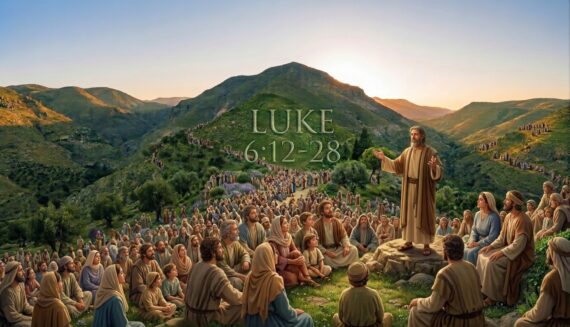
Text: Luke 6:12-28
The first 11 verses of this chapter set the stage for conflict over the Sabbath Day. But as we read the account, it becomes clear that the Sabbath is not really the issue. The enemies of Jesus have set out to find fault with him, following him from place to place. Present in every crowd, they took careful note of his actions and teachings. They listened for doctrinal error, breaches of the law and actionable offenses. They were just as happy to accuse Jesus of breaking the Mosaic law as those of Rome.
Through it all, Luke assures us that Jesus knew what was up. He not only knew that these men were present, but He knew what they were thinking and planning. I’ve often wondered if perhaps these men were unnerved by that fact. Jesus sometimes answered unspoken objections and private conversations. But, somehow, they were brazen enough to persist. This is what was going on. And this conflict forms the background or context of the passage that was read this morning. As verse 11 ends, Jesus left his enemies ‘…filled with rage and discussing what they might do to Him’.




Leaving them, he went off to the mountain to pray. The definite article suggests that this was a mountain to which Jesus habitually went to pray and on this occasion, He spent the whole night in prayer. In light of what was going on and what Jesus was about to do, I would suggest that Jesus prayed about at least two things.
He was about to choose and set aside 12 of his disciples. From that time on they would be looked at differently by their peers. He would separate them from the others – for a critical task. These twelve would become witnesses of all that Jesus did and said – from the beginning of his ministry until his ascension into heaven. They would serve as his chief spokesmen and each would be empowered by the Holy Spirit to impart supernatural gifts to Christians. The apostle Paul would later say of them that they were the foundation upon which Christ built his church.
So, this was an important occasion…important that Jesus chose the right men. So much depended on what these men would become and what they would do…so this was a milestone in the ministry of Jesus.
But hanging over this choice was a cloud of suspicion and animosity. By choosing these twelve men, He painted a target on their backs. Christ knew all about hostility. He wanted to be fair with his disciples right from the start. So he began to teach them just what they were getting themselves into.
While the text doesn’t say so, I think that Jesus felt the burden of all of this. He was in a habit of rising early to spend time alone in prayer, but on this occasion, He had reason to spend the whole night in prayer.
Luke names the men that Jesus chose and then informs us that they came down the mountain with Jesus.
Arriving at a place on the mountain that was level, they met a huge crowd of disciples whose numbers swelled as others joined them. They came from as far away as Jerusalem, Tyre and Sidon. Some came to be healed and others to have evil spirits cast out. Jesus did not disappoint.
Now there is a little phrase in verse 20 that’s easy to miss. Luke writes “And turning his gaze upon his disciples, He began to say…(to speak)”
Jesus looked at his own disciples as he spoke. He directed his teaching specifically at them. Others could listen, but he was looking at them. First and foremost among his disciples were the twelve. These instructions defined what it would mean to be an apostle and they begin to measure the price of apostleship. vs. 20-26
We immediately recognized that these verses are part of the “Sermon on the mount”, found also in Matthew 5-7. There is every reason to believe that this is the same event…though the wording in Luke is different than Matthew’s. So we consider that each supplement the other.
One thing that jumps right out, is the contrast that Jesus draws between ‘now’ and ‘then’, between the present and the future. He cautioned his followers not to put too much stock in the ‘here and now’. It’s not that this life is unimportant…quite the opposite. The danger is that we might misinterpret our lot in life and draw the wrong conclusions.
So – having set up this tension between the ‘present’ and the future, Jesus cites four different situations. He contrasts:
The poor with the rich
The hungry with the well-fed
Those who weep with those who rejoice
And those hated by the world with those loved by the world.
I think that Jesus chose these four situations for two reasons. He knew that poverty and hunger awaited his apostles. He was bracing them to accept hatred and rejection while preparing them to endure grief and heartache.
He did this against the background of a tupical Jewish hermeneutic. He knew that poverty, suffering, public rejection and death would be taken as signs of God’s disapproval. To counter this, Jesus set out at least Four Principles:
The first is that – present circumstances in life do not indicate where you stand with God. Wealth is not always a sign of God’s pleasure, nor does poverty mean that God is punishing you.
On a later occasion, Jesus met a rich young ruler – who asked the question; “What do I lack to be perfect?”. Jesus said ‘sell all that you have, give it to the poor and then come and follow me’. In other words give up the visible signs of God’s approval that bring you praise and respect from men. Put your trust in God alone. But the man refused. After the ruler walked away, the apostles said to Jesus – we have left everything to follow you. What’s in it for us!
It was a valid question. Jesus didn’t mind them asking. In our passage, Jesus is addressing these same disciples. I would submit, that this is the question is in the background. What’s in it for me? Having just chosen the 12, it is a question needing an answer.
Jesus’ begins to answer this way:
- Blessed are you who are poor, for yours is the kingdom of heaven
- Blessed are the poor in spirit, for yours is the kingdom of heaven (Mt)
This is really just two ways of saying the same thing. While not a virtue, poverty is also not a curse. A poor man is less likely to be self-reliant. He is more apt to be humble and dependent on God.
The history of the church has shown that it is largely the poor in spirit who have entered the kingdom of heaven (1 Cor 1:26) This is the reason that Jesus pronounced a ‘woe’ upon the rich. It is not that wealth itself is evil, but Wealth often produces arrogance and self-reliance. So Jesus said – you are receiving your comfort in full. The noun form of the word translated “receiving” means a receipt. Those who settle for what wealth can give them, have in this life – been paid in full.
Jesus knew what he was talking about first-hand. He lived at the very bottom of the socio-economic ladder. As a labourer (tekton) he knew what it was like to work for wages. As a teacher, he lived in poverty. He was homeless. He had no pantry filled with food. He owned the clothes on his back and experienced firsthand the social stigma of the poor. He understood that the poor have a lot less to hold onto in this life than do the rich. So poverty can turn out to be a spiritual blessing.
The teachings of Jesus turned the values of his world upside down and when accepted, they do the same to our world.
Here’s an example. Western culture generally believes that the cosmos is eternal. The earth is permanent while the human species is temporary. But Jesus taught that this world is temporary while people are eternal. Those who depend on earthly wealth will be disappointed, precisely because we outlast it and must leave it behind. The more you have, the easier it is to get really attached to it and to depend upon it. And that dependance can keep you from living for the world to come.
This was a warning to his apostles who would one day become the custodians of other people’s money.
Now poverty and hunger often go together. So Jesus turned to the matter of hunger. And he made it clear that spiritual poverty and spiritual hunger were on his mind.
The crowd was made up of two kinds of people. There were those who followed Jesus to be healed and fed. Others were there to find fault and to destroy him, having no appetite for anything that he said. And then there were those who hung on his every word. Those who wanted, more than anything else, to enter the kingdom of heaven. People like Mary, when Jesus came to visit and teach in her home – they chose the more important blessing. Jesus said that these are the ones who are blessed.
He went on to say: “Blessed are you who weep now, for you shall laugh. Blessed are you when men hate you and ostracize you and heap insults upon you and spurn your name as evil for the sake of the Son of Man” – “Be glad in that day and leap for joy, for behold your reward is great in heaven; for in the same way their fathers used to treat the prophets.” (vs. 21b-23)
Those who suffer for the name of Jesus Christ are blessed. They weep now, but one day will celebrate and laugh. In the meantime there is suffering. Jesus was very specific about it. He warned that some would hate them. Hatred is as old a Cain and at work in every generation. So Jesus said “expect it”. They will ostracize you, kick you out of the synagogues, shun you places of business, put you in prison and even to death.
Short of that, they will insult you to your face and you won’t be able to get away from it. You’ll face verbal abuse and psychological warfare. They will associate your name with every kind of evil and you will be falsely accused and badly treated. And I am telling you this right now, that it will be because of Me. It will happen to you because you believe in the Son of Man whom they will reject and crucify.
So the thing to watch out for is not their condemnation, it is their approval. If these men ever praise you – if they ever speak well of you – “Look Out.” It will mean that you have crossed over to their side.
Endure it all for my name’s sake, and you will be blessed. Know that you are in good company. They treated the prophets of God this very same way.
Jesus didn’t play games with his disciples. He knew what they would face and He didn’t hide what he knew. He wanted them to accept apostleship, with their eyes wide open.
What he said to them, he also says to us. Following Jesus will make you an enemy of those who hate Him…but it will also make you the friend of God.
‘Here and now’ is quickly gone. But there is a better place than here and an ‘eternal now’ at the end of time. Let us choose Christ and be numbered among the blessed.