
The Man
The opening sentence of the book states that the prophet Nahum was from Elkosh, which is otherwise unknown in Biblical writings. This has led to various suggestions, including Capernaum in Galilee, since the name means ‘village of Nahum’. It may have been that the town was renamed after the man whose book brought comfort and whose prophesies the Lord fulfilled. Then again, it could be another city altogether since Nahum wrote to Judah.
The author’s name is “Nahum“ which means comfort or consolation. It is perhaps more than coincidence that the book that bears his name – while all about the destruction of Nineveh, was intended to console Judah and other nations that Assyria had oppressed.








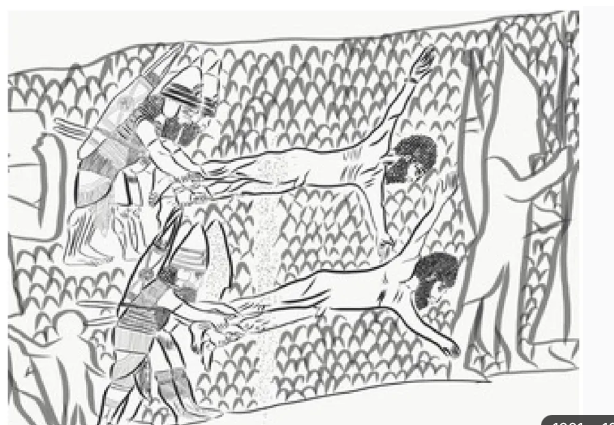
The brutality of the Assyrians left an imprint upon all of the regions that they conquered. They did it both to punish and intimidate. The Assyrians proudly recorded these atrocities, preserving them as engravings at their own capital and in conquered cities.
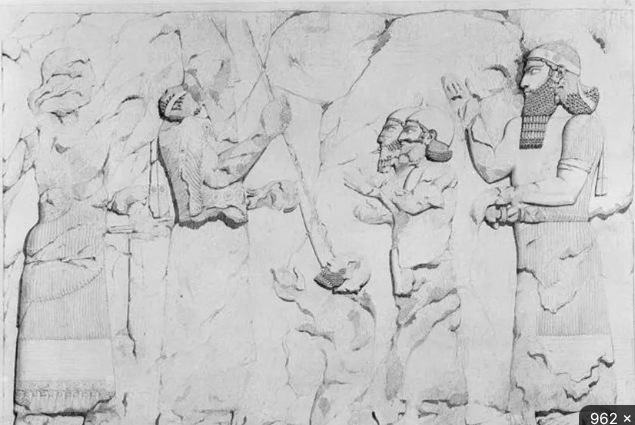
Accounts from conquered nations further document the extent of Assyrian violence and torture. It comes as no surprise then to find that the nations would celebrate the fall of Nineveh and that no one was going to mourn their passing (Nahum 3:19).
Date of Writing:
The exact date is impossible to establish, but other events bracket this one. Nineveh fell in 612 BC and since Nahum predicts that fall, it must have been written earlier. The book also foretells that Nineveh’s fall will be like that of No-Amon or Thebes (3:8), which took place in 663 BC. If that event was still fresh in mind and Assyrian power had not yet begun to decline, a date somewhere closer to mid century makes sense. But it was written somewhere between those two dates.
Nineveh and Judah:
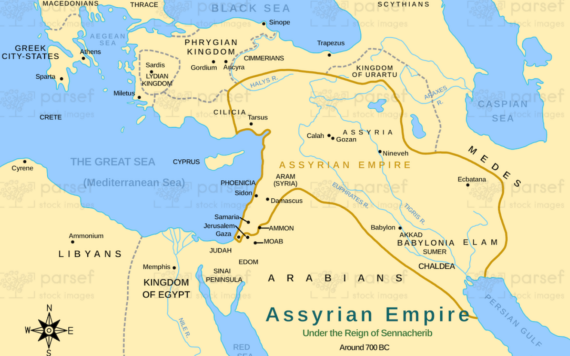
By the time this book was written, Judah had long suffered at the hands of the Assyrians. When king Hezekiah renewed worship to God and withheld tribute from Assyria, Sennacherib beseiged 46 fortified cities in Judah and according to his own annals (Sennacherib’s Prism) deported 200,150 people to Assyria. When Hezekiah’s son Manasseh rebelled, the Assyrians took him shackled and with a hook in his nose to prison in Babylon (2 Chron 33:11). When he repented, God restored him to the throne in Jerusalem, but tribute payments continued throughout the reigns of Amon and Josiah. While the fall of Nineveh was a relief to Judah, it was only temporary. Babylon took up where Nineveh left off.
The Assyrian empire gave way in stages. The city of Nineveh fell to a Persian-Babylonian coalition in 612 BC. Her forces were pushed westward and fought losing battles in retreat at Haran with the end coming at the Battle of Carcamish in 606-605 BC. Pharoah Necho II decided that it was in Egypt’s interests to intervene on the Assyrian side and travelled northward on the coastal road. He was stopped by king Josiah at the Megiddo pass. Josiah refused to back down and died from injuries sustained in battle (2 Chron 35:21-24). Necho installed Eliakim (Jehoiakim) on the throne in Josiah’s place.
The outcome was twofold:
- Josiah’s religious reforms came to a sudden end and Judah relapsed into idolatry
- The Egyptians advanced northward and were severely beaten at the battle of Carcamish along with the Assyrians. Nebuchadnezzar chased them back to Egypt, and Jehoiakim was forced to pay tribut to the Babylonians.
The Neo-Babylonian empire would last for another 7 decades and bracket the exile of God’s people and their return 70 years later. So while the fall of Nineveh was good news for Israel, it only changed the empire under which the exile took place. Israel doubled down on idolatry ensuring that Jeremiah’s prophecies about the exile would take place.
Doctrinal and Theological Aspects
In many ways, the books of Jonah and Nahum serve as literary bookends documenting God’s dealings with a pagan nation. Both involve Hebrew prophets, whose message was directed at Nineveh. The first was delivered in person while the second was published from afar. But by then, Judah was part of Assyria and the book did not have far to go.
Both books underline the patience and forebearance of God. The book of Jonah ends with the same theme with which Nahum begins. The second ‘hooks’ onto the first to finish the business at hand. Consider the following passages:
Jonah 4:1-3
But it greatly displeased Jonah, and he became angry. Then he prayed to the Lord and said, “Please Lord, was this not what I said when I was still in my own country? Therefore in anticipation of this I fled to Tarshish, since I knew that You are a gracious and compassionate God, slow to anger and abundant in mercy, and One who relents of disaster. So now, Lord, please take my life from me, for death is better to me than life.”
(Nahum 1:2-3)
A jealous and avenging God is the Lord; The Lord is avenging and wrathful.
The Lord takes vengeance on His adversaries, And He reserves wrath for His enemies.
The Lord is slow to anger and great in power, And the Lord will by no means leave the guilty unpunished.
Both passages echo God’s self-description after the golden-calf incident, as the fate of the nation hung in the balance. This is what God said about himself to Moses (Ex 34:6-7)
“Then the Lord passed by in front of him and proclaimed, “The Lord, the Lord God, compassionate and merciful, slow to anger, and abounding in faithfulness and truth; who keeps faithfulness for thousands, who forgives wrongdoing, violation of His Law, and sin; yet He will by no means leave the guilty unpunished, inflicting the punishment of fathers on the children and on the grandchildren to the third and fourth generations”. (Ex 34:6=7)
Some time later, Moses appealed to God on the basis of His nature when God threatened to destroy Israel and start over again with himself (Number 14). When the ‘spies’ returned from Caanan, the people had refused to enter. They accused God of bringing them into the desert to kill them. Their plan was to choose a new leader to take them back to Egypt. To avert disaster, Moses interceded in prayer, and this is part of that prayer (Num 14:17-19)
“So now, please, let the power of the Lord be great, just as You have declared, saying, ‘The Lord is slow to anger and abundant in mercy, forgiving wrongdoing and violation of His Law; but He will by no means leave the guilty unpunished, inflicting the punishment of the fathers on the children to the third and the fourth generations.’ Please forgive the guilt of this people in accordance with the greatness of Your mercy, just as You also have forgiven this people, from Egypt even until now.”
Some theological reflections:
- God is faithful and true. He speaks the truth. He keeps his word, and works on his own timetable.
- The guilt of sin does not go away on its own, nor does the passage of time solve the problem. Sin has consequences for unborn generations. As God loved Israel and blessed them for the sake of their forefathers, he also visits wrath upon the descendants of those who reject Him.
- God prefers mercy and extends it when people repent. But forgiveness is not once for all. It is needed every time a sinner repents.
- God is evenhanded in his treatment of all nations.
The patience of God is paired with justice. When Jonah warned Nineveh, they repented of their sins from the greatest to the least. Assyria lived on to enjoy God’s blessings for generations. But because they repented of their obedience, God was calling them into Judgment.
Jonah and Nahum were separated by about 150 years. God had not forgotten what he had planned to do to Nineveh. A reprieve is not a pardon. God is patient, but there is also end to his patience.
While Israel was God’s people, he dealt with them the same way that he treated pagan nations (See Gen. 15:16) He gave them time to repent. He warned and pleaded. But in the end, He used action to get action. Time ran out.
Through Moses, (Deut 28) God warned Israel that they would one day be driven from their homeland if they persisted in sin. God called the nation of Israel into judgment in 722 BC and Judah followed them into captivity in 586 BC.
These quotations in Jonah and Nahum were especially aimed at Judah. Would they take a lesson from what had happened to Israel and what was soon to happen to Nineveh? Or would they go on ‘sinning with all their might’ and hope that punishment would wait until they were dead?
Nahum reminds us that God rules the nations. Empires come and go. Dynasties rise and fall. Kings appear and disappear. God rules forever. As the apostle Paul would later put it in Acts 17:26-28b.
“He (God) made from one man every nation of mankind to live on all the face of the earth, having determined their appointed times and the boundaries of their habitation, that they would seek God, if perhaps they might feel around for Him and find Him, though He is not far from each one of us; for in Him we live and move and exist…”
God sets the boundaries of every nation both in time and space…and waits in patience for our return. He will not wait forever.
Barrie ON