
Revelation 3:7–13
Today, we are a small group of believers assembled in a dominion and former colony of what was the largest empire in the history of the world up to a hundred and twenty-six years ago. In 1920 the British Empire was 36 million square kilometres, seven times the size of the Roman Empire.
Simultaneously today, we are a small group of believers assembled in the global kingdom of Jesus Christ, Creator of the universe, King of kings and Lord of lords over all the empires of all time and all countries today (Revelation 17:14 and 19:16).



About 1935 years ago in the first century a small group of our brothers and sisters in Christ assembled in the young city of Philadelphia in the eastern part of the mighty Roman Empire. Simultaneously today as we meet, they are assembled in Jesus Christ in His eternal living assembly of His holy ones in heaven (Hebrews 12:22–24).
On earth, we are a small minority with little worldly power. The super powers around us seem overwhelming. Our brothers and sisters in Philadelphia were a small minority with little worldly power. The Roman imperial powers around them were overwhelming. Yet the Philadelphians were special to Jesus and so are you. Though their power in worldly terms was small, they were in Jesus whose power and authority are infinite. Jesus empowered them and gave them opportunities to work with Him in His kingdom.
He sent them this very encouraging letter:
7 “And to the angel of the church in Philadelphia write:
He who is holy, who is true, who has the key of David, who opens and no one will shut, and who shuts and no one opens, says this:
8 ‘I know your works. Behold, I have put before you an open door which no one can shut, because you have a little power, and have kept My word, and have not denied My name. 9 Behold, I will cause those of the synagogue of Satan, who say that they are Jews and are not, but lie—I will make them come and bow down at your feet, and make them know that I have loved you. 10 Because you have kept the word of My perseverance, I also will keep you from the hour of testing, that hour which is about to come upon the whole world, to test those who dwell on the earth. 11 I am coming quickly; hold fast what you have, so that no one will take your crown. 12 He who overcomes, I will make him a pillar in the temple of My God, and he will not go out from it anymore; and I will write on him the name of My God, and the name of the city of My God, the new Jerusalem, which comes down out of heaven from My God, and My new name. 13 He who has an ear, let him hear what the Spirit says to the churches.’”
Jesus encourages His people in Philadelphia with positive commendations and eternal promises. His letter to Philadelphia has no convicting rebuke as five of the others do. Notice His encouraging alternating commendations and promises in how He structures His letter:
Typical Parts of Jesus’ Letters, five of which had Convictions
1 greeting & vision
2 commendation
3 conviction
4 commands
5 consequences
6 promise
7 command to hear
Jesus’ Letter to the Philadelphians
1 Greeting & Vision verse 7
2 Commendations Part 1 8a
3 Promises Part 1 8b
4 Commendations Part 2 8c
5 Promises Part 2 9
6 Commendations Part 3 10a
7 Promises Part 3 10b, 11a
8 Command 11a
9 Promises Part 4 10b
10 Consequence 11b
11 Promises Part 5 12
12 Command to hear
No convicting rebuke!
1. Jesus’ Greeting and Vision
7 “‘And to the angel of the church in Philadelphia write:’”
Philadelphia was a young city among the seven cities of Asia. Eumenes Soter II King of Pergamum who reigned 197–159 BC founded Philadelphia in 189 BC.
Eumenes had made Pergamum flourish as a city of learning, adorning it with many impressive buildings as in Pergamum (Revelation 2:12–17). He expanded the Pergamum library to make it one of the great libraries of the ancient world associated with the invention of parchment which is more durable than paper.
Eumenes’ epithet, the second part of his name, Soter meant saviour. He set out to save and elevate the southeastern part of his kingdom by making Philadelphia a governing and educational centre of Greek and Asian civilization. He spread the Greek language and manners throughout Lydia and Phrygia.
For Eumenes, Philadelphia became a type of missionary city for culture, customs and loyalty of Hellenism in an Oriental land. In Roman times this was the east, the Orient. By two hundred years later in New Testament times in AD 19, Eumenes’ missionary plan to spread the Greek language had worked. Greek had replaced Lydian as the main language.
Greco-Roman religion made inroads in Philadelphia but local pagan religion remained strong.
Philadelphia was known as “Little Athens” for its many temples. The impressive temple pillars formed backgrounds for Jesus’ metaphor of His people becoming pillars in God’s temple in Revelation 3:12. A relevant feature of local Anatolian pagan religion was the publication of a god’s (that is small g) god’s forgiveness of confessed sin on a stele (a vertical memorial pillar) as a testimony.
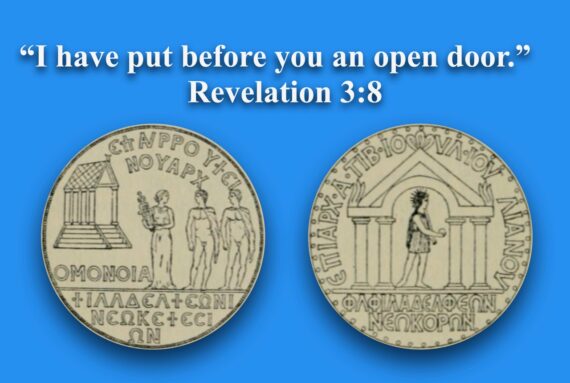
The two Philadelphian coins above show the influence of pagan religion in Philadelphia and provide backgrounds for Jesus’ words showing His vast superiority to them. The first coin shows two brothers, all but for their hair colour, identical to indicate their unity in brotherly love. They are conversing with Ephesus who is carrying a statue of Artemis by a Roman temple in Philadelphia commemorating the festival alliance of the two cities. They are introducing her to Philadelphia ritual. The second coin shows a sun god in a temple with an open door. He has rays of light around his head, a globe in his right hand (the sun or the earth) and a sceptre in his left hand, a symbol of ruling authority. Jesus’ words and promises will confirm for the Philadelphian Christians that He holds God’s sceptre of ultimate power and authority (slides 9 and 10):
Psalm 45:6 Your throne, O God, will last for ever and ever; a sceptre of justice will be the sceptre of your kingdom
Psalm 110:2 The Lord will extend your mighty sceptre from Zion, saying, “Rule in the midst of your enemies!”
Hebrews 1:8 But about the Son he says, “Your throne, O God, will last for ever and ever; a sceptre of justice will be the sceptre of your kingdom.
Revelation 2:27 that one ‘will rule them with an iron sceptre and will dash them to pieces like pottery’—just as I have received authority from my Father.
Revelation 12:5 She gave birth to a son, a male child, who “will rule all the nations with an iron sceptre.” And her child was snatched up to God and to his throne.
Revelation 19:15 Coming out of his mouth is a sharp sword with which to strike down the nations. “He will rule them with an iron sceptre.” He treads the winepress of the fury of the wrath of God Almighty.
For most of his reign, Eumenes was an ally of Rome supporting the expansion of the republic. His younger brother Attalus II was very supportive, particularly when Rome questioned Eumenes’ loyalty. When Eumenes’ health began to fail, Attalus ruled with him then becoming his successor. Thus Attalus II became known by the epithet “Philadelphus,” the one who loves his brother. Philadelphia is a compound word made up of the verb phileow for love and adelphos brother, “city of brotherly love.” In the church, philadelphus epitomises the love of Christians for one another. Parallel words in Bible times are philagathos, loving what is good, and philosophia (philosophy), the love of wisdom.
Philadelphia was 44 km (miles) SE of Sardis 75 km (miles) NE of Laodicea 112 km (miles) ENE of Ephesus and 117 km (miles) ESE of Smyrna.
Philadelphia was located in the fertile Cogamis Valley and near the Cogamis River that ran into the Hermus Valley and River in heart of Eumenes’ Pergamum kingdom. The valley was an important access route to the much higher table lands and kingdoms of the interior of Anatolia that rose over 3,000 ft. to the east.
Philadelphia was on an important trade route connecting the major port of Smyrna with the east. Philadelphia was on a Roman Post road that took mail to and from Rome through Troas, Pergamum and Sardis through Philadelphia and on to the east. Philadelphia was an important link in this empire wide chain of communication.
Like Sardis, Philadelphia had considerable coinage by the beginning of the Roman Empire with the 31 BC Battle of Actium after which Augustus became the first emperor.
Philadelphia was on a geological fault line which made it subject to earthquakes and volcanoes. In AD 17 an earthquake destroyed much of Philadelphia as it did Sardis and ten other cities. According to the ancient Greek geographer Strabo (64 BC – AD 24), tremor shocks were felt for at least three years afterwards. To minimise their risk of injury, many Philadelphians lived outside the city in temporary huts and booths. People came to live in fear of new disasters.
Tiberius, Emperor during Jesus’ adult life, assisted in the reconstruction for which the Philadelphians erected a monument to him. They also founded a cult in honour of his adopted son Germanicus for his probable part in providing the aid. Philadelphia also changed its name to Neo-kaisareia (that is New Caesarea) in honour of a Roman emperor, perhaps Tiberius or later Caligula. The government put New Caesarea’s name on coins and inscriptions. The new name was exclusive for a while but went out of use between AD 42 to 50 when Philadelphia returned to its original name. As we see, new names are significant in Jesus’ letter. During the reign of Vespasian, the father of Titus and Domitian, Philadelphia adopted the name Flavia which appeared on coins to the third century.
Philadelphia thus had several distinguishing characteristics among the seven cities: it was a missionary city of culture and learning, its people lived in anticipation of possible disaster, days of trial, as a result many of its people lived outside of the city and it took a new name from the imperial god. It continued to prosper and gain notoriety for many centuries. Like Smyrna and Thyatira, a city still exists over the ancient city today so few archaeological remains exist.
To be continued…
Winnipeg, MB