
Revelation 3:14–22
Part 1
Introduction to Laodicea: Riches, Clothing, Medicine




Laodicea has roots in wealth, royalty, trade, medicine, intrigue and self-reliance. Laodicea was a wealthy Macedonian Greek noblewoman. Laodice’s father, Achaeus the Elder, owned estates in Anatolia.
Laodice’s paternal grandfather was King Seleucus I Nicator. Nicator is from nike, meaning the “victor.” Seleucus I was one of the Diadochi, Alexander the Great’s successors. Seleucus I Nicator was founder of the Seleucid Empire which covered much of the continent of Asia and the southern half of Anatolia where the city named after his granddaughter Laodice would flourish along with the other cities to which Jesus addressed His seven letters.
Laodice married Antiochus II her paternal first cousin. When Antiochus II succeeded his father as king to reign from 261–246 BC Laodice became a Seleucid queen. As part of a peace pact nine years later following the Second Syrian War, Antiochus II divorced Laodice to marry Bernice the daughter of Ptolemy II of Egypt. Antiochus promised Ptolemy Bernice’s offspring would inherit the Seleucid throne. In the divorce settlement, Laodice inherited significant tracts of land in Anatolia along with revenues they generated. Laodice took up residence in Ephesus.
Upon Ptolemy’s death, Antiochus II returned to Laodice. To avoid a second departure and secure the throne for her eldest son Laodice purportedly poisoned her husband. Seleucus II inherited his father’s throne despite his step-mother Bernice’s expectation her young son by Antiochus II would succeed.
Laodice had Bernice and her son killed where they were hiding at Daphne. In his anger, Bernice’s brother Ptolemy III started the Third Syrian War, also known as the “War of Laodice,” against Seleucus II. Laodice encouraged an internal rivalry for control of the kingdom between her firstborn son Seleucus II and her younger son Antiochus Hierax (the “Hawk” so called for his ambition). During the Third Syrian War Ptolemy purportedly had Laodice killed though by some account she survived.
As namesake for the city of Laodicea, Laodice left a legacy of personal ambition and manipulation for the sake of control, power, wealth, self-sufficiency and self-aggrandisement. Any of these attributes creeping into the church from the cultural past of the city would certainly produce fruit contrary to the nature of Christ.
In brighter days, during the early years of his reign from 261 to 253 BC, Antiochus II built Laodicea naming it in honour of his wife, as he did for several other cities.
According to Josephus (Antiquities of the Jews 12.147–149), Antiochus III the Great brought two thousand Jewish families to Phrygia from Babylon though Jesus does not mention Jewish persecution of His people in Laodicea as He does in Smyrna and Philadelphia.
From these beginnings with the Seleucid royal family Laodicea came to flourish under the rule of Pergamum from 188 BC on shortly after Eumenes II founded Philadelphia in 189. From 133 BC on Laodicea prospered greatly as part of the Roman Republic and then the Roman Empire.
Laodicea became the chief city of a coventus, a provincial subdivision of about 24 cities. It prospered in industry, textiles, trade, banking and money changing. Following the earlier precedent of Sardis, Laodicea minted its own coins. Laodicean alliance coins frequently included inscriptions to their pagan gods.
The new Roman road system placed Laodicea at the junction of the main west to east international trade route and four regional roads. The international trade route connected Laodicea to the major centres of Byzantium, Greece and Rome to the north and west, and Syria, Israel, Egypt, Mesopotamia, Arabia, India and China to the south and east.
Laodicea was approximately square with the Ephesus Gate as its western entrance and the Syrian gate as its eastern entrance. The major port and capital of Ephesus was 180 km (112 miles) to the west just north of Miletus, another important coastal city.
Laodicea was near the junction of the Lycus and Meander River valleys. The city sat on a hill 30m (100 feet) high between two fertile valleys irrigated by the Asopus and Karpos tributaries of the Lycus River. Beyond the valleys and hills are higher mountains, Salbakos and Kadmos to the south above 2,440 metres (8,000 feet), and to the north the ridges above 1,525 metres (5,000 feet) leading to the great table lands plateaus of the interior of Anatolia.
Several important features of Laodicea relate directly to Jesus’ words to His assembled people in Laodicea and the self-sufficiency and complacency of their lifestyles that left them largely conformed to the image of the world around them.
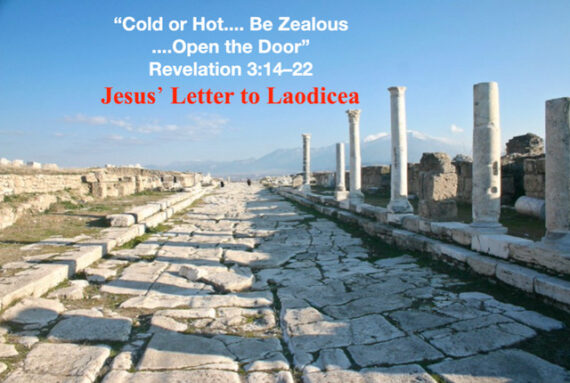
As we see Laodicea was wealthy from its beginning and steadily increased its riches and influence over the centuries up to the time of Jesus’ letter. The grand scale of the main streets had remnants of luxurious Roman baths and a theatre.
Laodicea suffered serious damage in the earthquake of AD 60–61. Tacitus said it “prostrated the city.” The Laodiceans rebuilt their city at their own expense without imperial aid as its neighbours Sardis and Philadelphia had received.
In an uncanny resemblance to patronage by the wealthy today, in AD 79 Nicostratus paid for Laodicea’s large new stadium “out of his own resources.”
Laodicea excelled materially over its nearest neighbours Colossae
and Hierapolis whom Paul mentions with Laodicea in his letter to Jesus’ assembly in Colossae. Though it had the same potential to spread Greek culture as Philadelphia’s “open door” to the east, Laodicea had little impact perhaps due to the complacency of its self-sufficiency as a centre where riches came easily to it from its hinterland and international connections.
In addition to this background on the city’s wealth, Laodicea’s neighbours furnish backgrounds to Jesus’ words about hot and cold. Regarding the hot water springs of Hierapolis, the ancient geographer Strabo wrote (Geography 13.4.14),
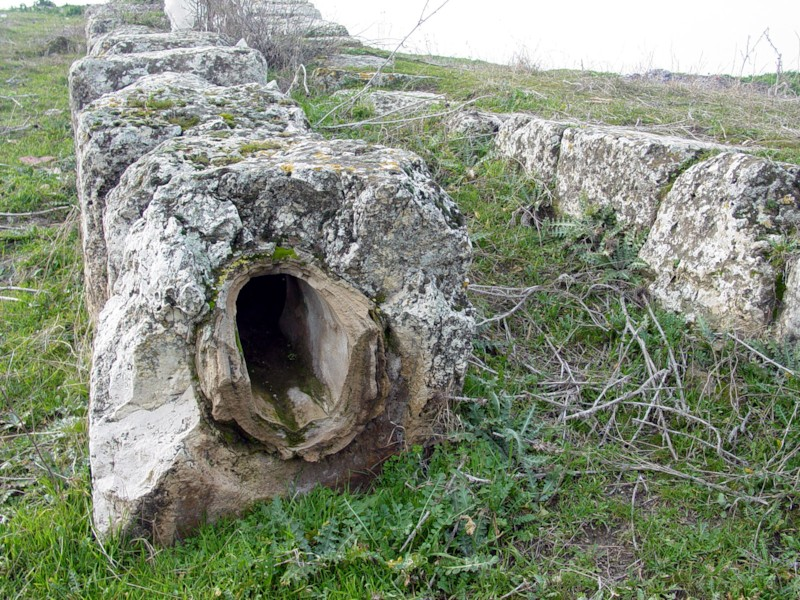
“After crossing the Mesogis…beyond the Mæander…we meet with cities. Near the Mesogis, opposite Laodicea, is Hierapolis (Slide 20, Frontinus Gate), where are hot springs, and the Plutonium (place of Pluto worship), both of which have some singular properties. The water of the springs is so easily consolidated and becomes stone, that if it is conducted through water-courses dams are formed consisting of a single piece of stone
The conversion of water into stone is said to be the property of certain rivers in Laodiceia, although the water is fit for the purpose of drinking. The water at Hierapolis is peculiarly adapted for the dyeing of wool. Substances dyed with ‘the roots,’ rival in colour those dyed with the coccus, or the marine purple. There is such an abundance of water, that there are natural baths in every part of the city.”
Hierapolis had an abundance of hot water. The medicinal hot springs on the hills of Hierapolis could be seen from Laodicea 10km (6 miles) to the north. Colossae 14.5 km (9 miles) to the SE had abundant cold refreshing water. As Strabo notes, Laodicea, on the tributaries of the Lycus River, had sediments leading to “the conversion of water into stone.” So Laodicea depended on water brought in from springs 10km (6miles) uphill to the south by buried aqueduct pipes, the later of which collected so many mineral deposits they became increasingly smaller in diameter. Through its transport initially hot or cold waters would both tend to become lukewarm.
On the plus side, the chalky water was ideal for dying wool. The region profited from distributing this wool known as colossinus (the raven colour origin of the Colossae’s name according to Strabo). Naturally black sheep carefully bred for the purity of their colour were also common in this area. Their wool was also highly prized in the garment trade. The Laodiceans were well and fashionably clothed for their times at cheaper prices than they received for their exports. Their trimita tunics were well known for centuries.
Laodicea had a medical school known for its achievements and health products for export. References to its physicians occur on coins in the time of Augustus. According to Aristotle, a local Phrygian powder was the basis of eye salve that was eventually exported throughout the Empire. It is thought to have been made from the mud of the Hierapolis hot springs that made a kaolin (clay) poultice effective for treating inflammation. Galen also mentions an ointment for the ears prepared in Laodicea.
In Jesus’ letter we see that Laodicean riches, clothing and eye salve are key elements in His convicting and encouraging words to His people there and for all like them today.
To be continued…