
Most of us learned the rule somewhere along the way, usually without anyone ever saying it out loud. If you want a gathering to stay pleasant, there are two subjects you leave alone. Religion and politics. Keep those off the table and the evening goes smoothly. Bring them up and you can feel the room change.
Now, if you are reading this, you probably have already made your peace with the first half of that rule. We talk about religion on purpose. But the second half has only gotten harder. I should say at the start that I am not writing as a man who has it all worked out. A good deal of what follows comes from me trying to think it through myself, the same way many of you have been.
Politics used to be one subject among many, something a person had opinions about the way they had opinions about hockey, and you could set it aside for an afternoon. That is no longer the case. Politics has become a lens, and it is now the thing people are sorted by. In a survey released by the Angus Reid Institute in the spring of 2025, 87 per cent of Conservative voters said the Liberal Party is a threat to the country, and 84 per cent of Liberal voters said the same about the Conservatives. That is not a disagreement about policy. That is each side saying the other is dangerous.






Our society is on edge. There is less trust in leaders, less trust in institutions, and less trust in one another, and we have watched it spill over into acts of violence.
It is tempting to avoid all of it and hope it passes. But Scripture never gives us that option. God calls His people to live faithfully in the middle of the world, and as it happens, our Lord was handed this very question.
The Pharisees had been looking for a way to trap Jesus, and they believed they had found it. They sent their own disciples to Him, and with them the Herodians. “Tell us then, what do You think? Is it lawful to give a poll-tax to Caesar, or not?” (Matthew 22:17).
On the surface that sounds like a question about taxes. It was not. It was a political landmine, and you can see that as soon as you notice who was asking.
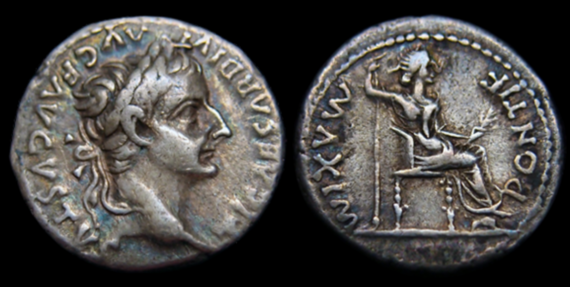
The Pharisees were religious and fiercely nationalistic, and they wanted nothing to do with Rome. To them the poll-tax was not just a financial burden. It was a betrayal of their faith. The coin required to pay it carried Caesar’s image, and around its edge ran the words TI CAESAR DIVI AVG F AVGVSTVS, which means “Tiberius Caesar, son of the divine Augustus.” So that little coin was not just money. It was Rome announcing that Caesar was divine, and that Caesar was the one who was owed. Handing it over felt like idolatry.
The Herodians had no such concerns. Their loyalty was to Herod’s dynasty, which existed only because Rome permitted it, so for them the tax was simply the cost of doing business.
One group was ultra religious and the other was ultra political. Under normal circumstances, these two groups could not stand each other, yet here they were working side by side, because they both wanted Jesus gone. If He said do not pay, He was a rebel against Rome. If He said pay, He was a traitor to His own people.
This question was never really about money. It was about allegiance. Whose side are you on? That is the same question at the root of most of the political tension in our culture today. People want to know, “who you are with?”.
Jesus asked for the coin. “Whose likeness and inscription is this?” They said to Him, “Caesar’s.” Then He said to them, “Then render to Caesar the things that are Caesar’s; and to God the things that are God’s” (Matthew 22:21).
In one sentence He escaped the trap and lifted the whole conversation to a higher plane. They wanted Him to pick a side inside their categories, Pharisee or Herodian, Rome or Israel, but Jesus refuses to be boxed in. He does grant that Caesar has a legitimate place. Pay your taxes. Respect authority. Live within the laws of the land. But He also draws a line, and He draws it with an image. The coin carries Caesar’s image. The more important question is whose image is carried by the man holding it.
God created man in His own image, male and female He created them (Genesis 1:27). Your life, your heart, your worship and your allegiance were never Caesar’s to claim. They do not belong to a party, a leader, or a system. Caesar can have his coin. God must have you.
Now, that principle cuts in two directions. It keeps us from dismissing politics, and it keeps us from worshiping it. Christians should care and should take part. But the moment politics becomes ultimate, we have crossed a line that Jesus draws clearly. Politics cannot save anyone.
If we are going to render to God the things that are God’s, we need to be clear about what those things actually are. He wants our whole lives. “You shall love the Lord your God with all your heart, and with all your soul, and with all your mind, and with all your strength” (Mark 12:30). But the things that belong to Him do not all come to us in the same form. Some of them are truths about the way things are. He determines what it means to be human. He designed marriage. He is the Author of life, knitting each person together in the womb. No legislature can amend those, and no election settles them.
But other things that belong to God are assignments, and they were handed to me. Care for the widow and the orphan. Showing compassion to the weak. Welcoming the stranger at my own door. Those are not policy positions. They are my obedience, and no government can carry it out for me.
Now, I am not saying laws do not matter, or that a Christian should be indifferent to them. Scripture has a great deal to say to kings and governments, and very little of it is gentle. “Woe to those who enact evil statutes and to those who constantly record unjust decisions” (Isaiah 10:1). Nations are held accountable for how they treat the weak. But God holding a government accountable has never once lifted a command off an individual believer. Both are true at the same time.
That second category is where we get into trouble, because the political grid offers us a way to feel faithful without actually being faithful. I can vote for a program and consider the poor looked after. I can vote the right way on marriage and on life and consider myself obedient. But a ballot has never fed anyone. It has never sat with a widow in times of distress. Whatever a government does or fails to do, the command still has my name on it Monday morning.
So when the labels come, and they will, the question is not which one fits. Conservative and liberal are Caesar’s categories, our version of Pharisee or Herodian, and we have grown very comfortable letting them sort us. Scripture takes precident over every platform, and there are times when it will put a Christian squarely against one. A believer who weighs a platform against the Word of God and concludes he cannot support it has not failed at being fair-minded. He has done what his conscience requires. That is not tribalism, for the scriptures will not let a platform own us, and it will not let a vote take the place of a life.
How we hold these convictions matters as much as the convictions themselves.
Now, Jesus was not soft with these men. He called them hypocrites to their faces, and elsewhere He called them blind guides and whitewashed tombs. But notice what was never true of Him. Jesus was never protecting Himself. He never spoke in order to win. Every hard word was for the good of the people who heard it, even when they hated Him for it. And He knew exactly what was in them, which is more than we can say about anyone with whom we disagree.
That is where most of us come apart. Our sharpest words are usually about us, about being right, and about not being made to look foolish. Even when we are right, if we handle ourselves the wrong way, we fail to render to God that which is God’s. He commands us to “love your enemies and pray for those who persecute you” (Matthew 5:44), and to “let your speech always be with grace, as though seasoned with salt” (Colossians 4:6).
So here is a fair question. Can I sit down with someone who sees politics very differently than I do and still listen? If I can’t, then politics may have hold of my heart more than I realize. People may never agree with our politics, but they will notice when we behave in a Christlike way.
It helps to remember how temporary all of this really is. Empires rise and fall. Leaders come and go. Through all of it God remains on His throne. “It is He who changes the times and the epochs; He removes kings and establishes kings” (Daniel 2:21). Caesar may sit in the palace, but God rules from heaven.
So give Caesar his coin. Pay your taxes, obey the law, vote thoughtfully, and listen to people who see things differently. But do not give Caesar your hope, your joy, or your worship. Those belong to God alone. And if the day ever comes when the two loyalties collide, we follow the apostles: “We must obey God rather than men” (Acts 5:29).
Our citizenship is in heaven (Philippians 3:20), and our King is Jesus. So let us keep politics in it place and serve the Lord with our whole being. Caesar can have his coin. God must have you.