
Have you ever felt overwhelmed by the number of things you have to do? Have you ever felt overwhelmed by the number of good things you would like to do but just can’t seem to find the energy required to get around to doing them? Have you ever wondered if the struggle to do good and live a godly life is worth it in a world going the opposite direction? Have you ever done something challenging that gave you a great sense of accomplishment but you just can’t see doing something that good again? Have you ever felt like you were coasting through life, just getting by with the bare minimum instead of reaching the potential you feel God has given you?
If you can say yes to any of these questions, you’re not alone! Multitudes of our brothers and sisters in Jesus have wrestled with these same questions through the ages. Today we’re going to read to some challenging words from Jesus to His people in Sardis who must have wrestled with questions like these. While Jesus has some very difficult things to say to them, I think if we read and look closely we can see, hear and take away encouragement, motivation and strength to go on to realize more of the potential God has given all of us. Jesus shows us that, yes, the struggle to do good and live a godly life is worth the effort. He promises to walk with us to make it possible.
As we read Jesus’ letter we hear the challenges facing the Christians in Sardis – and – the solutions and promises He gives them. We will also notice the careful way in which Jesus structures His letter to give them the best possible outcomes.





Jesus’ Letter to His Holy Ones Assembled in Sardis
“‘To the angel of the church in Sardis write: He who has the seven Spirits of God and the seven stars, says this: ‘I know your works, that you have a name that you are alive, but you are dead. 2 Be watching and strengthen the things remaining which were about to die; for I have not found your works completed in the sight of My God. 3 So remember what you have received and heard; and keep it, and repent. Therefore if you do not watch, I will come like a thief, and you will not know at what hour I will come to you. 4 But you have a few people in Sardis who have not soiled their garments; and they will walk with Me in white, for they are worthy. 5 He who overcomes will thus be clothed in white garments; and I will not erase his name from the book of life, and I will confess his name before My Father and before His angels. 6 He who has an ear, let him hear what the Spirit says to the churches.’”
Features of Jesus’ Letter: Problems, Solutions and Structure
Jesus’ letter to His people in Sardis has many features He includes to make it as effective as possible. We’ll look at two examples.
Jesus carefully frames His letter with the matter of their name.
Jesus begins by highlighting that the Sardis Christians have a name (verse 1): “‘I know your works, that you have a name that you are alive, but you are dead.’” They have a reputation for being alive. Jesus reveals the problem. They have a name, a reputation, for being alive but they are dead inside. As we will see, their situation parallels the former fame of their city: the glory days that built their reputation are past.
Jesus ends His letter showing there is hope for them to salvage their name. For anyone who overcomes, He “‘will not erase his name from the book of life.’”
Jesus’ next advice for their spiritual plight is to “‘be watching and strengthen the things remaining’” (verse 2). The reason: “‘I have not found your works completed in the sight of My God.’” Jesus provides a way forward. His Father created them with the inner potential for awareness and strength to complete the work that He both sees and approves.
At the end of His letter in seeing a Christian’s works complete before His Father’s eyes Jesus “‘will confess his name before My Father and before His angels’” (verse 5).
We have noticed in previous articles that Jesus structures His seven letters with similar parts, His
1 greeting & vision
2 commendation
3 conviction
4 commands
5 consequences
6 promise
7 command to hear
In light of the gravity of the problems in Sardis, Jesus uses a more intricate arrangement of these parts with some alternating repetition that reinforces His conviction and the commands necessary for their solution before He commends them and gives His promises:
1 Greeting & Vision (verse) 1a
2 Conviction Part 1 1b
3 Commands Part 1 2a
4 Conviction Part 2 2b
5 Commands Part 2 3a
6 Consequences 3b
7 Commendation 4a
8 Promises 4b-5
9 Command to hear 6
Jesus’ Letter to Sardis, Verse by Verse
Looking at Jesus’ letter verse by verse will help us appreciate His words and their power in our lives and congregations today.
1. Jesus’ Greeting and Vision
1a “‘To the angel of the church in Sardis write:’”
Sardis continues the trend that we have noticed in all the other four churches in Asia so far. The history of the city had a profound effect on its people, including those who became Christians.
The Greek historian Herodotus, who lived from ca. 484–425 BC, wrote that Sardis was “the First Metropolis of Asia, and of Lydia, and of Hellenism.”
Sardis had several natural and economic advantages. It was on the southern edge of the fertile Hermus valley on international trade routes linking Europe to the East. These routes connected Sardis to important cities in Asia and to the Province of Asia sea ports like Smyrna and Ephesus over which Sardis ruled as the capital city of Lydia.
As the crow flies, Sardis was about 53 km (32 miles) SES of Thyatira, 79 km (47.5 miles) E of Smyrna and 85 km (51 miles) ENE of Ephesus
The ancient city began on the acropolis of Mount Tmolus and spread out on the valley floor. “Acropolis” means “upper city,” usually on a hill or mountain, often above the lower portion of a city. At the foot of the mountain the Pactolus River contained electrum which is a natural alloy of gold and silver. The people of Sardis perfected the means of separating gold from silver. This enabled them to mint coins to a government standard with stamps of authenticity. This technology made Sardis an economic leader.
The city became very wealthy. Croesus was King of Lydia in Sardis from ca. 560–547 BC. His name became synonymous with wealth. People would describe a person of great means being “as rich as Croesus.”
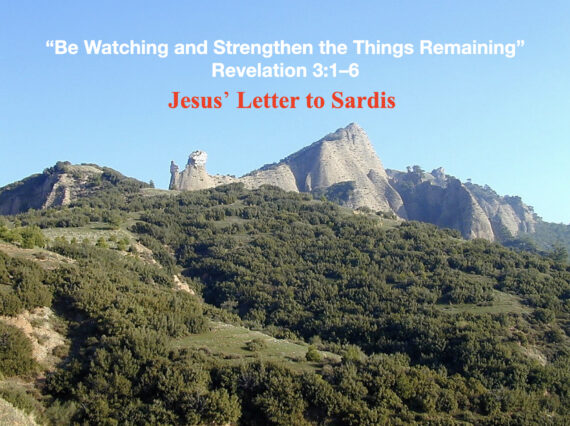
Croesus lived on the Sardis acropolis accessible only be a narrow causeway. Because of the steep sides all around Croesus considered it immune to attack. This over confidence ultimately lead to the city’s downfall.
You can view a video flyover of the acropolis of Sardis here:
https://app.box.com/s/n3qt4by57722ujd0jclo7p1j07ok3zzu/file/694987137394
To be continued…