
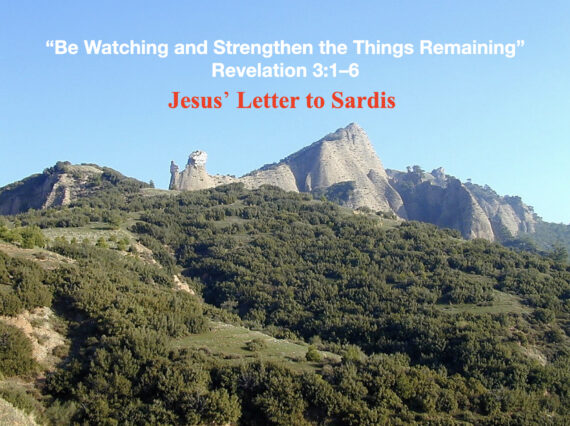
Jesus’ Letter to His People Assembled in Sardis: Revelation 3:1–6
Part 3
Part 1 is available at https://gospelherald.org/be-watching-and-strengthen-the-things-remaining-revelation-31-6/






Part 2 is available at https://gospelherald.org/be-watching-and-strengthen-the-things-remaining/
You can view the video flyover of the acropolis of Sardis here:
https://app.box.com/s/n3qt4by57722ujd0jclo7p1j07ok3zzu/file/694987137394
4. Jesus’ Conviction Part 2
After Part 1 of Jesus’ commands we studied last time, Jesus gives His second conviction relative to finishing what His people start:
2b “‘for I have not found your deeds completed in the sight of My God.’”
The way Jesus expresses His concern conceals positive potential. For the word completed, Jesus uses the perfect tense. The perfect tense describes a past action with an abiding result. Though people outside of His kingdom may not see it on earth, Jesus wants the works His people do to have lasting value “‘in the sight of My God,’” that is to say, from a heavenly perspective in the opinion of God. It’s His opinion that matters.
5. Jesus’ Commands Part 2
Jesus follows His second conviction with a series of major commands:
3a“ ‘So rememberwhat you have received and heard; and keepit, and repent.’”
Remember, keep, repent! Jesus told the Ephesians to remember, repent and do (2:5). He tells His people in Sardis to remember, keep and repent.
Like His command to continually “‘be watching,’” remembering here is to “hold in remembrance,” “keep in mind,” … all the time.
“‘What you have received’” is another perfect tense. We have received things from God in the past that have abiding enduring value for all of life and eternity. Foremost among them is the gospel of Jesus’ death, burial and resurrection which Paul said we have have received in His Word: “Now I make known to you, brethren, the gospel which I preached to you, which also you received, in which also you stand, 2 by which also you are saved, if you hold fast the word which I preached to you, unless you believed in vain 3 For I delivered to you as of first importance what I also received, that Christ died for our sins according to the Scriptures, 4 and that He was buried, and that He was raised on the third day according to the Scriptures, 5 and that He appeared to Cephas, then to the twelve” (1 Corinthians 15:1–5ff).
“‘What you have received – and – heard…’” In Revelation 1:3 God promises a blessing to those who will hear. Translating Revelation 1:3 with its original participles in place also connects the ongoing nature of hearing with keeping: “Blessed is the onereading and those hearing the words of the prophecy, and keeping the things which are written in it; for the time is near.”
Keeping what God has given us leads to faithful living and serving. Repenting, as we have seen in Jesus’ other letters, is willfully turning our minds to God to act in accordance with His will.
Remember, keep, repent!
6. Jesus’ Consequences
For Sardis, as in all His letters, Jesus gives His commands with consequences:
3b “‘Therefore if you do not watch, I will come like a thief, and you will not know at what hour I will come to you.’”
Jesus commanded them to be watching in verse 2. If they don’t He will surprise them with a visit at an unknown hour as Cyrus came upon the citadel of Croesus at night by surprise.
Jesus, Paul and John have used the metaphors like the thief coming at an unknown hour. To His people in Sardis, Jesus does not say what He might do. The threat of the Son of God coming by surprise at an unknown hour to discipline them should be enough.
The Roman historian Tacitus, who lived from AD 56–120, during the time of Jesus’ Revelation to John, wrote about the devastating earthquake of AD 17 that surprised the people of Sardis in his Annals 2.47.1–2, “In the same year, twelve important cities of Asia collapsed in an earthquake, the time being night, so that the havoc was the less foreseen and the more devastating. Even the usual resource these catastrophes, a rush to open ground, was unavailing, as the fugitives were swallowed up in yawning chasms. Accounts are given of huge mountains sinking, of former plains seen heaved aloft, of fires flashing out amid the ruin. As the disaster fell heaviest on the Sardinians, it them brought the largest measure of sympathy.”
The Christians of Sardis can halt Jesus’ threat by repenting and picking up and completing their deeds.
7. Jesus’ Commendation
4a“‘But you have a few people in Sardis who have not soiled their garments;’”
“‘A few’”: God always has a remnant of people faithful to Him. The remnant is hugely important in Scripture: God saved a remnant of eight people, Noah, his sons and wives, through the flood and repopulated the world. God’s prophets often commended the remnant and convicted the majority. The majority of the crowds abandoned Jesus but the remnant of His faithful disciples changed the history of the world. Many find the broad way of destruction while a few find the narrow way to life.
“Soiled” is a very strong word implying pollution and defilement. Their garments are a metaphor for their lives in Christ. They put on Christ at their immersion into Him. He is pure. The remnant have done God’s will and honoured His name.
While the majority had morally polluted their lives a faithful remnant remained unstained by the world.
8. Jesus’ Promises
In verse 4b Jesus promises “‘and they will walk with Me in white, for they are worthy.’”
Jesus recalls for them His vision of chapter 1 and His transfiguration where His garments became white as light (Matt 17:1–8: Mark 9:2–8; Luke 9:28–36).
White receives special attention in Revelation occurring 17 times, more than all the other New Testament books combined and more than any other single book of the Old Testament.
White was also a common visual symbol in the Greek and Roman culture all around God’s people in Asia. The white “toga virilis” indicated a young boy was a freeborn citizen of Rome. The Roman poet Persius called referred to it with as “candidus umbo,” shining white toga. An inscription from Sardis commemorating a ceremony for the emperor Augustus’ grandson speaks of his “brilliant white toga in all its splendor.” The normal term for toga, “toga pure,” highlighted ethical connotations: as boys emerged from childhood the white togas reflected a time of ritual purity and protection from sexual exploitation.
As He does with stones, rocks, temples, the sun, water and bronze, God transforms common things into metaphors of spiritual power. He uses them to show His superiority and sovereignty over all things, to inspire His people to aspire to greater eternal realities.
For Christians white is a metaphor for spiritual and moral purity. The blood of Jesus continually cleanses the souls of His people making them worthy, fit to live in the white light of God’s holy presence. In John’s Gospel and first letter God reveals that He is light (John 8:12; 9:5; 1 John 1:5). The promise of walking with Jesus in white is a truly awesome motive.
5 “‘He who overcomes will thus be clothed in white garments; and I will not erase his name from the book of life, and I will confess his name before My Father and before His angels.’”
In addition to His promise of clothing His people in white garments, Jesus affirms His promises in Matthew 10:32–33 and Luke 12:8–9, to confess each faithful Christian’s name in the presence of His Father and His angels.
As we saw in Thyatira, all Christians in Asia were at risk daily of having to confess faith in a pagan god or emperor. Jesus’ promise is a great motive. He will confesses us if we stay faithful to our confession of Him. The language implies a public profession of allegiance. This is the original idea of the word profession. It wasn’t about doing something for money but all about professing belief and acting accordingly with integrity. We know from Jesus’ words in John 13:35 that God cares about the reputation of His people in the world, “‘By this all men will know that you are My disciples, if you have love for one another.’”
Jesus’ word for erase is another strong one meaning to not blot out, obliterate or wipe out our names from the Book of Life. God will wipe out every tear (Revelation 7:17; 21:4). Like the purity of white, God’s Book of Life has a special place in Revelation where we find six of eight occurrences in Scripture. For His people in Sardis as for us Jesus emphasizes what matters is not the fame of our name in the world but having our names written in God’s Book of life.
9. Jesus’ Command to Hear
Jesus’ final words are particularly fitting for His people in Sardis where He stresses in verse 3 the importance of remembering all the eternally important truths they have heard from God.
6 “‘He who has an ear, let him hear what the Spirit says to the churches.’”
Conclusion
In His letter to His people in Sardis Jesus shows us that when we are feeling overwhelmed and finding it hard to go on, or when we are tempted to rest on our laurels, God empowers us to be vigilant, to be watching, to rely on the inner strength He supplies to go on and complete the works He gives us to do. “I can do all things through Him who strengthens me” (Philippians 4:13).
Remembering and keeping what He has given us, hearing His voice through His Word, and continually turning our eyes to Him will keep us on the way to eternal life. Living a godly life in an ungodly world is worth the effort.
Jesus’ promises to walk with us in white, to keep our names in God’s Book of Life and to confess our names before His Father and His angels are motives to be worthy to appear before God with Jesus.
“‘Be Watching and Strengthen the Things Remaining!’”
Waterloo, ON