
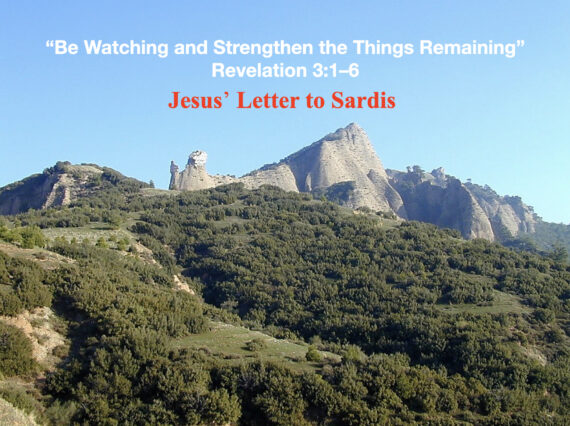
Jesus’ Letter to His People Assembled in Sardis
Revelation 3:1–6 Part 2
Part 1 is available at https://gospelherald.org/be-watching-and-strengthen-the-things-remaining-revelation-31-6/








A False Sense of Security
Cyrus the Great lived from about 600–530 BC. Cyrus was the founder of the Achaemenid Empire, also known as the first Persian Empire. He wanted to capture and include Lydia in his empire. Croesus consulted an oracle who falsely advised he could defeat Cyrus. Croesus misjudged the reliability of the oracle and the security of his city.
In his Histories, Book 1.84, Herodotus wrote, “Now this is how Sardis was taken. Croesus had been besieged for fourteen days, Cyrus sent horsemen about in his army to promise rewards to him who should first mount the wall. After this the army made an assault, but with no success. Then, all the rest being at a stand, a certain Mardian (a nomadic Persian tribe) called Hyroeades essayed to mount by a part of the citadel where no guard had been set; for here the height on which the citadel stood was sheer and hardly to be assaulted, and none feared that it could be taken by an attack made here. This was the only place where Meles the former king of Sardis had not carried the lion which his concubine had borne him, the Telmessians having declared that if this lion were carried round the walls Sardis could never be taken. Meles then carried the lion round the rest of the wall of the acropolis where it could be assaulted, but neglected this place, because the height was sheer and defied attack. It is on the side of the city which faces towards Tmolus (mountain range on the south side of Sardis defining the Hermus Valley named after the former king of Lydia, also a mountain god). So then it chanced that on the day before this Mardian, Hyroeades, had seen one of the Lydians descend by this part of the citadel after a helmet that had fallen down, and fetch it; he took note of this and considered it, and now he himself climbed up, and other Persians after him. Many ascended, and thus was Sardis taken and all the city like to be sacked.” So Cyrus captured Sardis and carried away a great sum the equivalent of about $8.5M.
The Glory Days of Sardis Passed
Over the following centuries Sardis changed hands several times. Alexander the Great captured Sardis in 334 BC leaving a garrison on the acropolis. Then the Romans put it under control of Pergamum until 133 BC. In AD 17, an earthquake destroyed Sardis. Tiberius gave a huge donation and tax breaks to assist in the rebuilding of the city. In AD 26 Sardis was overlooked in a competition of 11 cities for second temple to Caesar which went to Smyrna. Though the glory days of the political might of Sardis were past, it retained some of its economic strength along with considerable moral decay for three centuries thus including the time of Jesus’ Revelation.
In 1881 and 1882 the pioneering archaeologist William Mitchell Ramsay traveled the journeys of Paul through the cities of Anatolia that Luke recorded in Acts. Ramsay wrote, “No city in the whole Province of Asia had a more splendid history in the past ages than Sardis. No city of Asia at that time showed such a melancholy contrast between past splendour and present decay as Sardis. Its history was the exact opposite of the record of Smyrna. Smyrna was dead and yet lived. Sardis lived and yet was dead…. Carelessness and failure to keep proper watch, arising from over-confidence in the apparent strength of the fortress, had been the cause of this disaster, which ruined the dynasty and brought to an end the Lydian Empire and the dominance of Sardis” (The Letters to the seven churches of Asia and their place in the plan of the Apocalypse, 375–7).
Jesus’ Greeting and the Seven Spirits of God
Jesus said something unique in his greeting and vision before he repeats what we have seen of “the seven stars” in chapter 1:
“‘He who has the seven Spirits of God and the seven stars, says this:’”
Jesus says He “‘has the seven Spirits of God.’” This is one of only four places in Scripture we learn of the seven Spirits, all in Revelation. The first is in John’s salutation greeting in Revelation 1:4, “John to the seven churches that are in Asia: Grace to you and peace, from Him who is and who was and who is to come, and from the seven Spirits who are before His throne…”
The third reference is in Revelation 4:5, “Out from the throne come flashes of lightning and sounds and peals of thunder. And there were seven lamps of fire burning before the throne, which are the seven Spirits of God.”
The fourth is from Revelation 5:6, “And I saw between the throne (with the four living creatures) and the elders a Lamb standing, as if slain, having seven horns and seven eyes, which are the seven Spirits of God, sent out into all the earth.”
We know that God, Father, Son and Holy Spirit are one. As Paul says in 2 Corinthians 3:17–18, “The Lord is the Spirit.”
We see in Revelation 4:5 and 5:6 that Jesus’ seven Spirits were lamps burning before the throne and they are the eyes of the Lamb sent out into all the earth.
We learned in His letter to Thyatira that Jesus searches the minds and hearts of His people. He sees and knows everything.
Interestingly, in Zechariah 4:1–7, God makes a prophetic connection between the solid gold lamp stand and seven lamps that represent God’s Spirit as His means of renewal of His people of Israel.
We may be confident that God has sent out His Spirit to counsel, strengthen and comfort His people individually and collectively. While Ephesus had cooled spiritually, Sardis was spiritually dead. They were in need of spiritual resuscitation which God was ready to provide through His Spirit if they would obey and repent. Sardis had a great need so God sent His greatest power. God urgently exerts His power in hope of responses from people who must engage their will with His to regain spiritual vitality.
Letter Section 2. Jesus’ Conviction Part 1
3:1b “‘I know your deeds, that you have a name that you are alive, but you are dead.’”
We noticed that for Sardis and Laodicea Jesus does not start these letters with commendations as he does in others of His seven letters. His commendation for the few faithful in Sardis comes later in verse 4. He is first concern is their unfinished works.
Whereas Ephesus left their first love and the deeds it inspired, and Thyatira’s deeds were greater than at first, Sardis had quit.
Since all the letters circulated together, by the time the assembly in Sardis heard the other letters emphasising deeds, Sardis had the most illustrious past and may have expected the greatest praise. Surprise! As their city had a glorious reputation in its past, the Sardis assembly may have been spiritually lively in its early days but cooled the point of inactivity, resting on its laurels in a state of spiritual slumber, listlessness and apathy.
For God, Jesus, His Holy Spirit and John life is eternal spiritual life so…
3. Jesus’ Commands Part 1
3:2a“‘Be watching, and strengthen the things remaining, which were about to die;’”
Jesusdoes not give up on them. As He raised Lazarus in John 11, He can raise this church back to life. God can bring life to the spiritually dead who are willing.
Jesus uses many imperatives in this letter. Of major significance is His command for His people in Sardis to be watching. While some translations render this participial phrase “wake up,” a one time command, the beauty of Jesus’ participle to be watching is that it is an ongoing attitude of being: be vigilant, be always on the alert in constant readiness. It is the same as a Christian’s expectant attitude towards Jesus’ second coming.
As God wired us to see and watch, He has given us the ability to tap into reserves of strength He places in us by His grace and Spirit. He gives us this strength to pick up and complete unfinished work – and – to continue working on new things He gives us to do. Walking with Jesus and seeing with His eyes of compassion we see that the needs are infinite. As long as we live, there is always more to do.
To be continued…