
A boy got in trouble at school. He said a “bad” word. He said, “hate.” He could have claimed to be a girl. That is accepted if not openly encouraged. He could have used any of the ugliest curse words. That is free speech. But he said that he hated a certain football team, and for using the word “hate” he was punished.
People today, including many who call themselves Christians, seem to believe that it is possible to negotiate a peace settlement with anyone — including Satan himself. Therefore, we should never say hate. That is the modern view.
The Bible does not agree. We are to hate evil (10).
We must hate evil because evil and God are diametrically opposed to one another. The Lord reigns, let the earth rejoice; let the many coastlands be glad! 2 Clouds and thick darkness are all around him; righteousness and justice are the foundation of his throne. 3 Fire goes before him and burns up his adversaries all around. 4 His lightnings light up the world; the earth sees and trembles. 5 The mountains melt like wax before the Lord, before the Lord of all the earth.
Evil is opposed to God, and in being opposed to God it also opposes the image of God. The goal of evil is not to make everyone happy but to efface the image of God in everyone. Large parts of the world are currently slouching their way to Sodom; entertaining themselves to death. We are better fed, more educated, more served, more entertained and less happy than any previous generation. Why? In part because we are trying to compromise where there is no room for compromise. We try to reconcile fire and water. We try to be holy while embracing evil.
Elijah came near to all the people and said, “How long will you go limping between two different opinions? If the Lord is God, follow him; but if Baal, then follow him.” And the people did not answer him a word (1 Kings 18:21).
We must hate evil because evil hates.
Evil is unwilling to coexist with good. Evil will keep fighting against good as long as there is any life in it. Does anyone ever ask the doctor, “Leave a little of the cancer, please”? Does anyone ever ask the firemen, “Please don’t put the fire all the way out”?
Evil, like cancer, like fire, is not static. It is consuming; it is growing. Keep a little evil around (just for fun, just to show your broadmindedness) and it will try to destroy you.
As the goal of evil is our destruction, so our goal must be its destruction — not its control, not merely to escape from its consequences, but the destruction of evil.
Psalm 97:10 “O you who love the Lord, hate evil!”
Here is a psalm that must have an interesting history. Strange things are said about it.The heading in the LXX reads, “When the house was built after the captivity, a Song by [or to] David.” How can it have been written after the captivity and yet been written to or by David?!
Most of this psalm is quoted in 1 Chron 16. So, did the Chronicler borrow the psalm to fill out his account?Or did the compilers of the psalms borrow and adapt a song sung on that occasion to place in the Psalter?We will never know.
Although the history of the psalm must be interesting, we have no way to reconstruct it. Instead, we will do best to try to learn its lessons.The lesson here, as in many of the psalms, has to do with worship. Psalm 96 teaches us several things about worship.
In worship, some things are worthy of repetition. The call to worship begins “Sing, sing, sing” (1-2).Later we are called to Ascribe, ascribe, ascribe” (7-8).
There is such a thing as vain repetition (Matt 6:7), but there is also such a thing as healthy repetition. Certain things, said of or to certain individuals, can hardly be said too much.Most of us probably need to spend more time singing to the Lord and ascribing to him the glory due his name.
In worship, holiness is proper. “Worship the Lord in the splendour of holiness; tremble before him, all the earth!”
We serve a holy God and must worship him in holiness.The NIV assumes that his holiness is the focus of this verse, and, in a sense, it must be.We must worship him alone, because he alone is truly God.We must also be different, separate from, others; for the God we worship is different from, separate from, all others.
Holiness is not just a moral concept. There must always be ceremonial markers to remind us of what is special. Postmodern anti-culture has torn down these ceremonial markers when it comes to the worship of God.Yet, every culture has retained ceremonial markers in approaching those we really honour. When the King gives his throne speech, everyone attends and everyone in attendance dresses up. No MP will plead a soccer match as an excuse for missing. No one will wear inappropriate clothing.
It should not bother us that different people have different ways of marking specialness. It should bother us very much when no specialness is marked with reference to worshipping God.
While holiness is not entirely moral in nature, it is moral in nature. We cannot worship God correctly while failing to maintain his moral standards. To worship him, we must do so in holiness.
In worship, proclamation is inevitable. “3Declare his glory among the nations, his marvellous works among all the peoples! 10Say among the nations, “The Lord reigns!”
This is one of the reasons that worship ought often to be public. Private worship is good. Private worship certainly should be the practise of every Christian (Mt 6:6). But worship is supposed to lead to proclamation. To do that, it must be public.The world wants to pressure us into silence, but wherever God is truly worshipped, evangelism soon follows.
That which we can keep quiet about, is obviously of secondary importance to us. We talk about what really matters to us. As Jeremiah said, “If I say, “I will not mention him, or speak any more in his name,” there is in my heart as it were a burning fire shut up in my bones, and I am weary with holding it in, and I cannot” (Jer 20:9).
Let us make it our goal to worship him in holiness — repeatedly and publicly.
Psalm 95 divides into two major parts: a call to worship and a warning.
Oh come, let us sing to the Lord; let us make a joyful noise to the rock of our salvation! 2 Let us come into his presence with thanksgiving; let us make a joyful noise to him with songs of praise! 3 For the Lord is a great God, and a great King above all gods. 4 In his hand are the depths of the earth; the heights of the mountains are his also. 5 The sea is his, for he made it, and his hands formed the dry land. 6 Oh come, let us worship and bow down; let us kneel before the Lord, our Maker! 7 For he is our God, and we are the people of his pasture, and the sheep of his hand.
Today, if you hear his voice, 8 do not harden your hearts, as at Meribah, as on the day at Massah in the wilderness, 9 when your fathers put me to the test and put me to the proof, though they had seen my work. 10 For forty years I loathed that generation and said, “They are a people who go astray in their heart, and they have not known my ways.” 11 Therefore I swore in my wrath, “They shall not enter my rest.”
The call to worship is repeated three times and strengthened by two listings of reasons for worship (1-7a). Verse 1 calls on them to sing to the Lord. Verse 2 calls on them to come into his presence. Verses 3-5 gives the first reason for worship. He is creator and therefore Lord or King of all. Verse 6 calls them to worship and bow down, again giving honour to him as creator. Verse 7 expands on the reason for worship, reminding them of their close relationship with the Lord.
The second part of the psalm is a warning or a call to obedience (7b-11). It is based on their failure to honour the Lord as they should have at Meribah (provocation) and Massah (testing) in the wilderness (Ex 17:7; Num 20:13).
Praise and obedience is owed to the Lord because of his close, personal care (7). This is reiterated in the New Testament in passages like John 10:11-16, and elsewhere in the Old Testament in passages like Isaiah 40:11.
This shift from a call to praise to a stern exhortation or warning is a needed corrective to certain attitudes that are prevalent today. Some would broaden the idea of worship to cover anything and everything in life. Some of these same people, on different days of the week or in another mood, would limit worship to just praise — especially praise in song. The popularity of the term “worship leader” for what used to be called a “song leader” indicates too narrow of a concept of worship.
In song we are the ones doing the talking. We have not properly worshipped when we do all the talking. We must “hear His voice” as well as raising our voices in praise. Failure to hear and heed the voice of God is disastrous — even for, perhaps especially for, those who claim to worship him. As Marvin Tate has said, “Jubilation is one pole of worship; obedience of the demands of God is the other. The ‘resting place’ of God is closed to those who only jubilate” (503). Later he adds, “The old trek through the wilderness toward the promised land always passes by Meribah, where hearts may harden and the pilgrimage be lost…” (504)
This is the same thing Hebrews teaches in chapters 3 and 4, and that Jesus teaches in Matthew 7:21 and 15:8-9.
We must not harden our hearts as the Israelites did in the wilderness. We must honour him with our praise and with our obedience.
We will mention a couple of important matters raised by the psalm, but these first two will not be dwelt on at length.
First, it is best avoid preaching while praying. It is generally harmful to speak to the people while pretending to speak to God. Yet it must be admitted thatothers are naturally going to learn from our prayers. It must also be admitted that many biblical writers preached during their prayers. This psalm is an example of a mini sermon being placed in the middle of a prayer.
Second, the God of the Bible is a God of vengeance. The Bible states that repeatedly and with emphasis. There are two reasons why we struggle with that fact.One is that our sense of justice is fallen and warped.The second is that our understanding of the word “vengeance” is fallen and warped.But since the Bible insists that vengeance belongs to God, expecting us to accept that fact and even rejoice in it, we ought to learn what the word really means (as used of God).
The problem of evil is the major theme of this psalm.Psalms 37, 73, and the whole book of Job, are also concerned with this problem.In the New Testament, Romans chapter 8 and large portions of 1 and 2 Peter, and the Revelation are concerned with this issue.
In this series, we have covered other psalms that touch on the problem of evil. This psalm brings us to the matter again. Evidently God has chosen to place it before us again. He must think we need to give more thought to the problem of evil.
In this brief article, however, we will concentrate on only one aspect of what the psalm has to say regarding evil. We will skip the complaint of the psalmist to God, and the warnings directed to the evildoers. We will instead concentrate on what the psalm says to the believer.
We must find blessedness in discipline. “Blessed is the man whom you discipline, O Lord, and whom you teach out of your law” (12). Discipline is a blessing! The writer of Hebrews evidently agreed with this. He wrote”For the Lord disciplines the one he loves, and chastises every son whom he receives.” 7 It is for discipline that you have to endure. God is treating you as sons. For what son is there whom his father does not discipline?” (Heb 12:6-7) We often fail to see discipline as a blessing. We ought to give thanks for the parents and teachers who have disciplined us. We ought, like this psalmist, to thank the Lord for his discipline.
We must go to the scriptures to find blessedness in this discipline. To continue the quotation of verse 12,”Blessed is the man whom you discipline, O Lord, and whom you teach out of your law.” (see also 119:49-50, 81, 114, 105; John 8:31-32; Matt 5:10-12; John 15:20)What do the scriptures say that indicate the blessedness of discipline? If we read the scriptures while fully awake, we will notice that in having trouble and trial we are sharing in the experience of the saints of all ages, and in the experience of Christ Jesus. They suffered. They were disciplined. They experienced temporal injustice at times. If we forget that and begin to expect that life should be a ‘bed of roses’ for Christians, we will be disappointed.
We must trust in God’s promises. “…to give him rest from days of trouble, until a pit is dug for the wicked. 14 For the Lord will not forsake his people; he will not abandon his heritage; 15 for justice will return to the righteous, and all the upright in heart will follow it” (13-15).
It seems strange to some, but those Christians who believe most in heaven have done the most for the earth. On the other hand, those who do not trust God to carry out his promises, do not work in hope. They continually try to do things that are not theirs to attempt. In the end, they fail to accomplish what they ought to do. We must learn to stay within our limits and trust the outcome to the Lord.
We must not attempt to stand alone against the wicked. Who rises up for me against the wicked? Who stands up for me against evildoers? 17 If the Lord had not been my help, my soul would soon have lived in the land of silence. 18 When I thought, “My foot slips,” your steadfast love, O Lord, held me up. 19 When the cares of my heart are many, your consolations cheer my soul. 20 Can wicked rulers be allied with you, those who frame injustice by statute? 21 They band together against the life of the righteous and condemn the innocent to death. 22 But the Lord has become my stronghold, and my God the rock of my refuge. (16-22)
The devil is constantly using teamwork against the righteous. Those seeking to be faithful must take advantage of the support the Lord provides by means of the word, personal prayer, and by means of the fellowship of other believers. In our joint worship, prayer, Bible study, and service we strengthen each other for the task. We will never win if we fight alone. The Lord does not intend that we should fight evil alone. He is always with us. He is normally with us by means of the church, that group of people for whom he died (Acts 20:28).
We must leave vengeance in the hands of the God of vengeance. O Lord, God of vengeance, O God of vengeance, shine forth! 2 Rise up, O judge of the earth; repay to the proud what they deserve! …. 23 He will bring back on them their iniquity and wipe them out for their wickedness; the Lord our God will wipe them out. (1-2, 23)
The problem of evil might often be better described as the failure of faith. Our eyes are too much on evildoers and too little on God. When Christians become too focuses on evildoers, when we forget that the battle is the Lord’s battle, not our personal battle, we often make matters worse. The New Testament will remind us to leave vengeance in the hands of God (Rom 12:19). It is up to him, not to us, to deal with evildoers. He may sometimes do so via the “governing authorities” (Rom 13:1-6). Unfortunately, those authorities may often rebel against him and side with evil. But that must not change our resolve to trust him and keep on with our proper tasks.
We jokingly say that two things are for sure – death & taxes. For the writer of this psalm there is only one certainty, the Lord. Some folks escape taxes, and Enoch escaped death. But we all have the Lord to contend with or to rely upon. He is the one certainty.
The Lord is sure. The certainty and dependability of the Lord is illustrated in a couple of ways.
Unless we live in a region of very high incidence of earthquakes, we think of the earth as solid and dependable. But whatever dependability the earth has it derives from its maker. (1b-2).We recognize the power of the waters (3), but the Lord is far more powerful (4).
The Lord reigns; he is robed in majesty; the Lord is robed; he has put on strength as his belt. Yes, the world is established; it shall never be moved. 2 Your throne is established from of old; you are from everlasting. 3 The floods have lifted up, O Lord, the floods have lifted up their voice; the floods lift up their roaring. 4 Mightier than the thunders of many waters, mightier than the waves of the sea, the Lord on high is mighty!
Living this side of the cross, we have greater reason to trust in the dependability of our God. What then shall we say to these things? If God is for us, who can be against us? 3 He who did not spare his own Son but gave him up for us all, how will he not also with him graciously give us all things? (Rom 8:31-32).
Whether compared to the Old Testament saints, or most of the New Testament saints, or most of the saints down through the ages, we have more to be thankful for, more reason to be devoted to the Lord. Does it show in our lives?
His dwelling should be holy. This psalm concludes that it is fitting that such a God dwell in a holy house. Your decrees are very trustworthy; holiness befits your house, O Lord, forevermore (5).
This might have meant a couple of things.He may have meant that the Lord’s heavenly dwelling is unapproachable. He may have meant that the Temple, his earthly house, needed to be honoured and kept separate from every ordinary structure.
From a New Testament perspective, the holiness of God’s house means that Christians are to be intentionally and meaningfully different, separated from the world in ways that really matter.
1 Corinthians 3:16-17 Do you not know that you are God’s temple and that God’s Spirit dwells in you? 17 If anyone destroys God’s temple, God will destroy him. For God’s temple is holy, and you are that temple.
1 Corinthians 6:19-20 Or do you not know that your body is a temple of the Holy Spirit within you, whom you have from God? You are not your own, 20 for you were bought with a price. So glorify God in your body.
Colossians 3:1-5 If then you have been raised with Christ, seek the things that are above, where Christ is, seated at the right hand of God. 2 Set your minds on things that are above, not on things that are on earth. 3 For you have died, and your life is hidden with Christ in God. 4 When Christ who is your life appears, then you also will appear with him in glory. 5 Put to death therefore what is earthly in you: sexual immorality, impurity, passion, evil desire, and covetousness, which is idolatry.
Romans 12:1-2 I appeal to you therefore, brothers, by the mercies of God, to present your bodies as a living sacrifice, holy and acceptable to God, which is your spiritual worship. 2 Do not be conformed to this world, but be transformed by the renewal of your mind, that by testing you may discern what is the will of God, what is good and acceptable and perfect.
Are we intentionally and meaningfully different, separated from the world in ways that really matter? This is a question which, I fear, we ask ourselves rarely. We are God’s house. His Holy Spirit dwells in us or would if we would allow it. But too often we grieve the Spirit by our actions and attitudes (Eph 4:30).
The Lord is sure. His guidance, his protection, his salvation are perfectly trustworthy. His wisdom, knowledge, and power are matchless. But for us to fully benefit from his greatness, we must seek the holiness without which no one will see the Lord (Heb 12:14).
Romans 9:3 For I could wish that I myself were accursed and cut off from Christ for the sake of my brothers, my kinsmen according to the flesh.
This is a passage that amazes many Christians. As far as many Christians are concerned, THE reason for being a Christian is personal salvation. So how can Paul say that he would be willing to be lost for the sake of saving others?
The goal of personal salvation is nearly always prominent in conversion, and there is nothing wrong with that (Acts 2:37-40). But Paul has reached a point, and every Christian should reach a point, where the glory of God is more important than their own salvation. Paul being lost would not cause his nation to be saved, but if it were possible, and if their being saved would honour God more than Paul’s personal salvation, then Paul is willing to be lost for the sake of this greater good. Of course, Paul wants to be saved, and expects to be saved, but his personal salvation is not the most important thing to him.
It does not disturb me that a new-born is self-focused. For the sake of survival, new-borns must be, and there is nothing they can do to serve others anyway. But when a child of eight or ten is still fully self-focused, we should be concerned. When a teenager is still fully self-focused, it is alarming. When an adult is self-focused, it is depressing.
It does not disturb me that a new convert is focused on personal salvation. But it alarms me when I meet Christians who ought to have grown beyond that point who are still totally preoccupied with their own salvation. It alarms me because they ought to have enough confidence in Christ that they would not be doubting their salvation; and because they ought to have grown to the point of being more focused on helping others and glorifying God.
Yes, we want to be saved, that is appropriate. But it is not all about us. It is about the glory of God (Isa 43:21; Phil 1:10-11; 1 Peter 2:9; 4:1-11).
A lack of purpose is among the greatest faults of our generation. All too often, people do not know why they are here; they do not know the purpose of their lives. This psalmist knows the purpose of his life, and we do well to meditate on his words.
The writer’s purpose is to give thanks to the Lord. It is good to give thanks to the Lord, to sing praises to your name, O Most High; 2 to declare your steadfast love in the morning, and your faithfulness by night, 3 to the music of the lute and the harp, to the melody of the lyre. 4 For you, O Lord, have made me glad by your work; at the works of your hands I sing for joy.
It is a grave error when Christianity becomes for any of us nothing but a set of rules to be kept so that we can reach heaven. Many of the saints, especially in Old Testament times, lived and died without knowing much of anything about life after death. They praised God because he is worthy of praise, and because praise was the purpose of their lives.His steadfast love (2) and his mighty works (4-5) should be reason enough to praise him, even if we had no prospect of life beyond the grave.
The writer’s thoughts are sometimes distracted by the success of the ungodly. The stupid man cannot know; the fool cannot understand this: 7 that though the wicked sprout like grass and all evildoers flourish, they are doomed to destruction forever; 8 but you, O Lord, are on high forever. 9 For behold, your enemies, O Lord, for behold, your enemies shall perish; all evildoers shall be scattered.
This is one of the most common obstacles to praise. We get side-tracked when we see the wicked being successful. We must remind ourselves that, in the short-term, God has always allowed this, but in the long run, although we may not see it, his way is best.
The cross looked like the greatest triumph of evil.We must always remember that when discouraged by the success of the godless.
The writer’s own experiences lead him to praise. But you have exalted my horn like that of the wild ox; you have poured over me fresh oil. 11 My eyes have seen the downfall of my enemies; my ears have heard the doom of my evil assailants.
Those of us who have lived a while probably have an experience or two that demonstrates this. We need to tell our youth of such events and teach them the biblical examples of such.
We need to face current occurrences of the triumph of evil with the confidence inspired by past examples.We need to praise God for his ability to make use of human evil for good.
The writer’s expectation is that his life will continue to bear the fruit of praise to the very end. The righteous flourish like the palm tree and grow like a cedar in Lebanon. 13 They are planted in the house of the Lord; they flourish in the courts of our God. 14 They still bear fruit in old age; they are ever full of sap and green, 15 to declare that the Lord is upright; he is my rock, and there is no unrighteousness in him.
What does the future hold for us?The generation currently entering the work force believes their prospects are worse than those of their parents.Too much of the current generation in the church seems to feel that we are past our prime, that we have little or nothing to look forward to (in this life at least).
We need to make plans to praise him as long as we live.Quartets used to sing, “I don’t know what you came to do, but I came to praise the Lord.” For however many days or years we have left, that is what we should plan to do. Even in death, we plan to praise the Lord.
We are here to glorify God (1-2). That is our purpose. We should not allow the seeming success of the wicked to distract us from our task. We should not allow our lives to become lives of selfishness.
We should examine our lives regularly asking this question, “Is my life praising the Lord as it ought?” That is the fundamental question of life. We might be rich as Croesus, but if our lives do not glorify God, we have failed.We might be poor as church mice, but if our lives do glorify God, we have fulfilled our purpose.
Psalm 91
This psalm is comforting and useful as a devotional reading, but difficult to make into a lesson.There are three voices in this Psalm. In verse 2 note the first-person singular (“I”). In verses 3-13 note the 2nd person singular (“You”). In verses 14-16 this changes to the 3rd person “he.”
This Psalm may have been read by three different voices, the last voice representing God.But that does not go far toward helping us understand the psalm.
There are three keys to understanding this Psalm.
To have this psalm ring true for us, we must dwell in the shelter of the most high. Charles Spurgeon wrote, “Every child of God looks to the mercy seat, but not all dwell there; they run to it at times, but do not habitually reside in the mysterious presence.”
The writer does not say (2) “God is a refuge,” but “God is MY refuge.” He does not say, “God is one of my refuges.” God is his only refuge.
There are difficulties in the Psalm for the average reader, but the one dwelling in the shelter of the most high, finds no insurmountable difficulty.
To understand this psalm we must let the figures of speech have their natural effect. It is not natural to always read the Bible literally, nor to always read it figuratively. The natural reading of poetic figures of speech is to allow them to affect our thinking without over-analysing them.
We are unlikely to fear a literal snare (3). We do not expect to be covered by literal wings (4). A shield would be a protection if attacked by means of arrows. A buckler would be helpful in sword or knife combat. But again, these are figures of speech.
Verses 7-10 bring us to a possible difficulty. Will the faithful never fall in battle? Will trouble never come near them? Again, it helps to remember that these are figures of speech. But ultimately we must move on to the third key.
To understand this psalm we need the gospel perspective. Verses 7-10 must be taken together with 11-12, which leads us immediately to Jesus.When looked at from this side of the cross, we must surely realise that the promise is not of a trouble-free life, but of sufficient grace to overcome the troubles. Jesus did, ultimately, trample the roaring lion and snake (13), but not without difficulty.
Romans 8 gives a post-Calvary understanding of the problem of suffering for the godly. All things are worked together for our good (8:28). That does not mean that we will never experience tribulation, persecution, famine, nakedness, or the sword (8:35).We may experience these things, yet we are more than conquerors (8:37) “It will not come near us” (7, 10) really means it will not come close to defeating those who trust the Lord.
In the psalms, we often are reading human words to God; but this psalm closes with God’s word to us.As Wieser says, to know the name of God is “more than merely ‘being informed’ about something; it comprises at the same time ‘to be on terms of intimacy’ with someone and to be inwardly devoted to someone. Only the man who lives in such intimate communion with God may be assured of his help …” (P 612).
To fully appreciate this psalm, one must live it; and live it in light of the cross (Isa 53:12).
The fourth book in the Psalter does not contain as many headings as the other books.Those we do see here are of questionable use in understanding the psalms.We do best to take the inspired text at face value, without recourse to guessing the exact situation of the writer, with or without the help (or hindrance) of the headings.
This psalm is a reflection on the contrast between human mortality and God’s eternity.There are no enemies here, nor disasters to endure, just the question of our mortality. God is forever (“from everlasting to everlasting you are God” 2). We are short-lived (“The years of our life are seventy, or even by reason of strength eighty; yet their span is but toil and trouble; they are soon gone, and we fly away” 10).
Time is very different for him than for us (“For a thousand years in your sight are but as yesterday when it is past, or as a watch in the night” 4).Our mortality is the result of sin and God’s judgment on it (“For we are brought to an end by your anger; by your wrath we are dismayed. You have set our iniquities before you, our secret sins in the light of your presence” 7-8).
Such reflection could lead in different directions.Some find it depressing to reflect on human mortality, the fact that we are all terminal.But there is no evidence of discouragement in the tone of this writer. The facts presented in this psalm are not depressing at all.The writer seems to take comfort in the fact that, although we are “soon gone” (10) God is our dwelling, and he is eternal (1).There is even comfort in the fact that our death comes from God’s hand because of our sin. It is not an accident of blind chance. Our death is controlled by an all-wise and all-powerful God.
The writer makes two requests of God.
He says, “Grant us wisdom” (12-13).
Wisdom should come from meditation on the matters mentioned here.If what we do were of no consequence, it would not matter if we did it well or poorly, wisely or foolishly, righteously or sinfully.The fact that God takes action against our sin (8) invests our lives with meaning. Our lives have significance, otherwise our sins would be of no consequence.
Denial of sin’s significance leads, inevitably, to a sense of pointlessness.A denial of sin leads to mental problems. Karl Menninger, a psychiatrist and in no sense a Christian, wrote the book Whatever Became of Sin? The main premise of the book is that the denial of sin inevitably leads to an increase in mental illness, for it makes human life utterly meaningless.
We are here for just a short time, yet we are of consequence to the eternal God. There is a double need for wisdom.With short days and high stakes, the need for wisdom is all the greater.This psalm does not outline a plan for gaining wisdom, it merely asks for it from God.
He also says, “Pity us.”
We do not always grow in wisdom, and so we need God’s pity. We need it primarily in two ways.
God is asked to show pity by showing us his work (16).We can endure a lot, risk a lot, if we know that the end goal is worthwhile and is achievable. If we know that he is in this with us, and if we trust his wisdom and ability, we are much better equipped to face discouraging circumstances.
God is asked to pity us by granting that our work be not in vain (17).The curse of sin is that it renders our work ineffective (Gen 3:17-19; 4:12).Again, this is the cry for significance, a cry made acute by the denial of sin and amplified by the seemingly insignificant nature of so much of our labour.
We are not going to live very long. That is frustrating, even frightening, because we have not accomplished much. The world tells us that we do not really matter much, that our actions are not significant. But God is eternal. God says our actions are significant to HIM. If our actions are of significance to the eternal God, then we are significant. It matters what we do and even what we think.
Let us live our lives confident that there is significance in what we do; and praying that the Lord will intervene to establish the work of our hands. Let us not waste our significance on insignificant matters. Let us rather redeem the time by living wisely.
This is the last psalm in book three of the psalter.Book three is perhaps the most difficult of the five books. It deals with dilemma.It opens with the question of why the wicked prosper (73) and asks why God has abandoned his people (74).It closes with similar themes in 88 and 89.
Most lament psalms start with the problem and then move on to praise.Last week we noticed that psalm 88 is an exception, it never gets past the lament, ending with the word “darkness.”Psalm 89 is an inverted lament. It begins with praise of the Lord’s creative power and his covenant promise. Then it moves on to lament the current condition of David’s house.
Clearly this psalm was written well after the time of David. Evidently the king has recently suffered defeat (38-45). It also seems that the king in question was young (45).Several scholars suggest that Jehoiachin may be in view. Or Josiah’s death might have called forth such a lament.
Though the psalm does not reach a conclusion, it ends on a note of praise. It ends on a note of “hallelujah, anyway.”Many of us are aware of our limited perspective, and therefore of the need to trust God and say, “hallelujah, anyway.” But it is not always easy to do.Perhaps we could learn something from how the writer approaches his situation.
In the long opening section, he reviews the Lord’s covenant promise (1-37).God is able to deliver. He is creator and has all power (5-14).The Lord has made promises to David’s house. The promise was freely and unilaterally offered (cf 2 Sam 7:4-17). This is remembered in verses 20-22, 28-29, and especially in 30-37.
“If his children forsake my law and do not walk according to my rules, 31 if they violate my statutes and do not keep my commandments, 32 then I will punish their transgression with the rod and their iniquity with stripes, 33 but I will not remove from him my steadfast love or be false to my faithfulness. 34 I will not violate my covenant or alter the word that went forth from my lips. 35 Once for all I have sworn by my holiness; I will not lie to David. 36 His offspring shall endure forever, his throne as long as the sun before me. 37 Like the moon it shall be established forever, a faithful witness in the skies.”
The psalmist then wrestles with the current situation in verses 38-51.First he describes that situation (38-45).Then he asks the Lord why things are as they are and how long they will remain in this state (46-51).In doing so, the writer asks the Lord to remember his human frailty (47-48).He acknowledges that there may be cause for God’s anger at his people. The writer does not question the justice of that anger but asks how long it will continue (46).He is also clear that the current situation insults the Lord, not just the worshipper (50-51). This is often a central aspect of biblical prayer – the appeal to the honour of the Lord’s name, rather than a claim of innocence on the part of the ones offering the prayer. Moses’ prayer after the people refused to enter the promised land is typical (Num 14:13-19).
The psalmist concludes in praise. “Blessed be the Lord forever! Amen and Amen” (52).Praise, in this situation, and without a word of promise having been spoken, expresses a settled confidence that the Lord will do the right thing.And he was doing the right thing, even though it was hard to see when Josiah died or when they were taken captive, or at many other points along the way. The Lord kept his promise to David, although not in the way they expected.
If Jesus is not the son of David and king of God’s people, then it is difficult to avoid the conclusion that God has not kept his promise to David. Perhaps that is part of why modern Judaism has become more a culture than a religion.
What should we learn from this psalm?
We should learn that when it seems that the Lord is not fulfilling his promises, that may be the time that he is doing something for us that is beyond our understanding.We should therefore review his promises and his power. We should present our situation to him, and trust that he is once again up to something greater than we can understand. We should say, “Blessed be the Lord forever!” For as he kept his promise of a continuing dynasty for David, in an unexpected and unheard-of manner, so he will keep all his promises– in Christ (2 Cor 1:20).
The Bible is an honest book, the most honest book in the world.We ought to be honest people; but we must also understand that our task is not to tell others about ourselves but to point them to God. Doing that often involves telling things that we have not yet learned as we ought to have learned them. We are to hold up God’s ideals, not just our realities.
Psalm 88 is a painfully honest passage. It gives us a glimpse into a place where we might prefer not to look. In this psalm we are shown the heart of a believer who has given up hope. He does not expect deliverance. He does not expect to be saved from death; and he does not seem to expect communion with God beyond death (5, 10). He has given up hope; but he has not given up faith. He still believes in God. He still cries out to God, although he feels no sense of hope.
This psalm calls us to ask a terrible question. Would our faith abide alone? Could we go on believing amid hopelessness, in a situation where we enjoyed no loving contact and had ceased to believe that we were loved?
Psalm 88 addresses the same question the book of Job addresses. Will a man serve God for no reason, or must he always be looking for something to gain? (Job 1:9)Or to put it more personally, “Would we serve God just because it is right, or must we always be looking toward a reward?”
This psalm seems to show us that there was at least one person who did so. He continued to go to God even when he despaired of hearing a positive response.That does not tell us what we would do in similar circumstances. Let us hope that we never have to find out.
Leaving that question, which we hope will never become a practical question for us, let us turn to some matters to which this psalm speaks.
Prolonged, unexplained suffering is a possibility for believers. Despair is not a right response, but it is a possible response. And it is not one that should always be condemned.
Sometimes it should be condemned. Those who despair over spilled milk need to be told to straighten up.But it is not fair to say to those feeling despair over prolonged and unexplained suffering that they lack faith. It is possible to lack hope without lacking faith.
Honesty with God is acceptable. We should tell him the truth.This psalm plainly shows that.
Your wrath lies heavy upon me, and you overwhelm me with all your waves. 8 You have caused my companions to shun me; you have made me a horror to them. I am shut in so that I cannot escape; 9 my eye grows dim through sorrow. Every day I call upon you, O Lord; I spread out my hands to you. (7-9)
Job, Elijah, Jeremiah and Habakkuk are all very honest with God. They are rebuked at times, But they are never condemned for their honesty. Often, they are not even rebuked when they are in despair. Despair may be a wrong response, but it is not one often helped by rebuke.
There is nothing in the New Testament that parallels this psalm. This may be partly because, by New Testament times, the idea of life beyond death was much clearer. So, even when there was no hope in sight, there is always hope beyond the grave for the believer who knows that Jesus is risen.But in the Old Testament we see several passages in Job, Jeremiah, Lamentations and Habakkuk that come close to this level of despair.
Is it possible to pray in faith when praying without hope? This psalm says that it is possible.Would we do it? That is another question. Perhaps we should close right here, with that unanswered question.
But, instead, let us close with a passage that starts out like Psalm 88, but ends on a different note. Instead of ending with “darkness” (18), as this psalm does, this other passage ends with a clear note of hope.
The different note may not always come. Some Christian somewhere might die in despair. But often the prayer begun without hope develops hope along the way. The one who has faith enough to pray in his hopelessness, often learns to hope again. But while we have hope, let us acknowledge that we have moments of hopelessness. Let us realise that we are not to be harsh with those experiencing such a time.
Lamentations 3:1-24
1 I am the man who has seen affliction under the rod of his wrath;
2 he has driven and brought me into darkness without any light;
3 surely against me he turns his hand again and again the whole day long.
4 He has made my flesh and my skin waste away; he has broken my bones;
5 he has besieged and enveloped me with bitterness and tribulation;
6 he has made me dwell in darkness like the dead of long ago.
7 He has walled me about so that I cannot escape; he has made my chains heavy;
8 though I call and cry for help, he shuts out my prayer;
9 he has blocked my ways with blocks of stones; he has made my paths crooked.
10 He is a bear lying in wait for me, a lion in hiding;
11 he turned aside my steps and tore me to pieces; he has made me desolate;
12 he bent his bow and set me as a target for his arrow.
13 He drove into my kidneys the arrows of his quiver;
14 I have become the laughingstock of all peoples, the object of their taunts all day long.
15 He has filled me with bitterness; he has sated me with wormwood.
16 He has made my teeth grind on gravel, and made me cower in ashes;
17 my soul is bereft of peace; I have forgotten what happiness is;
18 so I say, “My endurance has perished; so has my hope from the Lord.”
19 Remember my affliction and my wanderings, the wormwood and the gall!
20 My soul continually remembers it and is bowed down within me.
21 But this I call to mind, and therefore I have hope:
22 The steadfast love of the Lord never ceases; his mercies never come to an end;
23 they are new every morning; great is your faithfulness.
24 “The Lord is my portion,” says my soul, “therefore I will hope in him.”
Some things are easier understood than explained, and I fear that the idea behind this psalm is one of those things. You either understand or you do not. Explanation rarely helps.
Sometimes there is more to a place than the place. Sometimes a given place is more important as a symbol of something else than it is as a place to work or eat or sleep.
The symbolic importance of places was brought out negatively on September 11, 2001. The attack on the Pentagon made some degree of sense in practical terms. But the attack on the twin towers was an attack on a symbol. Aside from the business carried on there, the towers were a symbol of world capitalism — a more vulnerable symbol than the stock exchange.
To certain generations of Americans, West Virginia, Colorado, or the Rocky Mountains were symbolic of something that went far beyond the places themselves. For others there are other symbolic places: Flanders, Normandy, Ellis Island, Pearl Harbour. For many Africans, Robben Island is more than a place. It is an important symbol of the long struggle against Apartheid.
Within the Bible there are a number of places that have symbolic meaning. Telling people to “Come out of Babylon” (Zech 2:6-7; Rev 14:8) is not always a literal geographic term. Isaiah calling people, “Rulers of Sodom” (Isa 1:10) is not literal.
Likewise, Zion is a place, but it is far more than a place, it is symbolic of dwelling in the presence of God.
Zion is representative of the city of God.
“On the holy mount stands the city he founded; 2 the Lord loves the gates of Zion more than all the dwelling places of Jacob. 3 Glorious things of you are spoken, O city of God.” (1-3)
God is not confined to a place, but it was here that he made known so much about himself, on so many occasions. This is why the Bible ends with the picture of a new, a spiritual, Jerusalem (Rev 3:12; 21:2).
Unexpectedly, it is a city of all nationalities.
“Among those who know me I mention Rahab and Babylon; behold, Philistia and Tyre, with Cush— “This one was born there,” they say. 5And of Zion it shall be said, “This one and that one were born in her”; for the Most High himself will establish her. 6 The Lord records as he registers the peoples, “This one was born there.” (4-6)
I say “unexpectedly” because they, and we, tend to not think in those terms, but God has been saying it right along. We think of God’s interest in all people as a New Testament teaching (Acts 10:34; Rev 5:9). But it is found throughout the Bible (Gen 12:3; 14:18; Isa 2:2-3).
Zion, if understood as the dwelling of God, is the source of all true blessings. “Singers and dancers alike say, ‘All my springs are in you.’” (7)
All that we have that really matters is related in one way or another to Jerusalem. Our gospel was accomplished and first proclaimed there. Christ’s primary work was accomplished there. And it is in his redeeming work that all God’s promises are realised (2 Dor 1:20).
What about the many ‘ordinary’ blessings we enjoy? In the hymn “for the Beauty of the Earth” we rightly celebrate all that God has given and praise him for it. Let us consider for a moment the third verse of that hymn.
“For the joy of human love, brother, sister, parent, child, friends on earth, and friends above, for all gentle thoughts and mild, Lord of all to you we raise, This our sacrifice of praise. – Folliott S. Pierpoint-
In many cases, without the message that came out from Jerusalem, our home lives would have been very different. The joy of human love would have been little known.
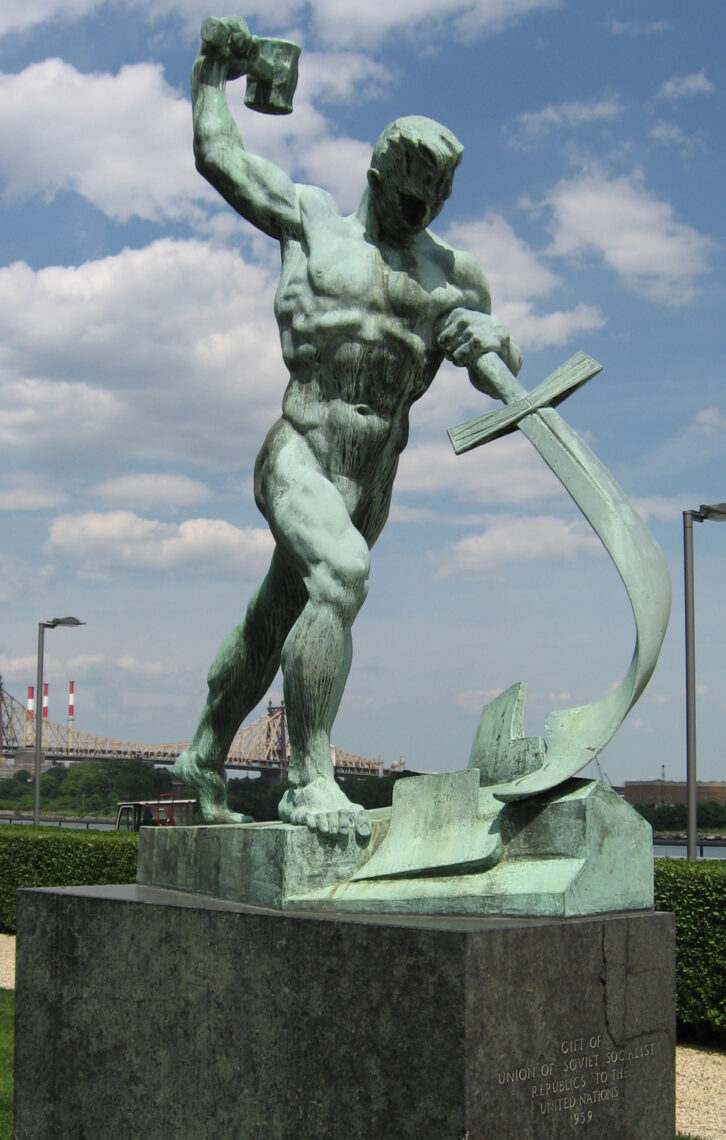
Virtually all the good we know in our society is today connected in our minds with secular institutions. But nearly all of it traces back to events in Jerusalem in the distant past. We credit our governments, or the UN, with the degree of peace we enjoy. But that organisation was inspired by the knowledge its founders had of the biblical message, as even the sculpture at the entrance (donated by an officially atheistic government) attests.1
If you are musical and have access to a psalter, try singing this psalm. Or sing John Newton’s paraphrase of it (“Glorious Things Of Thee Are Spoken”). Or listen to recordings of the psalm being sung.2 Sometimes the meaning goes beyond the words and can best be heard in song.
Psalm 87 is indeed an odd psalm. Perhaps we have not done it justice, but if it causes us to think back before we move forward, it will have done us good. If it causes us to look forward, to the new Jerusalem, that will be even better.
1 The bronze sculpture “”Let Us Beat Our Swords into Ploughshares,”” was created by Soviet artist Evgeny Vuchetich, and presented to the United Nations on 4 December 1959 by the Government of the USSR.
2 https://www.youtube.com/watch?v=nVyeGVxmv7E https://www.youtube.com/watch?v=ot_Irw2aH0M