
One hundred years ago this past June, disciples of Christ began meeting at this place, to worship God, to honour their Lord, to announce the good news, and to love each other.
For a century of time they have worshiped, fellow-shipped, and evangelized. Relationships on every level have been richly blessed. Today, we gather to remember, worship, share, and to rededicate ourselves to the cause of Christ.
BEFORE
Strathmore emerged from a rich history experienced during the previous century. As the country struggled to recover from the ravages of the War of 1812, in Toronto, then known as “York,” two young men from Ireland, who had Anglican influences in their lives, read the scriptures and determined that they should be baptized. Each baptized the other, in the Toronto harbour!
One of these, James Beaty by name, began meeting with a group that identified as “Disciples of Christ,” in the home of James Armstrong. (In 1834, “Toronto” incorporated with 1,000 residents.) Then in 1841, the group assembled in a church building formed from two homes joined together, on the corner of Shuter and Victoria Streets. With Beaty’s support, in 1862, a brick building was erected on Louisa St. Across the front of this building, carved in stone, was the scripture, “IF YE CONTINUE IN MY WORD, THEN ARE YE MY DISCIPLES INDEED,” Jn. 8:31. Then in 1876, leaving the Louisa St. building, as required by James Beaty, now a lawyer and member of parliament, the congregation moved to Albert Hall, then to Temperance Hall, then to Alice St. The Louisa St. building was finally razed in 1884, and the engraving was stored in a work yard. Forty years later, in 1924, 62 years from its first installation, it was retrieved and incorporated in the Strathmore building! Disciples of this influence also later worshiped at Bathurst St., (1902), and Bayview Ave, (1945).
Influences from east Toronto, however had the more direct effect on Strathmore’s beginnings. Moving from Meaford, on the Georgian Bay, where a congregation after the New Testament order had been meeting since the early 1800s, came in the 1890s the Trout and Duncan Stirling families (cf. Harriet (Trout) Stirling, one of Canada’s first female doctors). Meetings were held first in the Stirling home on Main St. (Samuel Keffer, Beamsville, held a meeting here.) Then a group of disciples met in a hall owned by Edward Trout, at Main and Swanwick Sts. Included in the “East Toronto” fellowship with Ralph Schell, preacher, were Alfred Firth, from Meaford, (who had attended the Beamsville Bible School), and Annie Jones (husband, Alexander) who conducted a popular Bible school in her house at 183 Gillard Ave. Five blocks away, on the corner of Coxwell Ave. and Strathmore Blvd., an open field
at the time, Ralph Schell pitched a tent, in late 1923, and conducted a gospel meeting. Eight surrendered in baptism. Schell then promoted the beginnings of the Strathmore Blvd. Church of Christ.
Plans were laid for the construction of a brick building. A Sunday school was promptly begun, temporarily conducted in nearby Earl Haig School, and directed by Alfred Firth. The East Main property was given to the new work. The Shuter St. engraving was retrieved from its work yard and incorporated in the front of the building. Brick laying was done by Colin Cameron, expert brick mason, of the Wychwood Church of Christ. The cost of the building was $18,000.
(The choice was made to locate the building on the side street, Strathmore Blvd., rather than on the main corner, Coxwell Ave. — looking forward to the future when a more commodious building might be erected. That time did not come. Necessity required that the corner lot be sold, and Strathmore settled into its permanent location. Five sister congregations shared a similar experience in Toronto!)
1924
The Strathmore Blvd. Church of Christ opened on the first day of June, 1924. Edna Wade was the first convert, age fifteen, and eighteen new members were added the first year. Bertha Brooks and Edie Doherty were early members. First memories center in the preachers and teachers who served. D. H. Jackson served as the first full-time preacher; (he passed away in one year in 1925). Maitland Watterworth, Earl C. Smith, and Kenneth Carl Spalding followed. Wallace Cauble served during 1928-33. Then came Madison Wright, F. L. Brooks, and W. G. Charlton. J. Scott Greer preached during 1936-39.
The church building was extended in the early ‘forties. Five classrooms were added on the lower level, and an apartment for the preacher’s family was provided on the upper level. It was reported that member, Joe Ewing, worked hard on the improvement. (He and his family lived at 364 Strathmore Blvd. We note that the church building is at 346 Strathmore Blvd.)
During the ‘forties, came Jack McElroy from Tennessee, whose stay was cut short, but who contributed to the placement of the next four preachers at Strathmore, whom he recruited and gave some training. (McElroy would return for “gospel meetings” at Strathmore and elsewhere in the province.) These four were Raymond Crumbliss (1940-1943), Charles Lemons (1944-1946), Ernie Fletcher (1947), and T. J. Mitchell (1947-1950). Charles Lemon’s wife was “Nellie,” and Ernie Fletcher’s wife was “Mitylene.” T. J Mitchell arrived as a bachelor and married a Strathmore member, Olive Peddle, daughter of Munden Peddle. Brother Peddle was in charge of the Sunday-school program, which featured on the lower floor a six foot stand and a projector that used glass slides for singing—as I remember. (These four preachers impacted my life in significant ways. GHE)
[My personal experience, 1943-1950, GHE]
[In early August, 1943, I, with my brother, David, and mother, Mary Ellis, began meeting with the saints at Strathmore. We had moved from Hamilton where for three years we had attended the Sanford Ave. Church of Christ. This had been possible because of the kindness of Alex Fisher who drove us to meeting each Sunday. There, David was baptized by Lemuel Keffer. And there, I became impressed by the message of the 4’x8’ sign hanging from the ceiling, “One Lord, One Faith, One Baptism.” Brother Fisher also made it possible for David and me to attend Omagh Bible School for two years, 1942 and– 1943. I was baptized by Raymond Crumbliss in the Sixteen Mile Creek at Camp Omagh in July, 1943, two months away from twelve years old. For seven years, 1943-50, my teen years, my life was shaped at Strathmore. The four preachers, cited above, were good men, who had a distinct influence in my life, contributing, no doubt, to the direction I chose in later years. In late summer, 1950, Ed Haufschild, highly regarded at Strathmore, drove me and my five suitcases, to the bus station in Toronto, on my first trip to Abilene, Texas, and Abilene Christian College, where I hoped to prepare for a life of preaching.]
Robert McCready was the first “son” of Strathmore to preach for the congregation, having studied at David Lipscomb College, in Nashville, Tn., and serving 1950-54. His wife, “Reathel,” was well loved. Robert was followed by Ralph Perry, who grew up in Tintern, Ont., and who also studied at Lipscomb. Ralph married Joyce Dale, daughter of Herbert Dale of Strathmore. Ralph, who served Strathmore, 1954-1960, was well known for the Sunday School program he developed at Strathmore, where over 200 students were enrolled at one time. Ed Bryant preached at Strathmore, 1960-69.
From Strathmore, members went out to plant new congregations: in 1954, to Ajax, Ont., John Sanna and his wife, Ardath (Stevenson); and in 1969, to Bramalea, Ont., Fred Whittington and his wife, Thora (Stevenson).
1964
Strathmore celebrated its 40th anniversary in 1964. The preacher in 1964 was Ed Bryant. He preached during1960-1969. The elders then were George Barber, Ed Haufschild, and Grant Stevenson. To commemorate the occasion, a large montage was prepared and hung in the entrance-way, picturing the history, leadership, and outreach of the congregation. (The lettering was done by Ed Bryant and the framing by Fred Whittington.) This included the pictures of eleven young men who had, by then, gone out from Strathmore to preach the Gospel; (added here are places where these men went to preach): Walter Dale (GLCC, Niagara Falls), Geoffrey Ellis (GLCC, Waterloo), Howard Ewing (California), Roger MacKenzie (Georgia)*, Victor McCormick (Ohio)**, Robert McCready (Alabama), Ronald Meecham (Pennsylvania), Louis Pauls (Meaford), Arthur Peddle (Michigan), Bert Thompson (Kingston), and Blenus Wright (Thunder Bay). (*Roger, while preaching in Georgia, baptized a young lady who would later become my (GHE) son’s wife while at Harding College. **Vic was still preaching at age 85, in Florida.) Pictured were Strathmore’s older members: Alfred Firth, Daniel Yake, O. H. Jackson, Bert Noad, Edna Weir, Wm. Houlgrave, Violet Grey, Kate Jordan, Bertha Brook, and Edie Doherty. The most recent baptisms are pictured, Al and Joanne Parker.
In 1970, the exterior stairway entrance was replaced by an enclosed access to the two levels. The dedication of the new entrance was held on October 4. Present at the ceremony was Colin D. Cameron, son of Colin Cameron, who engaged in the building’s construction in 1924. Although somewhat obscured by the addition, the engraved scripture, John 8:31, is still readable. A time capsule was included that contains a poem written by Anita Harris. A gospel meeting was then begun, by Charles Lemons. Unfortunately, this was cut short because of illness in his family; Murray Smith concluded the meeting. Elders at the time were John Cargin.
1974
The fiftieth anniversary came in 1974. At that time there were 125 members. The elders were John Cargin (his wife, Margaret, was from Meaford), Charles Harvey, and Grant Stevenson. Marvin Johnson, of Winnipeg, was preaching then, and served in this roll during 1969-82. He then served a
number of years as an elder. Marvin Johnson was followed by preachers, Mark Bryson, Roy MacDonald, and Jonathan Tabije.
Strathmore established its Hispanic ministry in 1986, supporting an active Hispanic ministry. Santiago Molina, of Honduras, arrived in June, with his family arriving in June. Santiago Molina became the full-time minister in this work. (Santiago had a part in establishing the Ibero Americano Encuentro ministry, an annual gathering of believers in Central Americano.) The first Spanish speaking meeting at Strathmore was held in the lower auditorium on November 16, 1986, with 11 people in attendance. Since then, the Spanish group has grown to 40+ and is a vibrant part of our congregation. The Hispanic fellowship at Strathmore was the first of the multi-cultural fellowship that would subsequently develop. The Hispanic services are held Sunday afternoons. Marlon Molina is following his father’s steps as he preaches in both languages, and manages the Key to the Kingdom program.
With elders now William Harvey and Marvin Johnson, beginning in 1987, and serving Strathmore for the next 30 years, was Max Craddock, with his wife, Cledith. Max thus holds the record for years preached at Strathmore, from 1987 until his semi-retirement on June 20, 2017. Max came to Canada as a 19 year-old, from Ohio, to serve the Sanford Ave. Church of Christ in Hamilton. He went on to preach at Fenwick, serve as Dean of Boys at GLCC, and plant a church at Grimsby. At Strathmore, in 1992, Max coordinated the “Good News is for Sharing” effort, a project that attempted to place a teaching tract in every home in Canada. This was an extension of the American, “One Nation Under God” effort, re-titled to match Canadian perceptions. (Arthur Peddle, a Strathmore “son,” preaching in Cookeville, TN, at the time, was engaged in the American effort.) Then, in 1994, Strathmore supported the American effort to launch a Canadian-wide TV broadcast, as an extension of the American nation-wide program, “Key to the Kingdom.” Then, in 2005, with Max Craddock doing the preaching and co-ordinating, Strathmore took on responsibility for the Canadian-wide program. Max was known for his service as a church planter, Christian educator, Christian journalist, and as a media evangelist.
1999
The 75th anniversary took place in 1999. To celebrate that occasion Audrey (Haufschild) Wright, wrote, “Remembering 62 for ‘75.” Several of these memories are included here: “Raymond Crumbliss baptized her (Audrey’s) mother. Charles Lemons baptized her father, Ed Haufschild. Reathel McCready taught art as well. Sunday School was at 3:00 pm. Olive Peddle married the preacher, T. J. Mitchell. We would rent a street-car to take us to the picnic at High Park. Clarence Peddle went to Harding College, and came home, “Arthur.” Goldie Tallman did the painting over the baptistry. The apartment rooms upstairs in the church building became classrooms. John Sanna taught Friday night Young People. One meeting had Jack McElroy, S. H. Hall, Roy Osborne, and William Madearis preaching in a two week effort. Wendell Stevenson and Glenda Doherty married. Audrey Haufschild and Blenus Wright married in 1955. Preacher Ralph Perrry would scrub the basement floor Saturday nights. Strathmore hosted the “June Meeting” at Eastern High School. At the Mutual Arena roller skating, Chuck Harvey met Joyce; Roger MacKenzie met Marie Carlisle.”
Max Craddock continued preaching at Strathmore on occasion during his semi-retirtrathmore continues to supportement, as well as speaking for Key to the Kingdom until close to his passing on December 15, 2019.
2004
Key to the Kingdom was first shown in Canada on the Vision Network in 1996 when it was the product of 16th and Pile congregation of the Church of Christ in Clovis, New Mexico. The speaker during that time and until Nov. 2004, was Michael Tackett. Then Strathmore aired the first Canadian production in March, 2005, with Max Craddock the speaker. Max then taught the Canadian programs of the Key to the Kingdom, a new lesson every week, even after his retirement, from that time until his passing, December, 2019. Bob Hibbard also recorded lessons for Key to the Kingdom before his passing. Strathmore continues to support Key to the Kingdom through television, and plans to continue reaching out through social media in the future.
2014
In October, 2014, Max received an invitation to visit Harding University, Searcy, Arkansas. He was invited to share a description of the Strathmore Church of Christ, with particular attention to the multiplicity of ethnic groups then sharing in the congregation’s fellowship—which at the time was reported to be thirty-five! This was considered as being both remarkable and laudable.
Bob Hibbard was Strathmore’s preacher from June, 2017 until he and his wife, Debra, went in 2020 for advanced Biblical studies at Southeast Institute of Biblical Studies in Tennessee. They studied there from from July, 2020 to June, 2022, when they returned to Toronto and Strathmore. They resumed their work with emphasis upon both the local community as well as cross-Canada outreach through Key to the Kingdom. Sadly, Bob passed away on October 31, 2022. Debra continues that local outreach with the assistance of local members. This outreach has resulted in several recent baptisms.
Tony Brewer was the preacher in 2020 and 2021. With the arrival of the Covid pandemic, government health mandates limited the numbers who could assemble. Worship services were broadcast on the internet, with a limited number permitted to attend in the building. While Covid is largely behind us now, that was a disruptive time in our century’s experience! Sadly, several of our leaders have passed away recently: Santiago Molina, Hispanic evangelist, Oct. 2020; Peter Dwomoh, elder, Mar. 2022; and Marvin Johnson, preacher and elder, May, 2022. Currently, the elders at Strathmore are Stephen Gill, Moises Velasco, and Jean Volcy; and the deacons are Kwabena Akuoko, Edward Brown, Gerry Ellis, Leo Razon, and Immanuel Velasco. Starting in 2021, several men of the congregation started taking turns both in teaching and preaching. It was discovered that Strathmore is gifted with several men who are very good preachers! Strathmore is blessed by all who serve! Specific ministries have been established: Families and Visitation, Evangelism, Edification, Administration, Information, and Technology. The search for a full-time evangelist continues.
In recent times, the congregation has conducted the following seminars: “Congregational Evangelism,” with speaker, Matt Wallin, Sept. 29-Oct. 1, 2023; “Personal Evangelism,” with speaker, Austin Fowler, Mar. 29-31, 2024; and, “What We Believe,” with speaker Robby Eversole, May 31-June 2, 2024.
Attendance figures currently are (average): English, 147; Spanish, 40. On the last day of each month a combined English and Spanish service are conducted, with an average 180 in attendance.
Not one brick of the Strathmore church building is sacred. Yet, together the bricks of the building located at 346 Strathmore Blvd. have provided shelter for the saints who have been gathering in this place now for 100 years. These believers “…like living stones, are being built into the spiritual house to be a holy priesthood, offering spiritual sacrifices acceptable to God through Jesus Christ.” (I Pet. 2:5)
“Then I saw another angel flying in midair, and he had the eternal gospel to proclaim to those who live on the earth – to every nation, tribe, language, and people. It said with a loud voice, “Fear God and give him glory, because the hour of his judgment has come. Worship him who made the heavens, the earth, the sea, and the springs of water.” Rev. 14:6-7.
Give God the glory!
Presented by Geoffrey Ellis, September 21, 2024
Note: With appreciation to the CANADIAN CHURCHES OF CHRIST HISTORICAL SOCIETY.
TWENTY-ONE THINGS THAT HAPPEN AT BAPTISM
Baptism, and God the Son
The car’s ignition draws my attention: multiple circuits spring together into action when the ignition is turned on, and these circuits interact so that the car “runs!” While a limited analogy, this intricate cooperation reminds me of the shared actions of the Persons of the God-head at baptism, as they together bless the person being baptized. Baptism is a very special event, both because of the presence the three members of the Godhead, and because, now and beyond, they bless the candidate in multiple ways, as a new and blessed life begins!
This begins the Gospel Herald’s study, “Baptism, God’s Moment of Grace: Twenty-one Things that happen at Baptism.” The study will be given in three parts: 1. Baptism, and the Son; 2. Baptism, and the Spirit; and 3. Baptism, and the Father.
That the three members of the Godhead are present when baptism takes place might come as a surprise. Indeed, there is more going on at baptism than “just getting wet!” or, than “meets the eye!” Begin with the concept of the “omnipresence” of deity as well as the “omniscience’” and “omnipotence”” of God presented in Scripture, and be prepared for mind-expanding insights. Continue with thoughts of “forgiveness,” “cleansing,” “justification,” “sanctification,” and “indwelling!”
Each of the three studies will feature the blessings in baptism that, as noted in the Scriptures, are associated with the particular Person of the Godhead identified.
II. Baptism. and God the Spirit
While this will sound extravagant in the extreme, the Attention of the Ages was drawn, on that day in July, 1943, to a rural location on the Sixteen Mile Creek, near Omagh, Ontario, where Raymond Crumbliss, evangelist with the Strathmore Blvd. Church of Christ, in Toronto, was about to baptize me, a nearly twelve-year old boy, in the name of the Father, the Son, and the Holy Spirit.
While the activity taking place would perplex the casual bystander, there were few witnesses. And most of these were young people, perhaps also somewhat puzzled by the proceedings. Indeed, it would take me a lifetime, and beyond, to understand the preciousness of that moment, and the significance of that occurrence. Yet, excitement in heaven surely marked that event as “timelessly precious!”
Immersed in the murky, shallow, lukewarm waters of that rural creek, Christ, the Son applied the soul-saving benefits of his shed blood, delivered on the cross, where, at this remarkable meeting, Jesus became my Lord, for a life-time and for eternity. His presence and action were also graced by that of the Holy Spirit, and of God the Father!
Grace was present in total abundance on that occasion, with the implication that grace would be present for a lifetime, and beyond.
This study is about the moment of grace experienced at baptism, grace generously given in unison by the three Persons of the Godhead, grace that blesses one’s life on earth and beyond.
8.And it is also the Spirit who baptizes into one body.
9. Baptism is the climaxing work of the Spirit who convicts.
10 It is at baptism that the Spirit creates new life.
11. Baptism is the gracious work of the Spirit in justification.
12. Baptism begins the sanctifying work of the Spirit.
13. Christian baptism is with the Spirit.
14. At baptism the Spirit takes up his work as the indwelling presence of God
III. Baptism, and God the Father
We must ask the question, “Does baptism save?” Certainly, there is no special spiritual power in that remarkably powerful H2O that amply blesses and distinguishes this planet, to effect spiritual cleansing. And no credit can be earned by one’s simply making the decision to accept baptism. Indeed, theologians warn that to credit one’s obedience in baptism as the reason for “forgiveness” would amount to “work’s redemption,” a no-no in our faith-system, we are reminded. And from the consistently passive state that prevails during baptism’s enactment, there is little evidence to indicate any spiritual change—on earth or in heaven!
Yet, what if God elects to meet you at a baptismal site at a time and place of your choosing! For truly, He does! This is grace in action! God’s omnipresence means that the most obscure pond is no problem for Him. God’s omniscience means that the request of the humblest person is instantly monitored. And Christ has promised to meet the penitent sinner in the watery grave of baptism, bringing forgiveness. And here, the omnipotence of God is in evidence. These following scriptures, from the apostle Paul’s teaching, were noted in our first study: Colossians 2:9: “…having been buried with him in baptism, in which you were also raised with him through faith in the powerful working of God, who raised him (Christ) from the dead.” And Romans 6:3-4: “Do you not know that all of us who have been baptized into Christ Jesus were baptized into his death? We were buried therefore with him by baptism into death, in order that just as Christ was raised from the dead by the glory of the Father, we too might walk in newness of life.” Note that both passages say that Christ is WITH the one being baptized!
Quite accurately then, while baptism in itself does not save, Christ’s promise to be present at each baptism to apply his saving grace means that salvation is found IN baptism! God has determined that the starting point in the new life for all Christians is at their new births, at their baptisms. This is where Christ’s sacrifice of blood washes them from their sin, thus beginning their new lives in the family of God!
15. It is God the Father who administers baptism.
17. In baptism one is raised by God with Christ, that is, to newness of life
a. Col. 2:12having been buried with him in baptism, in which you were also raised with him through faith in the powerful working of God, who raised him from the dead.
18 It is in baptism that God gives his Holy Spirit to the obedient believer
19. It is in baptism that God cancels the certificate of our condemnation
21. Salvation is offered through baptism, “in the name of the Father, the Son, and the Holy Spirit.
. . .Conclusion:
“Baptism, the moment of God’s grace: twenty-one things that happen at baptism.”
The word “baptism” and its derivatives occur 104 times in the New Testament, according to the concordance that I consulted. In this study, we examined 25 scriptural uses of “baptism,” focusing on God’s grace. Baptism is a big subject in Scriptures, and for our lives! Because the Scriptures teach that every Christian’s life is to begin at baptism, it is a subject that deserves our study, our wonder, our gratitude, and our compliance!
McPhee concluded his nine years of work in Beamsville in 1945, and moved to Toronto, to serve the Bayview Ave. Church of Christ. His home address was 18 Banff Rd. He spoke often on the radio station, CKEY. He remained in that work for three years, returning to Jordan in 1948. “My three years in Toronto have not been fruitful.” He had to sell his home in Beamsville to go to Toronto, leaving him short, $2,500. (His daughter, Rosalie, age 16, spent a year at the David Lipscomb College high school during this time.)
From Toronto, C. G. preached at Jordan for a year, ’48-’49, but found it necessary to conclude this work there. He returned to Meaford in 1949, where he served the second time, from June 4, 1949 until June 1, 1952.
GLCC opened in the fall of 1952, enrollment 14. By the third year, 1954, enrollment had grown to 53. However, in October, 1954, the announcement came that McPhee would leave his post as president. The Nov. issue of the Gospel Herald announced, C. G. McPhee “to preach full-time.” No explanation was, or has been, given re this decision.
Gordon, while president of GLCC, returned to Nova Scotia, in 1953. This was the first time since leaving in 1915 that he had returned to his birth place, having been away 38 years. In Truro, he visited his brother, Henry and wife.
McPhee was preaching for the St. Catharines Raymond St. congregation in 1955 when the addition of Sunday school rooms was begun. This involved the raising of the building and placing the classrooms in the lower area.
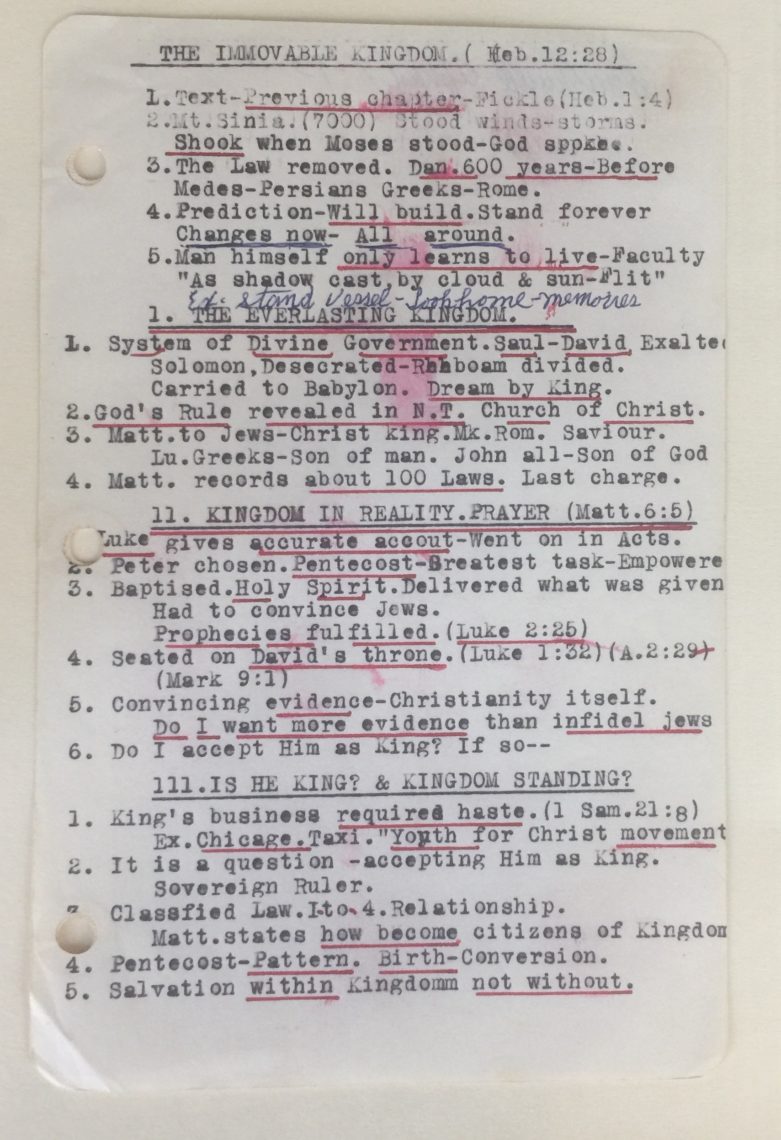
In about 1955, C. G. began preaching from small one- page, typed outlines. (No evidence has been found of his sermon notes practice, during 1920-1955, following his hand written, longhand, work book sermons, used up to 1920.) These later sermon notes were on 7 ¾” X 5” pages, punched for a small three-ringed binder. The sermon outlines are type-written, using black/red typewriter ribbons so that he could highlight or underline in red, the special emphases of the lesson. The outlines typically contain: title and Scripture text, (usually one verse), with usually three main points. On these pages, C. G. would note the time and place of their delivery. The McPhee files include 260 sermon outlines, with 453 times preached (and where) noted. While most sermons were preached only one or two times, C. G. did have his favourites: e.g. “Rightly Dividing the Word,” eight times; “Revelation,” eleven times; “Namaan,” twelve times; “Has Christ Failed?” 16 times; and “The Great Salvation,” 29 times! The city where C. G Mcphee preached the greatest number of times was St. Catharines: Raymond and Beecher, 70 sermons; Ontario Street, 69, for a total of 139. (Strangely, no reports of lessons delivered at Niagara Street were found.)
In 1956, C. G. went to Nova Scotia, where he preached for three Sundays, beginning Sept. 16: “The church has revived at Mill Village where I did some preaching.” Also, at Nine Mile River, he went “to stir up some interest, where I preached my first sermon.” And then to Halifax, where he began Oct. 7, 1956, for a dozen lessons and radio sermons. Later in 1956, McPhee visited the Manitoulin Island, and preached at Ice Lake, Nov. 18, and Little Current, Nov. 14.
Then in 1957, he went to St. Johns, Newfoundland, July 7-21, preached 20 lessons, and every week on the radio. He also returned the next year, 1958, to St. Johns, Nfld., preaching, June 1-22.
There are a few funeral records in the files: the records do not include a complete account of the many times he was called to bring solace to family, friends, and strangers. (In October 2, 1958, McPhee conducted the funeral service for my grandfather, William Patterson,)
1959 was a full year for Brother McPhee: delivering 187 sermons, 30 radio sermons, and a meeting in Beamsville, Oct. 18-30, including 18 lessons.
In 1960, McPhee conducted a meeting at Meaford, Oct. 3-12, preaching 12 lessons. He held meetings at Ice Lake, on the Manitoulin, Oct. 3-12, delivering 11 lessons.
In late 1960, while McPhee was conducting the meetings at Meaford, he phoned home to announce that the Raymond and Beecher and Niagara and Manning congregations would join forces. On Dec. 4, 1960, the Niagara and Manning members moved “in a body.” The merged church totaled 150 members. By April, 1961, attendance averaged 172, and they were “looking for a suitable lot” for a new church building. C. G. McPhee had now been with the Raymond and Beecher congregation since the fall of 1954.
During 1961, C. G. conducted a meeting in Ottawa, preaching 12 sermons, June 11-21. Also, he preached a meeting at Griersville, July16-26, including 11 services, where there were 4 baptisms.
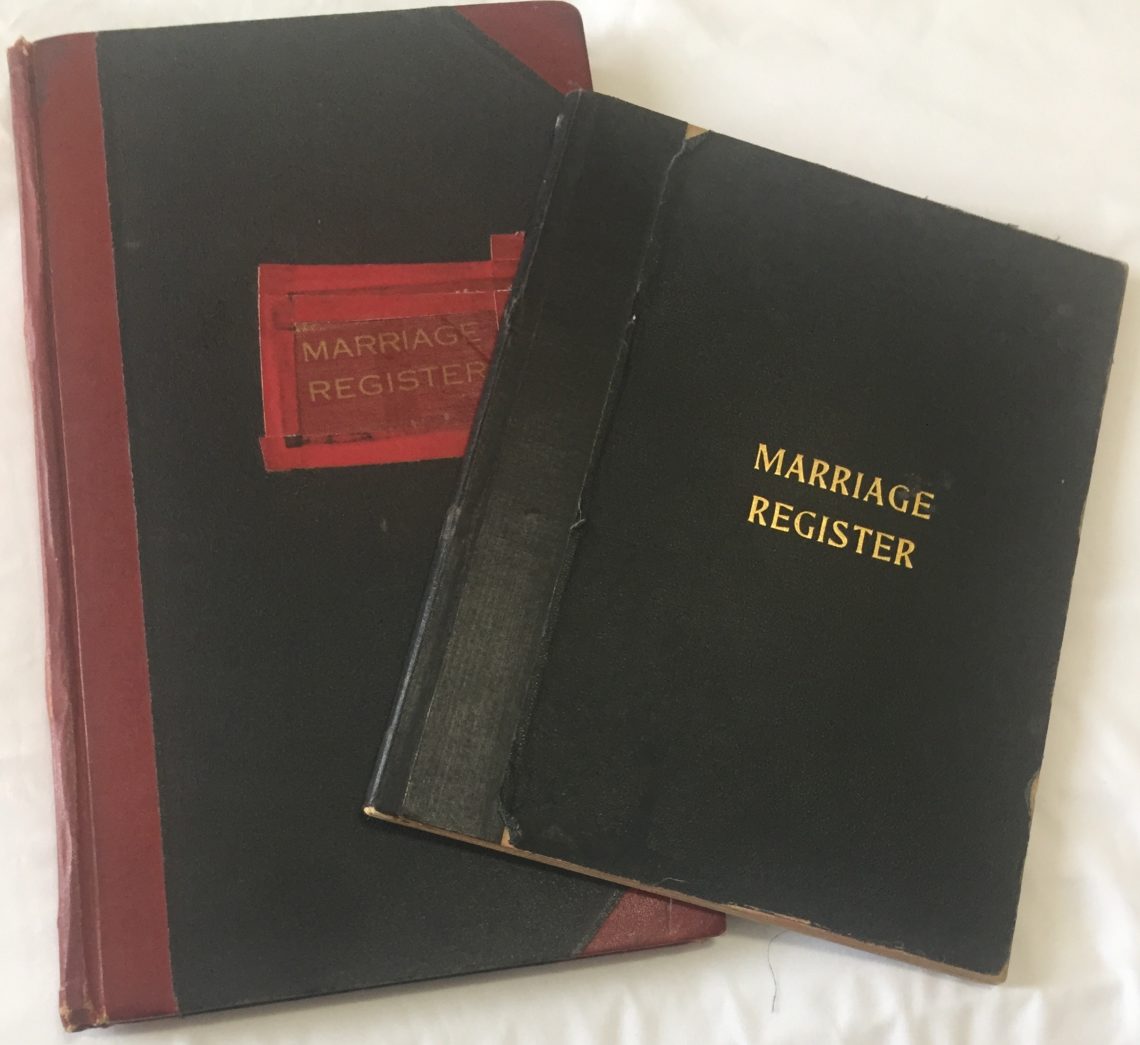
Pictured are McPhee’s Registers of Marriages: the top registry includes 100 registrations—Oct. 5, 1921-Oct. 10, 1942; the bottom, 153 registrations—Oct. 24, 1942-Jan. 20, 1979; 253 weddings in total. (In addition, for whatever reason, there were weddings at which C. G. officiated that are not registered in these books (cf. mine in Dec. 1952, as an example!)
On Friday, Feb 23, 1962, “C. G. suffered a severe heart attack.” He would not preach again until May.
He recovered and preached for another 17 years.
Gordon and Grace celebrated their 40th wedding anniversary, June 16, 1962, inviting their friends to their home, afternoon and evening, at 4 Fawell Ave. in St Catharines.
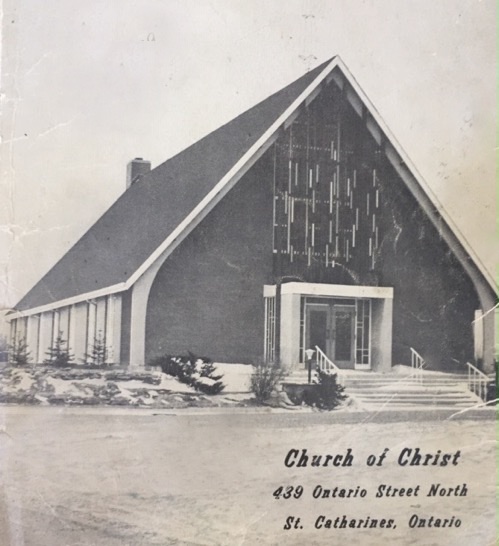
During the summer, 1962, two acres were purchased on Ontario St. N, in St. Catharines, for a new church building. On October 12, the digging of the basement was begun. Members from the congregation directed the construction: Gordon Stewart, Loney Wallace, Jim Allcock. The building was designed for a 350 capacity; to cost $90,000,
On May 29, 1963, the Raymond and Beecher building closed, and on June 23, the Ontario St. building was opened.
The Gospel Herald in 1963, reported, “St. Catharines Opens New Home; Open house held June 23, 1963.” Also reported, June 2, “June Meeting, 1,000 present.” That June 2-21, McPhee preached 7 radio sermons. Later that year, he returned to Nova Scotia, to Mill Village, Sept. 25- 29, delivering 6 lessons, and to Halifax, Oct. 2-6, for 6 lessons.
During 1964, McPhee held a meeting at Ice Lake, Manitoulin, May 3-16, giving ten lessons. McPhee preached regularly over the radio from the mid-1940s: St. Catharines, CKTB; Toronto, CKEY; Owen Sound, CFOS. He was the second preacher, after W. F. Cox, to preach over the radio for Churches of Christ in Ontario.
In April, 1966, the Ontario St. elders made the decision that Charles Gordon McPhee should retire from his full-time responsibilities as preacher with the Ontario Street congregation. They offered to provide him a pension of $200 a month.
In April 16, 1967, Gordon McPhee reported, “Last day of regular work, four years, one month,” i.e. with the Ontario St., St. Catharines congregation. However, he kept on preaching! His records for the rest of that year (1967) list 24 sermons preached in eleven churches! Then for the next twelve years, this record exists: an average of seven congregations a year visited, with an average of 58 sermons per year preached.
Summary of preaching for the following years, 1968-1979:
1968: 9 churches, 104 sermons 1974: 9 churches, 78 sermons
1969: 9 churches, 116 sermons 1975: 7 churches, 101 sermons
1970: 9 churches, 79 sermons 1976: 11 churches, 82 sermons
1971: 4 churches, 57 sermons 1977: 3 churches, 87 sermons
1972: 8 churches, 128 sermons 1978: 7 churches, 82 sermons
1973: 7 churches, 62 sermons 1979: 2 churches, 42 sermons
Congregations in Ontario that C. G. McPhee served during this period, 1968-1979, include: Blair, Harding Ave (Toronto), Fenwick, Griersville, Heathcote, Ice Lake, Meaford, Newmarket, Omagh, Pine Orchard, Ontario St (St. Catharines), Port Colborne, Smithville, Strathmore Blvd. (Toronto), Tintern; and also, Halifax, Mill Village, NS, and Lachine, Que. (The preaching of these sermons – each required travel from his home base in St. Catharines.)
During the twelve years of C. G. McPhee’s “retirement,” he preached an average of 77 times a year, to an average of seven different congregations per year.
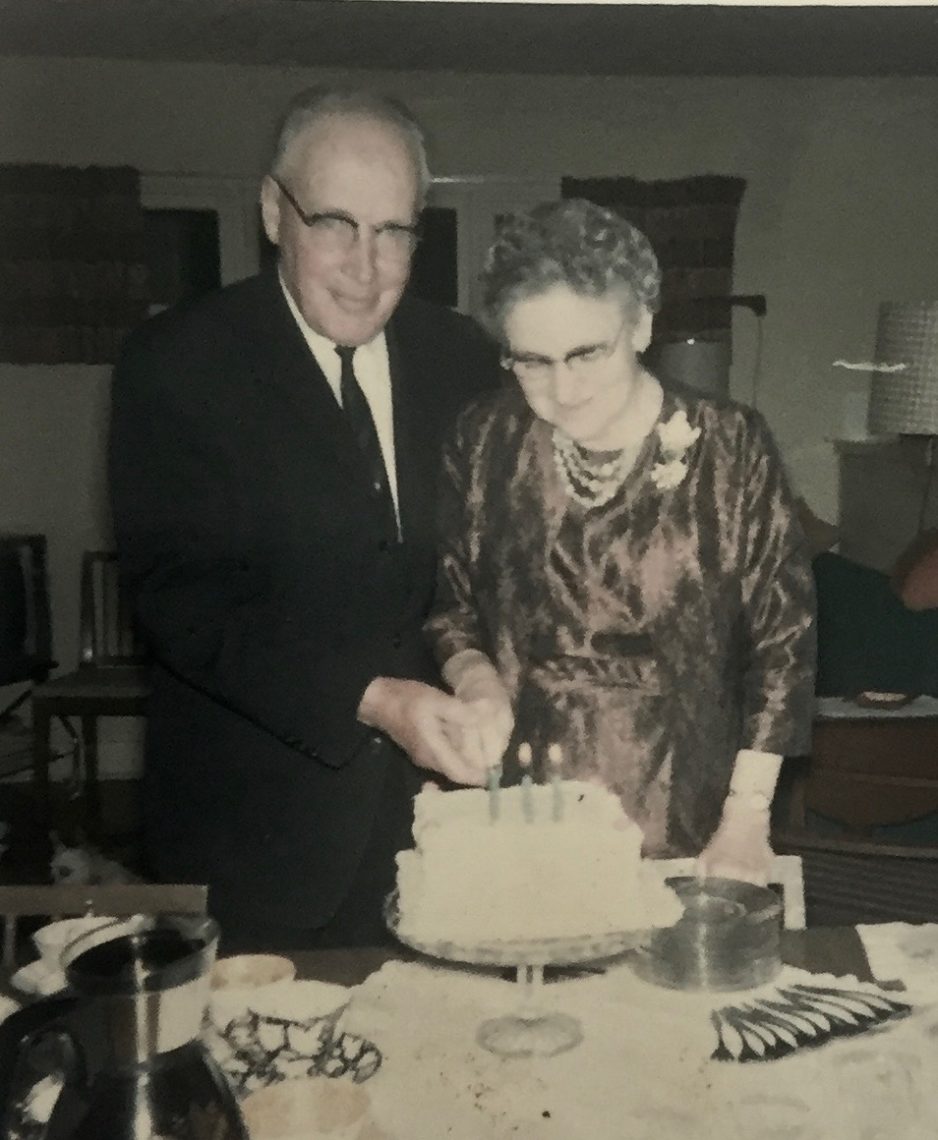
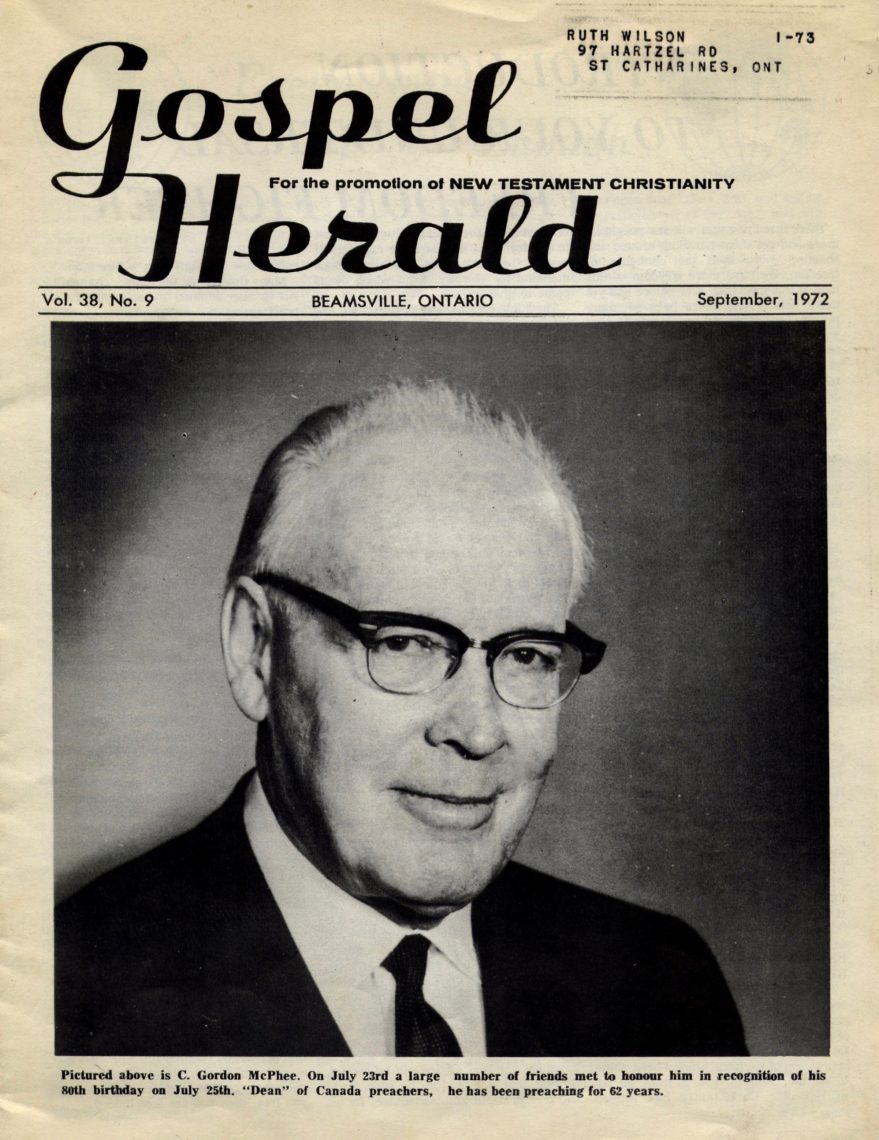
1970 was a special year for C. G. McPhee. A celebration of his life and ministry was held May 22, at Great Lakes Christian College in Beamsville, attended by 275 people. The gathering was reported in the Gospel Herald, Aug. 1970, issue, p. 12. It was remembered when McPhee was the only full-time evangelist for the Churches of Christ in Ontario. The next month, a colleague of McPhee’s, Walter Dale, wrote a tribute to McPhee, entitled “Well Done,” tracing McPhee’s fifty-five years ministry in Canada (Gospel Herald, Sept. 30, 1970).
Gordon broke his ankle, Jan. 31, 1976, and didn’t preach until April 11.
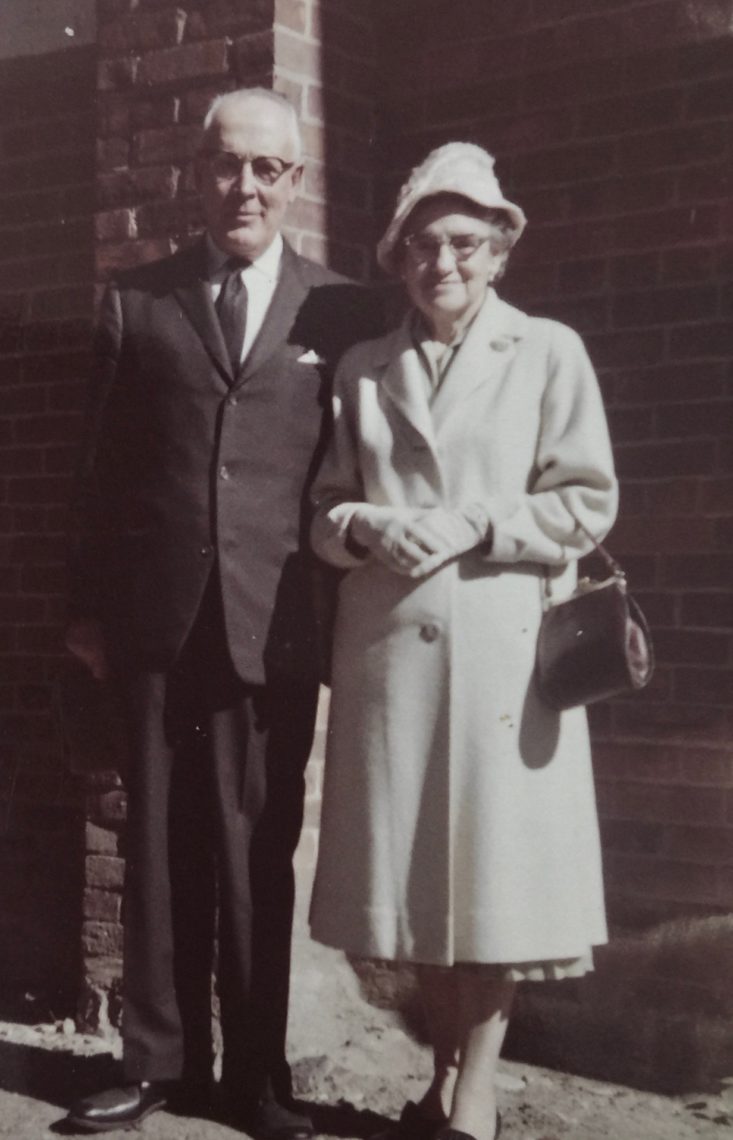
Grace McPhee passed away July 23, 1972, (born Nov. 23, 1893), age 79. (Her obituary is in the Gospel Herald, Sept. 1972, p. 17.)
Charles Gordon McPhee at the end of his life, said: “My whole heart has been involved in preaching the Gospel. I believe the Gospel is the power of God. Always have I felt that it is my responsibility to preach the word of God. My responsibility is to the Lord and I pray that I may never fail him.”
“On Sunday, November 25, 1979, he preached his final sermon in Smithville, Ontario. Two days later – at age 87 – a fatal heart attack took him to be with his Lord.” – Paul Dale
C. G. McPhee passed away, Nov. 25 1979, age 87 years. He had preached 65 years, (cf. beginning at River John, NS, in 1913; when his preaching was announced in, The Bible Student, “Evangelist.”) Roy Merritt wrote in the Gospel Herald, “The Passing of a Prince.” His obituary is in the GH, Jan. 1980, p. 4, 5.
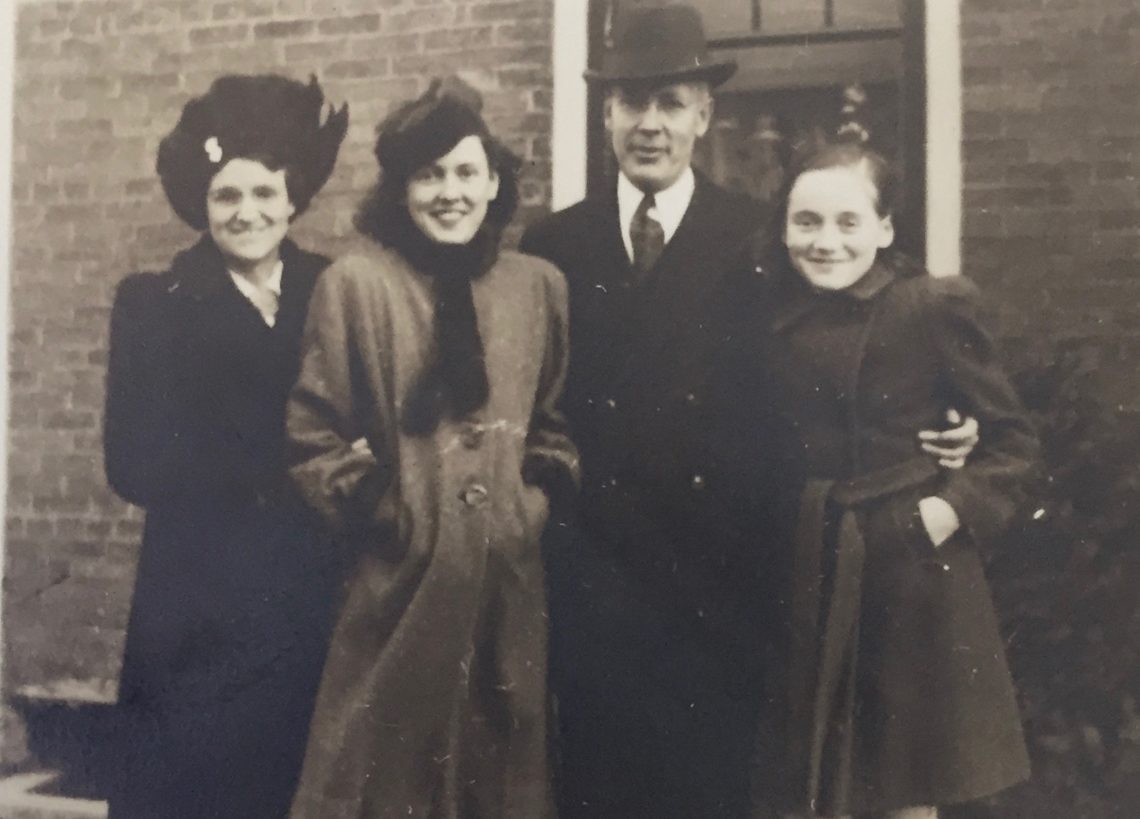
Ruth married Jim Wilson, and lived in St. Catharines; Rosalie married William Kosick, and lived in Colorado. The McPhees had six grandchildren.
“For most of his life he has been a mainstay of the work among Churches of Christ in Canada, mostly in Ontario; but he also served in Carman, Manitoba, and for a few years in the United States in his early years. He is known and loved by literally thousands.”
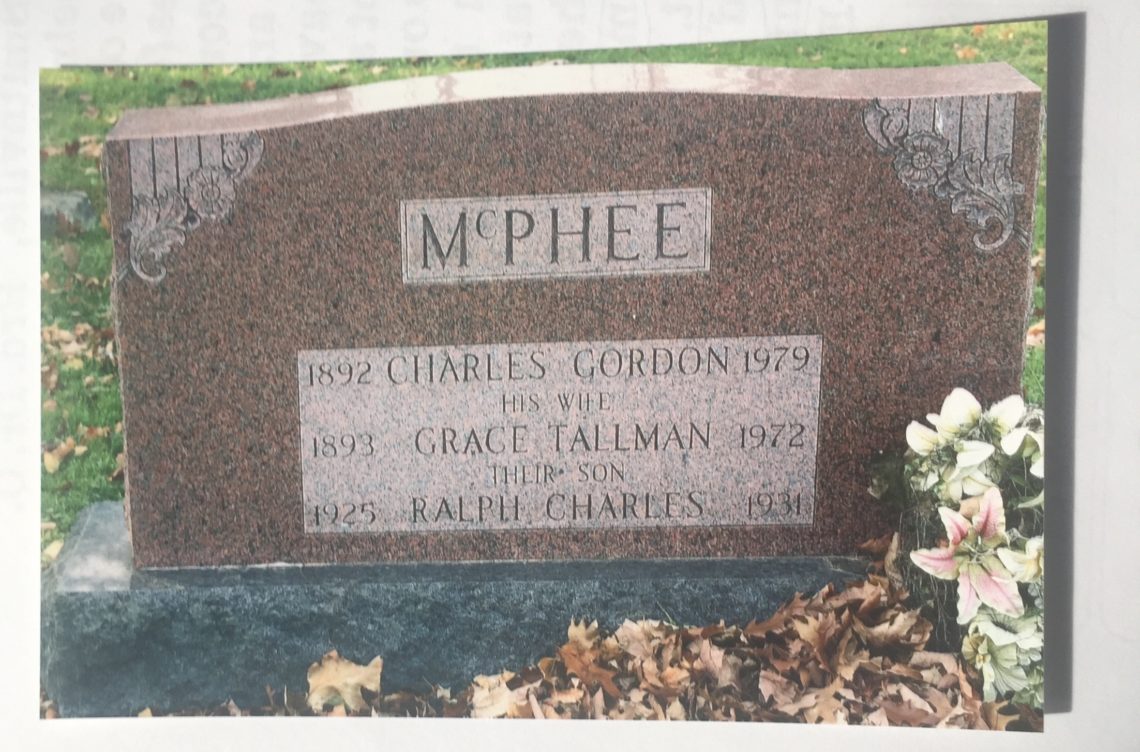
Appreciation is expressed: to Murray Hibbard and the board of the Canadian Churches of Christ Historical Society for making the McPhee files available for this study; to Paul Dale for sharing his repeated researches in the life and ministry of C. G. McPhee; to Ralph Tallman for sharing his 1977 taped interview with C. G. McPhee, and for arranging with Sandy McBay for its recent transcription, with a huge applause for Sandy’s work in her careful transcription of the tape; to my son, Mark (Georgia) for guiding me through the intricacies of Mac computing; to Dave Knutson, editor of the Gospel Herald (online), for his helpfulness in bringing this study to the GH readership.
The five chapters of Charles Gordon McPhee: Canadian Preacher are available in book form. To secure a copy, contact GH Books.
Finally, the unnamed person who shared the unidentified picture at the beginning of this study, was Dave Carruthers, Thorold, Ontario.
A. Peace Maker:
(1) In 1930, G. G. McPhee was invited to return to Carman, Manitoba. The congregation there looked to his leadership to overcome their troubled state that had afflicted them since the last years of the second term of the Carman Bible School, 1921-1927. The school had been reactivated at the urging of H. A. Rogers who saw the value of the first session, from 1899-1902, and the need for Christian education in western Canada. He encouraged H. L. Richardson to take on the task of directing the school. Howard Lipscomb Richardson had grown up in Meaford, where his father was an elder. (The wife of H. L. Richardson was the widowed Goldie Lawson, sister to Grace (Tallman) McPhee.) Richardson had both studied and taught at Beamsville Bible School. Then in 1918, Richardson opened a commercial school in Little Current, Manitoulin Island. This was a Bible school in disguise, for all students were required to take a class in Bible along with their commercial studies. The school was described as a success. The Carman school of the twenties attracted such students as Alonzo Rogers, Wilford Orr, J. C. Bailey, Bethel Vine, and George Johnson. However, Richardson was drawn to the teachings and practices of the Disciples of Christ in western Canada. He left Carman and the Carman school in November, 1926, to join the Disciples movement. The school closed after one more year. But the congregation in Carman remained troubled and divided. They then turned to C. G. McPhee.
McPhee related, (in a 1977 interview), “I spent two months, and got them back together again. They have remained together since, even though reduced.”
(2) Later in 1930, Gordon McPhee moved to St. Catharines (to a new home in nearby Port Dalhousie; and later to the city at 4 Trapnell Ave.) to work with congregations in the Peninsula. Relations at the time were strained between the congregations in Beamsville and St. Catharines, and between the two congregations in St. Catharines, Raymond and Beecher, and Niagara and Manning. McPhee was able shortly to bring harmony between Beamsville and St. Catharines.
The Niagara Street congregation had been formed in 1928 by members from the Raymond and Beecher congregation who saw the need for a second congregation in the growing city. There was estrangement existing between the two congregations. Some in the Raymond Street church viewed the move as divisive. One person described the move as a “swarming.” O. E. Tallman, who had preached for the Raymond and Manning congregation during the twenties, however, encouraged the move, and became the group’s evangelist. McPhee knew the importance of reconciliation and worked for peace between these groups.
Two events occurred that deeply impacted both McPhees and the St. Catharines churches. On November 5, 1930, O. E. Tallman, age 48, died suddenly. Then, on January 19, 1931, Gordon’s son, Ralph, age five years, four months, died, also suddenly, of pneumonia.
O. E. had experienced an appendicitis attack, in 1909 or 1910 in Nova Scotia. A similar attack in 1930 hospitalized him for nine days, when he suddenly died, age 48.
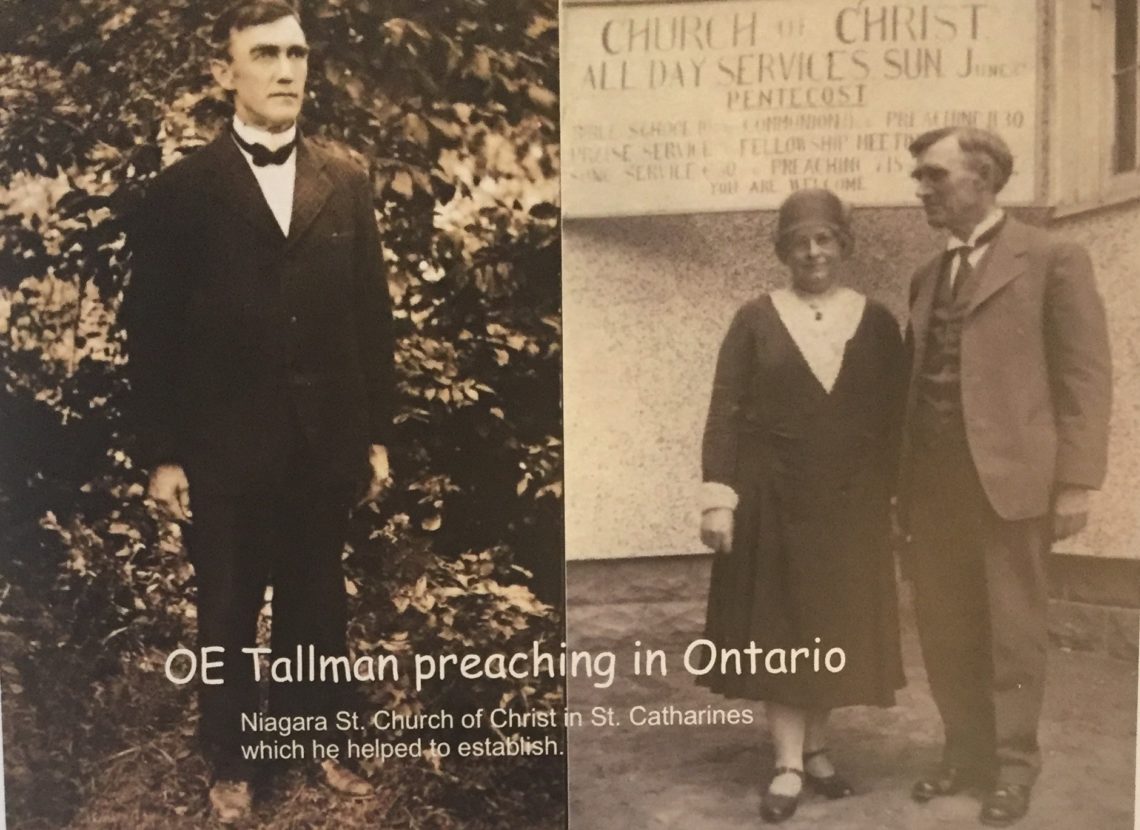
His picture and eulogy appeared in The Christian Monthly Review, written by C. G. McPhee.”
Gordon wrote a moving eulogy that was published the next month in the Christian Monthly Review: “I first met Brother Tallman in 1909. He came to West Gore, Nova Scotia, and joined his brother Ora H. Tallman in the opening of the Maritime Bible and Literary College. For six years he taught and preached in his earnest and characteristic manner, where he accomplished much good. I for one can say that those years of study and association will always be cherished. There my character was shaped. What I am today, I owe in a large degree to the sacrifice, patience, and exhortation of Brother Tallman and his co-laborers, who now mourn their loss.”
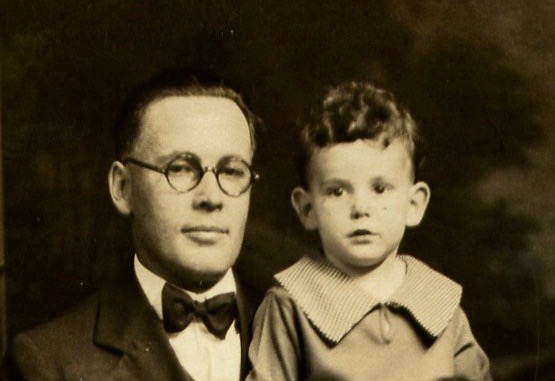
C. G. said of the loss of his son’ “It was the greatest blow I have ever suffered. He was a very bright, intelligent boy.” Gordon remembered Ralph saying, “I am going to preach, sing, play golf, and hunt for bears!” (Years later, he wrote in a sermon note, about a Biblical sorrowful loss, and he inserted “…and Ralph.”)
Pic. 3b “O.E. and Mabel Tallman, Niagara and Manning, St Catharines.”
Charles Wesley Petch, preaching at Charlton Station in northern Ontario, was invited to mediate between the two congregations and McPhee. In 1932, word of reconciliation came. C. G. wrote a letter (Sept 30, 1932) to O. H. Tallman, Cookeville, TN., reporting the development: “Troubles over.” He noted that the division was because of personal matters rather than doctrinal. A leading member of the Niagara St. congregation, wrote a letter of apology; a similar statement was signed by a number at Raymond Street, and peace was secured.
Reported in the Oct. 1932, issue of The Bible Student, “The Churches in St. Catharines have arranged to have a Fall meeting on Oct.16. Both churches in the city are co-operating.”
(3) Then in May, 1936, C. G. McPhee returned to work with the Beamsville congregation. (This began a nine year stay with the brethren in that town. It was in the Depression. McPhee took another drop in his support, to $18.00 per week. Yet, he was able to purchase the house, of the “Gibson Estate,” on King St., next to the Knox United Church; “offer of purchase, $950.”) The congregation he served was the “Brick” group. There were two congregations in Beamsville at the time, both meeting on Queen St., one-half block apart. They were not in fellowship, and had not been for 26 years, cf. the 1910 split. McPhee had experienced the devastation this had caused, both in Beamsville and in the province. He stated, “The effect has been felt from one end of Canada to the other.”
The “June Meeting” was scheduled that year for Beamsville, June 20, 1938. Claude Witty, of Detroit, was to address the gathering. He would remain a week or so, working on the reunification of the brethren. In the meantime, McPhee had prepared a statement of reconciliation, to which he had secured the signatures of all the members of the “Brick” congregation. He presented this document to the “Block” group (also named “Cement,” and by now, the “Frame,” as the congregation had sold their building and were meeting in the frame building next door). McPhee and Witty had worked two weeks, securing signatures of all the “Block” group except two or three, and Witty went home. Then on Sunday evening, June 28, all but two or three, “the group moved to worship with their brethren up the street!” The healing took “a great deal of work and prayer by Godly men, the patience and labour of brethren, and the special efforts of Claude Witty,” according to McPhee. Later, McPhee admitted that he made little headway in the community during his nine-year stint at Beamsville. “The damage had been done.”
Later that summer, July 1, 1938, Gordon was present in Meaford to remember the congregation’s 90 years, 1848-1938. Alex Stewart, of Toronto, spoke in the morning, W. F. Cox of Hamilton, in the afternoon, and C. G.McPhee, in the evening This was followed by a three-week meeting by McPhee.
These nine years in Beamsville found him at his peak of energy. He would preach in the morning at Beamsville, go to St. Catharines and preach a radio sermon at the CKTB station in the early afternoon, go in the later afternoon to either the 30 Mountain gathering (west of Beamsville), or to Rosedene (east of Beamville,) both on the Escarpment, preach at the evening service at Beamsville, and if Tintern had an 8:30 p.m. service, sometimes preach there too! And he reported that this schedule did not phase him!
B. Educator:
Charles Gordon G. McPhee had an important role in the formation and early years of both Omagh Bible School and Great Lakes Christian College. That McPhee was both energized and prepared for these roles in his formative years as a student at the Maritime Bible and Literary College, West Gore, Nova Scotia, 1909-1915, goes without saying.
McPhee was influential in shaping the terms of Omagh’s Incorporation in 1943. Through his insistence, board members were to be members of Churches of Christ, recognizing that church music was a cappella only. The debate lasted past midnight.
In 1945, the first summer that Omagh Bible School used the ten-acre facility next to the 16 Mile Creek for its activities, McPhee directed the program. The property had been gifted to OBS by the Johnstone family, cf. William B. Johnstone, who had begun the activities in 1936 that led to this accomplishment. The campus had been completed under the direction of Jardine McKerlie, Toronto. The boys’ dormitory, built in 1943, and located in the field opposite the farm house, had been moved to its new location and converted into the dining hall/activities center; the kitchen, dormitories, and “bunkies” were added. The staff-house, McKerlie Hall, was added in 1947. McPhee, in 1945, was 53 years old. He would serve in the post of “principal” for fifteen summers.
Omagh’s four weeks of Bible teachingin 1947, July 3-31, included seven teachers per session, with three groups of students, ages 10-12, 13-15, 16+. In 1948, the teachers were: C. G. McPhee, Geo. M. Johnson, Bruce Merritt, T. J. Mitchell, John Whitfield, and William Bryson.
Dr. George S. Benson, president of Harding College, Searcy, Ark., visited Ontario, March, 1947. He toured the Omagh campus, with the OBS board, in snow! Then, he held meetings on Saturday and Sunday in Toronto. He noted: “30 Ontario young people are presently in American Christian colleges. How do we insure that Canadians return to Canada for evangelism?” On Monday, Benson was the guest speaker at the Omagh Bible School’s annual meeting, held that year in Beamsville, with George M. Johnson, chairman. Benson recommended that OBS become a winter school, a junior college!
What Benson could not see was the Omagh’s students were becoming younger—its special work would be a summer camp, much in keeping with the founder’s vision. In the meantime, and in keeping with Benson’s vision, serious interest in Christian education on the college level in Ontario was stirring in the province. Within three years, 1950, Great Lakes Christian College, to be located in Beamsville, received its Letters Patent.
McPhee serving in Meaford at the time, received two visitors from Beamsville, Carol Tinlin and Hermon Mason. They wanted him to become a director on the board of the new Great Lakes Christian College. McPhee said: “I was willing to do that. I had talked about it and helped some. I think there was something else behind it all, why they came up there. I came down to the first Directors meeting and was appointed the President of the school. Had I known what was going to take place, I might not have appeared on the scene. But nevertheless, we started—with nothing. It was a long, hard job to get things started. It started with a number of teachers, and went forward. I left it in the fall of 1954 and moved to St. Catharines.”
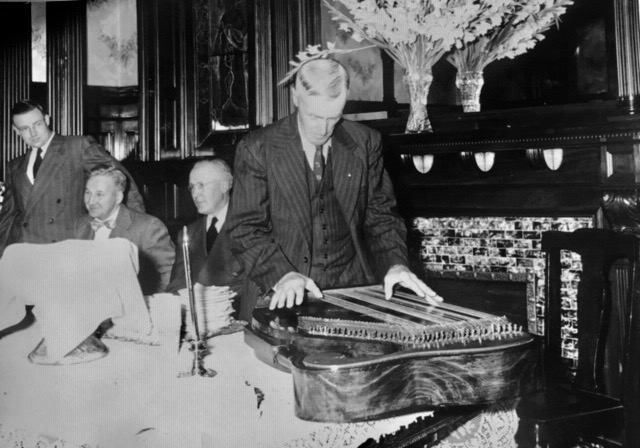
While serving as president of the yet to be opened Great Lakes Christian College, McPhee and his wife, Grace, left on his first fund raising trip, in early 1952. At this time McPhee was still “located” at Meaford and he had ongoing duties to fulfill before they left: preaching, arrangements for a wedding, pre-recording of radio sermons in Owen Sound, a funeral, plus a couple of trips to Beamsville where preparations for opening were ongoing under Bruce Merritt’s direction. Then on the road: to Birmingham, staying with W. G. Tallman. Meeting at Clawson in the evening, some support. Meeting that night at Birmingham, some support received. On to Toledo, visited members. Drove hard to Indianapolis for overnight. On to St. Louis and through to Oklahoma City. Then on to Tulsa where he spoke to a full house at 15th & Drexal where support and promises were received. Visits next day in the city receiving gifts and promises. Then an all-day trip to Abilene, Texas. At the college (ACC) the next day for the Bible Lectures, where he had opportunity to address briefly a crowd of 1,200. Met a number of students, including “Jeff Ellis.” “Time passed quickly and gave insight into the work and future prospects.” On to Fort Worth and Dallas for several contacts, and then home.
In his 1977 memoirs, C. G. said, “Today you enjoy the services of Great Lakes Christian College. Each one had a contributing part. Some at great sacrifice. But it all grew from the Nashville Bible School. And I will always stand behind of Great Lakes Christian College because of its fruit. It has turned out a lot of teachers, a lot of preachers, a lot of business men, and has been instrumental in helping many of the churches in Ontario.”
For over two decades, McPhee was front and center in Christian education in Ontario!
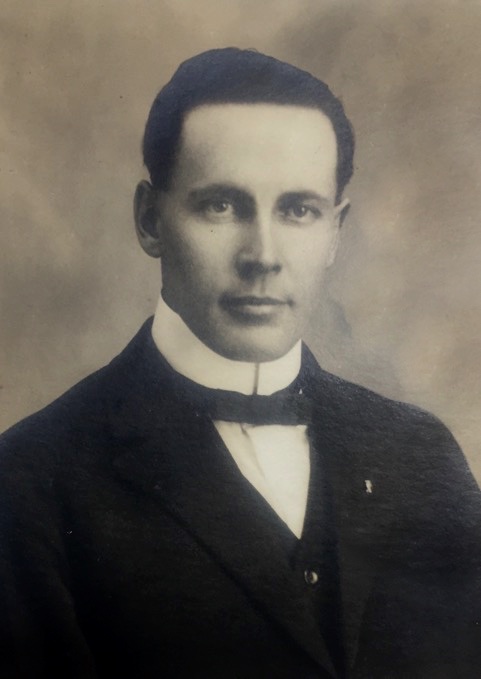
(1) Nashville: Gordon with a train ticket to Nashville, departing from Smithville, with nine dollars in his pocket. He went forth in faith. (McPhee patterned his life on that of James A. Harding, whose leadership at the Nashville and Potter schools literally operated by faith for their support. Near the end of his life he said: “The older I get, the more I believe He rules in the affairs of men. If it hadn’t been that my father died, I never would have gone into the homes of those Christian people from whom I learned a lot and became a Christian.)
At the border, he was subjected to a gruelling examination by officials (it was wartime). In a little room he was interrogated. “Where were you born?” “In Nine Mile River, Nova Scotia.” And one of them said, “Well, I came from Milford.” That is about seven miles from Nine Mile River, so McPhee ask him, “Do you know a man by the name of Norman Loggett?” (He was known all over the country as inspector of roads.) “Certainly.” McPhee named several others who were also known by this official. They then went before a larger committee where the man from Milford recommended that McPhee be allowed to enter the US!
McPhee enrolled in Nashville Bible School and began to preach every Sunday. Typically, he was paid $3.00 for his services, until one Sunday when he was given $6! He mentions preaching at Thompson Station, and Spring Hill. However, his income was insufficient. After two or three months, he went to the president’s office, cf. H. Leo Boles, where he said, “I can’t stay here. I am not getting enough money for preaching. I’ll have to leave.” Boles said, “You are not leaving. You are staying here!” “They kept me here for two years. I will always be grateful to Brother Boles for keeping me there.” When he graduated, he signed a note—for between two and three hundred dollars.
He graduated with his Bachelor of Literature degree in 1917. (David Lipscomb, age 86, died November 11 in that year, and the Nashville school was renamed, David Lipscomb College. Thus, C. G. McPhee has the distinction of being the first foreign student to graduate from NBS once it became DLC.) (It should be noted that “a number of other Canadian students had enrolled in Nashville Bible School, from 1891-1917) On the day of graduation, he met Sister Foster, widow of Abraham Foster, who had founded and directed Carman Bible School, 1899-1902, “the first Bible school in Canada,” i.e. among Churches of Christ. (Foster had passed away in 1908, in Calgary.) McPhee recalled, “I had a place to go and preach, and that was in Carman, Manitoba. So, I left there (Nashville), after bidding farewell to my friends. I made a lot of them there. Well the school was closed, I was out of school, and out of money. The brethren at Carman had sent me a ticket to take me there to preach. I left Nashville with ninety cents in my pocket.”
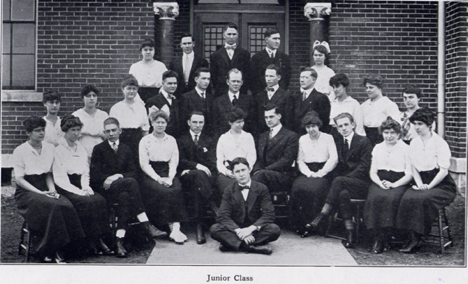
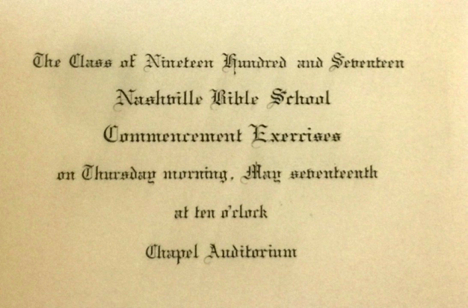
(2) Western Canada.
Upon graduation from the NBS/DLC, Gordon McPhee moved immediately to Carman, Manitoba. There he began his life’s work of preaching the Gospel. That he chose to preach first in Western Canada shows his missionary spirit. It also confirms the influence of the Tallman brothers upon his life. The Tallmans had also headed west in their early years: to Carman, Manitoba, where they had helped plant the Winnipeg Church of Christ, in 1901. They, no doubt, had a hand in C. G.’s serving at Carman for two summers (1913, 1914), during his college years in Nova Scotia. And, that O. H. Tallman had devoted his service to evangelizing in Western Canada, during the last year of MBLC’s operation, 1914-1915, was surely noted by Charles Gordon. He was returning to familiar territory.
Arriving from Nashville, he was met in Carman by a brother Stewart, who said, “Did you know you are starting a meeting on Sunday?” The meeting lasted for three weeks. By the end of the meeting, eighteen people had been baptized.
Gordon preached for the next three years at Carman and in the western provinces. Gordon preached his first gospel meeting, at that time, in Hanna, Alberta. He also preached in nearby Calgary, and at Winnipeg. He held meetings at Bromhead, Saskatchewan. In January, 1919, C. G. was in Prince George, British Columbia (where he wrote to Donald McDougall, then editor of The Christian Monthly Review, Nova Scotia, to renew his subscription!) His report from Carman, published in the March, 1919, CMR: “The work at Carman is doing fine. The interests and crowds are both good. We are opening several mission points in the country around here, which we expect to be fruitful for the Master.”
McPhee reported forty baptisms during this period. He conducted his first wedding at Carman, in 1919: Franklin Russell and Luella Meeks, March 26, the first of literally hundreds of weddings that Gordon would perform during his ministry. Gordon reported that during his stay at Carman, he retired what was still owing to DLC on his tuition.
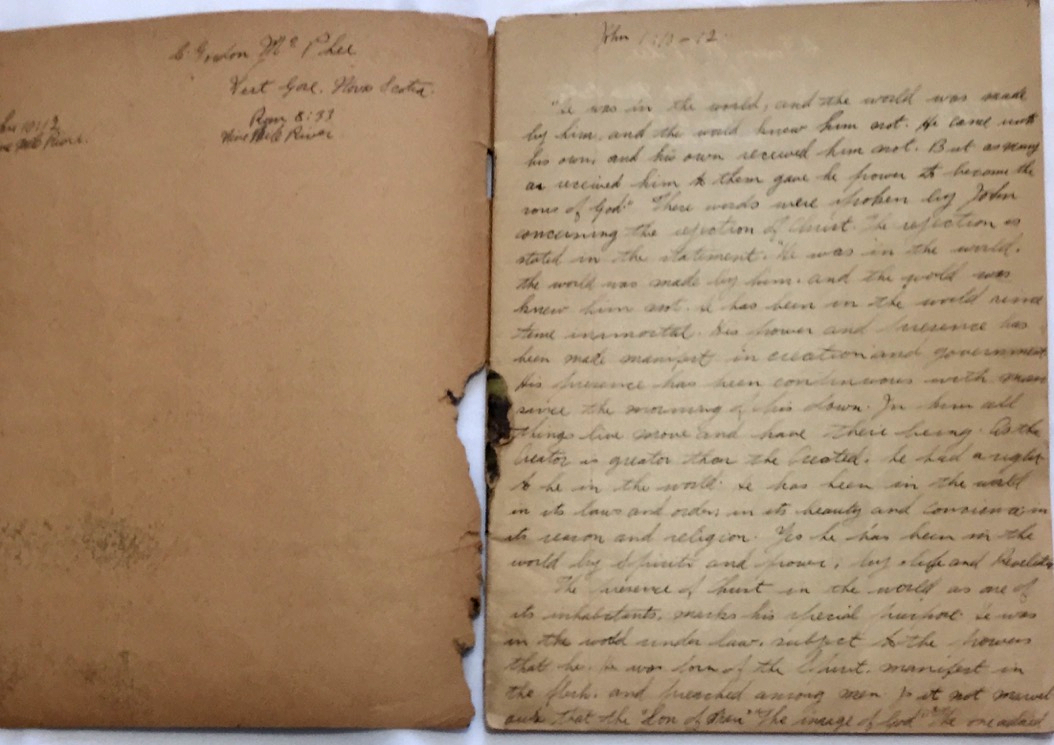
Gordon’s practice, begun while a student in Nova Scotia, and maintained during his work in western Canada, was to write out his sermons in longhand. He used student study books, size 10 ½” X 7 ¾”. Mostly, one sermon averaging 17-20 pages was written in each book. Some few have two, even three sermons included. Most booklets have few details of the place and date of preaching, but a number do identify Carman, Manitoba. The mind and beliefs of C. G. McPhee are preserved in these workbooks! (Sixty-four workbooks with 79 sermons by C. G. McPhee are in the CCCHS files.)
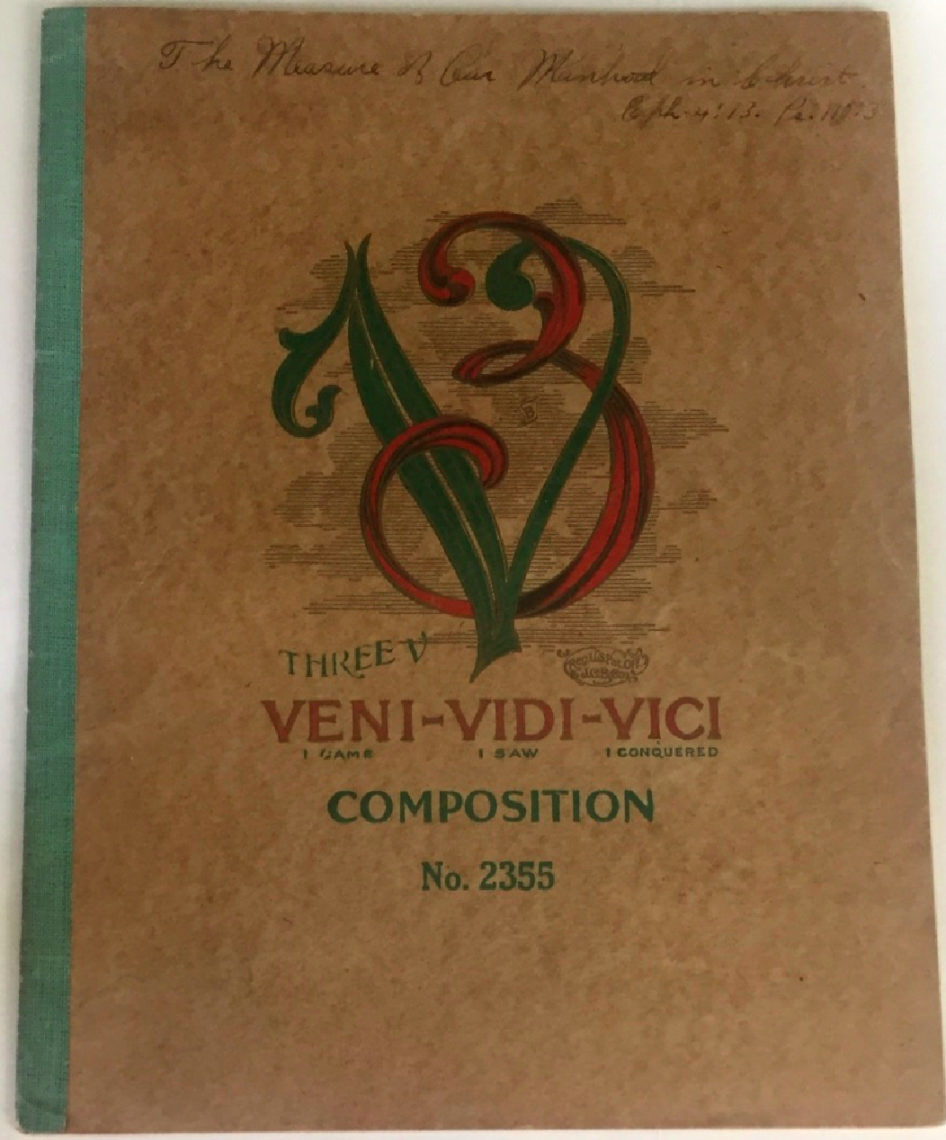
(3) Ontario.
The December 1920 issue of the Christian Monthly Review, reported that C. G. left the west for Ontario, early in the summer, working in southern Ontario, then arriving at Meaford later in the year. The CMR also reported, “Brother C. G. McPhee, who is locating in Meaford, Ontario, has been on a flying visit to his old home and friends in Nova Scotia, visiting and speaking at Mill Village, Nine Mile River, Upper Rawdon, and one evening was allowed to speak at West Gore.” McPhee began his work in Meaford, on the first day of 1921.
Upon his arrival in Ontario, earlier in 1920, however, McPhee was soon recruited to become “Ontario Preacher,” by a co-operation (similar to “Co-operations” common in 19th century) maintained by the Bathurst Church of Christ at the time and by the Toronto churches. His support was $25 per week. At the “June Meeting” in St. Catharines that year (1920), a special meeting was called to report on this activity. At one point, in the meeting, C. G. arose and declared, “I will not work under a couple of men, but I will work under a church.” There was “an arousing clap from the whole congregation,” and McPhee sat down. He later reported, “That ended it. I conducted meetings at St. Catharines, Jordan, Beamsville, Toronto, Meaford, and Newmarket, and in the Fall, I quit, and arranged to go to Meaford.”
Gordon, at the end of 1921 in Meaford, reported on his work: “Four added at Meaford, six at Cape Rich, and two at Griersville.” An American evangelist, C. R. Nichols, who had conducted a gospel meeting in Meaford in 1923, wrote: “Brother C. G. McPhee who is the minister-evangelist for the Meaford congregation is an untiring worker, and is loved by the congregation, and by the citizenship of Meaford for his intrinsic worth, as well as for his ability and consecration in the work for the Master.” McPhee served in Meaford until 1924. He later would remember his encouraging the Meaford congregation to show the same interest in the Sunday evening service as the morning. He also became well-known as the soft-ball playing preacher! Later, he would look back and declare: “Those were the best years of my life!” “Finest young peoples class ever.” “I baptized and buried a good number in Meaford.”
(4) Marriage.
On June 14, 1922, Gordon married Grace Tallman, in Hamilton. Grace was born, November 23, 1893, the third daughter of Peter Tallman (uncle of O. H. and O. E. Tallman) and Jennie (Tufford) Tallman, of Beamsville. (Grace was the third of four daughters: Goldie Lawson, Gertie McKenzie, Grace, and Cora Peckham.) (Peter Tallman passed away in 1909, when Grace was 15.) Grace, who had attended Beamsville Bible School, was living and working in Hamilton, as a milliner. Having impressed the brethren with his preaching at Jordan, C. G. had been invited to conduct a three-week meeting and assist in opening the new Sanford Ave. Church of Christ meeting house in Hamilton. “I didn’t baptize anyone. But it was one of the best meetings I ever had.” Here, the couple met, and the rest is history! “There was someone there that attracted my attention—the dark eyes, the beautiful face.” One thing that Gordon remembers about the church opening, “There were Tallmans everywhere!” There, Gordon was invited by Oliver Tallman, Grace’s uncle, to visit at the Tallman home, “Evergreen Hill farm,” in Smithville, where he stayed three weeks. Gordon proposed—he was 30 and Grace 29 when they married. “Dr. O. H. Tallman from Owen Sound, my first Bible school teacher, was invited to come and marry us.”
Their honeymoon was remarkable—centred on the Manitoulin Island, where Grace’s sister, and husband, Gertie and Donald McKenzie lived. The couple took the train to Sarnia, a boat to the Soo, and on to Little Current, on the Island. (C. G. may have subscribed to the notion that the Manitoulin Island resembled Nova Scotia!) They then took a cruise on a side-wheeler boat to Detroit. Here the couple was entertained by the daughter of Henry Ford. (Cf. The McKenzies managed the Ford’s family vacation property on the North Channel, and were well regarded by the Ford family.) They took the side-wheeler back to the Soo, a boat to Little Current, then on to Killarney for a couple of days. They then proceeded by boat to Owen Sound where they visited the O. H. Tallman family. O. H. was preaching and working in his new career, Chiropractic medicine. O. H., his wife, Hallie Richardson (from Richardsville, KY), and his family, eventually of five children, at the close of the college in Nova Scotia, 1915, had returned from his preaching at that time in Western Canada. They had settled in Owen Sound where O. H.’s sister, Charrie, her husband, William Ellis, wholesale grocery-man, and their family of five sons, were living. Will Ellis had led a house church in the city since arriving in 1908. O. H. was preaching for this group, while training for, and launching his career in Chiropractics. The married couple then returned to Meaford.
Gordon remembered the helpfulness of Grace. She was “a great help to me in many ways…” “could do a lot of things I could not do…” “good musician…” “Knew her Bible as well as I do…” “at home with the rich and poor…” “She was a wonderful woman. She helped me along the way. She stood by me when others were against me.”
At Meaford, Grace and Gordon received their first child: daughter, Ruth Avonelle McPhee, born June 27, 1923.
(5) Texas.
C. G.’s health failed and he was advised to seek a dryer climate—sinus problem.: “While in Meaford, Charlie (C. R.) Nicholl, one of the outstanding preachers from Texas, came and he saw the situation. The church in Waco, Texas (100 miles south of Dallas), through his influence, invited me to come down there. So, I left Meaford in February, 1924, for Waco, Texas…One of the best cities in which I have ever lived. I met many people, was kept busy all the time with funerals, meetings, weddings.” He served the congregation in that city for almost four years. C. G. recalls that when he first arrived, the elders sent him by train to Abilene, to attend the Abilene Christian College Bible lectures. From Fort Worth, he rode to Abilene with the noted preacher of the day, C. G. Brewer. (The A.C.C. campus was still downtown, shortly to move the “Hill.”)
While in Texas, the McPhee’s received their second child, Ralph Charles McPhee, born in Waco, April 30, 1928.
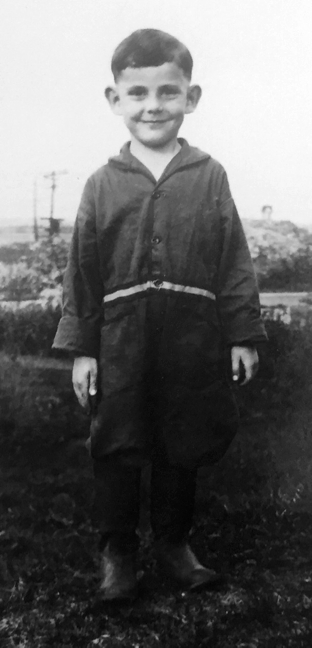
C. G. had a successful ministry in Waco. He pioneered a Saturday youth meeting, and helped build a new building (cost $50,000, seating 400). Years later, in 1975, when McPhee was back at the A.C.U. Bible lectures, at a large gathering, the chairman, A. Overton Faubus (teacher of Business at the college), shared: “There is a man sitting back there in the audience. He baptized me 47 years ago in Waco, Texas…he was my ideal preacher then…I guess he still is!’
C. G. then preached briefly at Denison, Texas (75 miles north of Dallas).
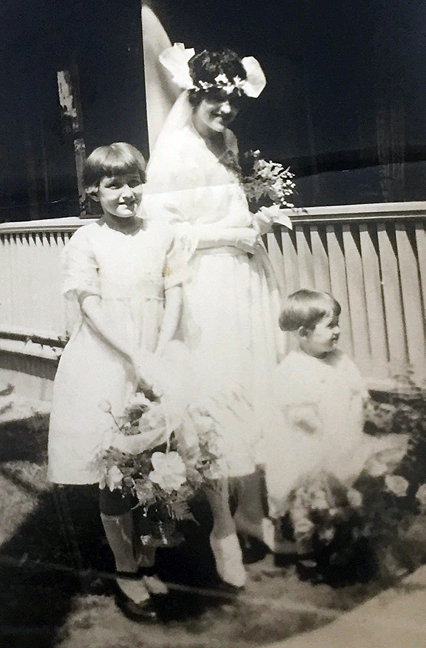
In September, 1928, C. G returned to Ontario to hold a gospel meeting. There he heard the complaint: Canadian preachers are working in Texas, but no full-time preachers are serving in Ontario! (Brethren Cox and Keffer were preaching part-time at that time.) O. E. Tallman had stated, “He is a splendid speaker, a gentleman, and a Christian. We’d gladly see him in our work in Canada again.” Gordon’s wife, Grace, said, “You are going home to see the people of Ontario.” Gordon: “I saw this, and decided to come home.”
(6) Ontario again.
The McPhees returned to Ontario in 1928, settling at first in Hamilton, at 102 Wentworth St. N. He conducted a gospel meeting at Beamsville, for two weeks, concluding, Aug. 26 (where he baptized ten, including my uncles, Billy and Gerald Ellis). He then held a meeting at Jordan, baptizing 20. At the end of 1928, he became the full-time evangelist where he served the Beamsville “Brick House” congregation until 1930, but declared, “No progress.” (His income had dropped from $45/$55 week, to $25.)
The McPhees received their third child, Rosalie, in Beamsville, October 28, 1929.”
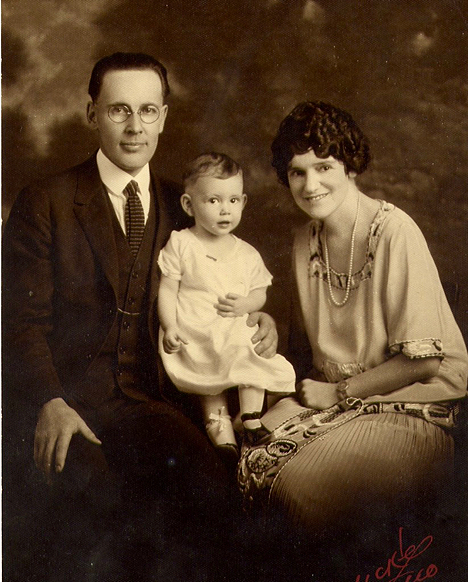
The McPhee Files:

Pictured is a bankers box that contains the records of the life and ministry of Charles Gordon McPhee. Of the thirty-five files that are included, are those that Gordon developed during his day-to-day ministry. Also included are files added subsequently about his life and ministry, gathered from a variety of sources. His personal files were preserved by his family, and presented in 1981 by his daughter, Ruth Wilson, to the library of Great Lakes Christian College, in Beamsville. They were later transferred to the archives of the Canadian Churches of Christ Historical Society. As noted above, these archives were held first in Meaford, Ontario, and then moved to McPhee Hall in Beamsville. Appreciation is extended to the CCCHS for making these files available for this study.
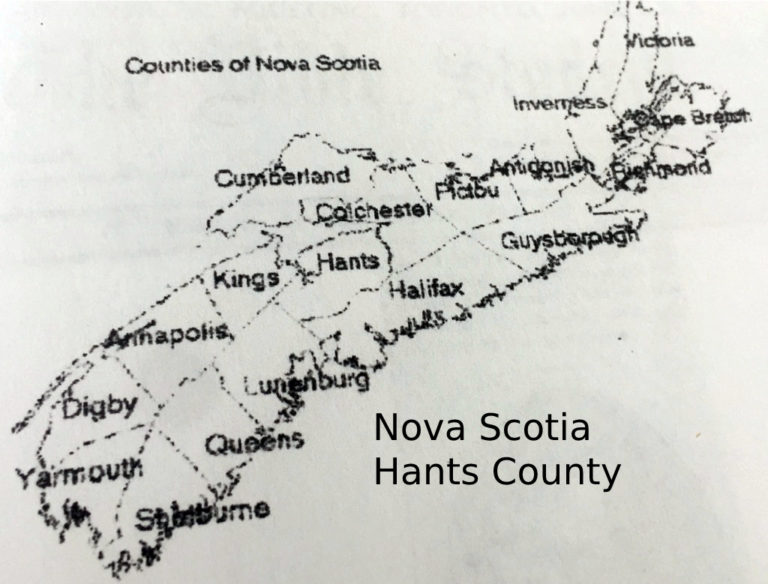
Charles Gordon MacPhee was born July 25, 1892, at Nine Mile River, Hants County, Nova Scotia. His parents were Charles, a farmer, and Emily MacPhee. Emily, of Scottish descent, came from Halifax and settled in Nine Mile River. C. G. was the youngest of four children: a sister, Annie, and two brothers, Henry and Cyril Stanley. The family was reported to be staunch Presbyterians. (Years later, C. G. McPhee remembered: “Being raised among Presbyterians, by a Presbyterian mother, and all my ancestors being the same…”) His family spelled their name, “MacPhee,” the spelling that Gordon adhered to until his move to Nashville in 1915, when he shortened it to “McPhee.” (I have been assured that there is no national or religious significance to either mode of spelling.) Family lore remembers a preacher, John Wright, passing by when C. G. was just two or three days old. His father invited him in to see “the little baby preacher.”
Sadly, Gordon’s father passed away shortly after he was born. The family moved first to Cape Breton Island for a year, and then back to Nova Scotia where Gordon was boarded out in two homes. Gordon was three when his mother remarried, the family moving to Upper Rawdon. He was twelve when his mother passed away. He then went to live with the Joshua Wallace family in Centre Gore, Hants County, attending church meetings at the West Gore Church of Christ. In May, 1907, at age fifteen, Gordon was baptized into Christ, one of ten, at a meeting conducted by A. J. McCloud, at the Nine Mile River Church of Christ. He was 18 years old when he preached his first sermon, at Nine Mile River. It is said, “He had to walk twelve miles through snow up to his knees to get there!”
“Nine Mile River Church building.”
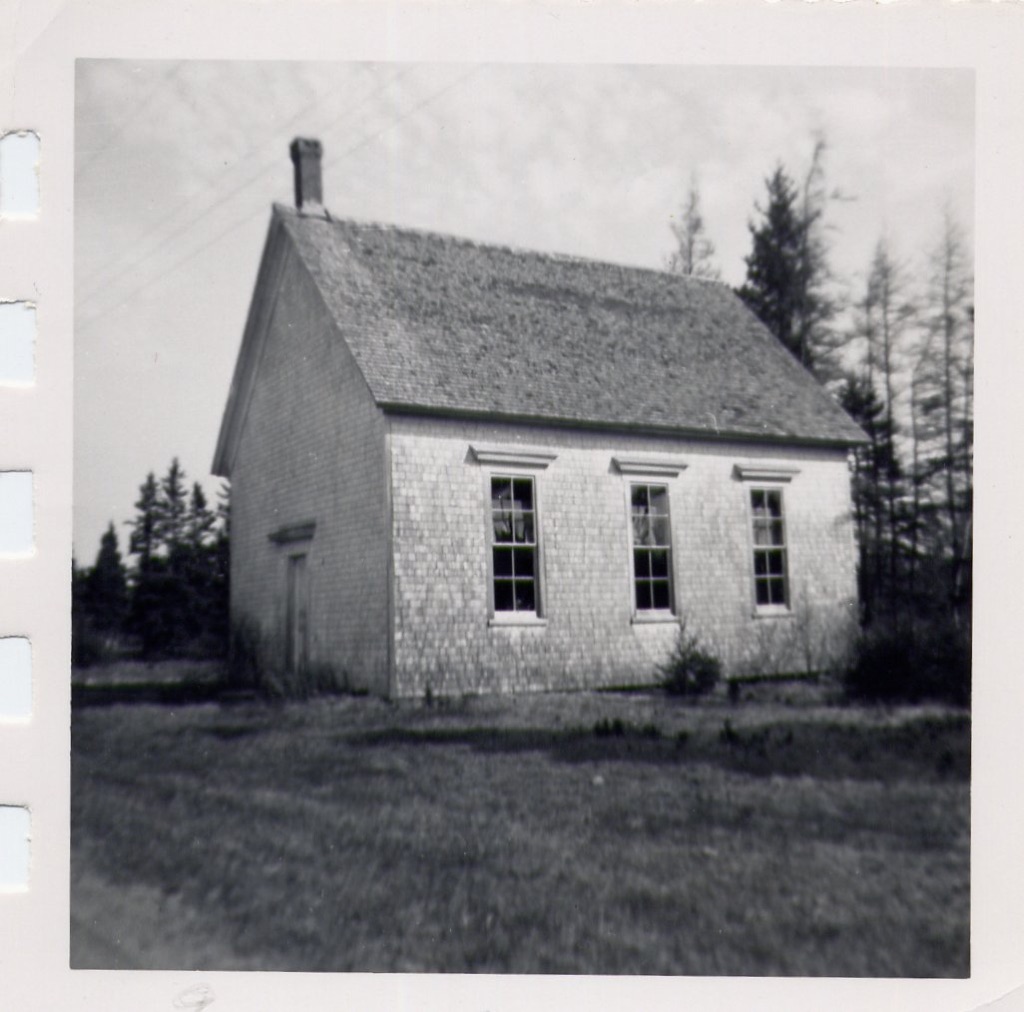
The events that occurred during the next eight years, 1908-1915, in the normally placid central Nova Scotia, were remarkable, unique, and powerful in shaping Gordon’s life. In 1909, at age 18, Gordon determined to become a preacher. He had found strong influences at the West Gore Church of Christ, particularly among the McDougalls, McDonalds, and Wallace families.
(1) 1908-09. Ora Hubert (“O. H.”) Tallman, from Ontario, came to serve as “evangelist” for Hants County, supported by the West Gore Church of Christ. The Tallman brothers, including O. H.’s younger brother, Ozro Ellis (“O. E.”) Tallman, growing up on a farm near Smithville, Ontario, had experienced the spreading
Bible school influence centered in Nashville, Tennessee. Students from the Nashville Bible School, (cofounded in 1891 by David Lipscomb and James A. Harding), had planted two similar schools in Canada: Carman Bible School (1899-1902) in Carman, Manitoba, by Abraham Foster; and Beamsville Bible School (1902-1916) in Ontario, by Sim Malious Jones. The Tallman brothers studied for two years at Carman, and O. H. studied for two years at the Beamsville school. Then the brothers headed to Bowling Green, KY, where James Harding (having left his work as president of Nashville Bible School) had opened, in 1901, the Potter Bible College. Here, the brothers earned their B.A and B.S. degrees by 1907. Both continued at Potter for the next year, serving as teachers of science and language. During the summers, the brothers held productive Gospel meetings in Kentucky and Tennessee. In 1908, O. H. went to serve as evangelist in Nova Scotia; O. E. went with Harding and several Potter teachers to open a new school, Western Bible and Literary College, at Odessa, MO.
(2) 1909-10. This was the founding year of Maritime Bible and Literary College at West Gore, Hants County, Nova Scotia. Charles Gordon MacPhee, age 17, was a charter student. MBLC opened October 25, 1909. Twelve students enrolled that first year. The largest student body to gather subsequently was thirty.
Donald McDougall, a leader in the West Gore Church of Christ, wrote in the April, 1909 issue of The Bible Student, “An educational institute where the Bible itself … is made the chief study and predominating influence would be perhaps the most effective force that could be employed in this great work.” It was McDougall’s suggestion that the school be named, “Maritime Bible and Literary College.” McDougall also claimed to have recruited O. E. Tallman to come and be number two in the college’s operation.
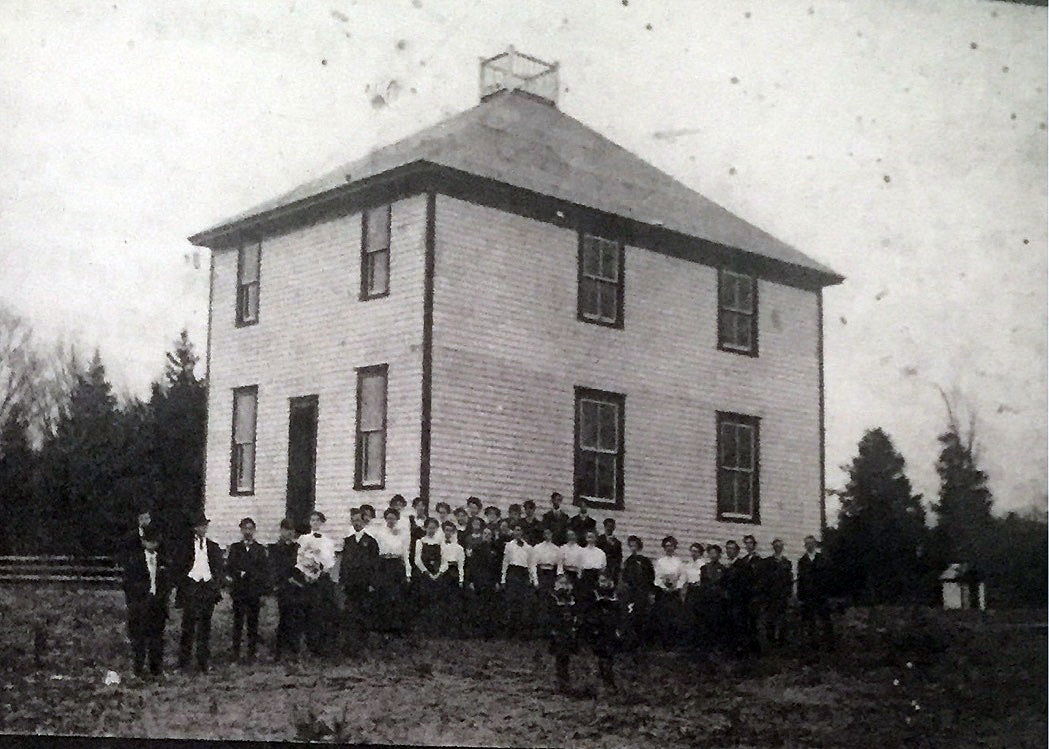
Two acres of land in West Gore were donated for the college campus by Mabel (Wallace) Covey, widow of John E. Covey, parents of Harold Covey. She who would later marry O. E. Tallman.
“One Saturday morning in May, 1909, a notable collection of workmen, including farmers with teams of horses, men and boys with picks and shovels, and bars, etc. were observed…” (quite probably Gordon MacPhee was included!), gathered to build the college building.
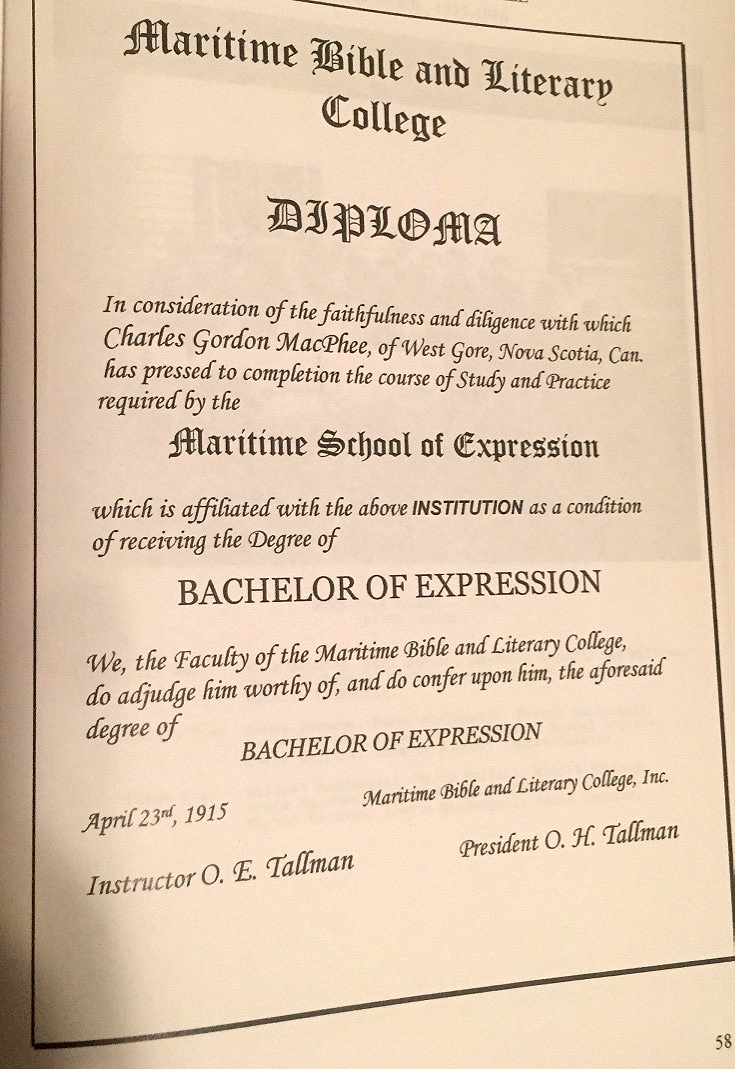
(3) 1910-1915. The school was designed to include three years of high school and four years of college. Gordon’s six years of studies included activity in preaching, and “made his living by working in lumber woods, cutting wood and working on a farm.” In 1913, it was announced in the Bible Student that C. G. MacPhee would serve as evangelist for the reactivated River John, Nova Scotia, congregation (the first to be established in that province, 1815). In fact, it was C. G. McPhee, with the help of a fellow student, Fred McMadden, that the congregation was reactivated.
During two summers, 1912 and 1913, MacPhee went to Carman, Manitoba to preach.
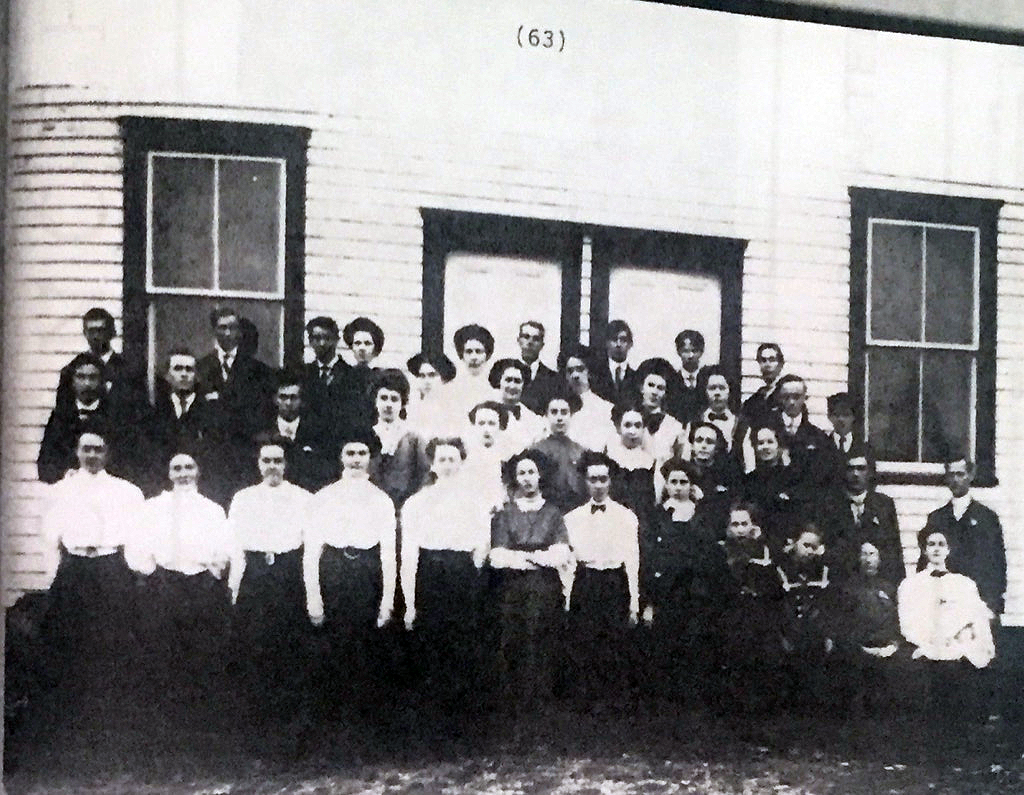
Sadly, after its sixth year of operation, 1914-15, due to the dislocations of World War I and trouble in the West Gore Church of Christ, the Maritime Bible and Literary College closed its doors. C. G. MacPhee may well have been the last to receive a degree from the college. In early summer, Gordon travelled with the O. E. Tallman family, including O. E.’s wife, Mabel, stepson Harold Covey, and young Oliver, and baby Lena, to O. E.’s childhood home, the farm, Evergreen Hill, near Smithville, Ontario. Then in late summer, Gordon journeyed by train to Nashville, Tennessee, where he enrolled in Nashville Bible School, as a Junior student, where H. Leo Boles served as president. (Harold Covey, 1900-1920, died of the Spanish Flu, and is buried in the Jacob Snure Cemetery, Jordan, Ont. O. E. and Mabel Tallman had two more children, Ora Hiram (“O. H.”), and Erma.)
Recently a friend forwarded this picture, without a caption, but with the question. “Guess who?” I responded immediately, “Charles Gordon McPhee.” He answered, “Well done. He baptized me. ”At that moment I knew that it was time to refresh our collective memory of C. G. McPhee, Canadian preacher extraordinaire, of the 20th century.
I will first share my personal memories, and then attempt a more general recollection of Gordon’s life and ministry.
I. Charles Gordon McPhee, Memories
During the summers of 1950-52, it was my privilege to serve as “sports director” at Omagh Bible School under the direction of C. G. McPhee. I and the campers viewed Brother McPhee as “principal” in those days. Thus, began my lifetime association with Charles Gordon McPhee.
The vision and work of “Omagh Bible School” had been passed on to C. G. McPhee by his predecessor, Raymond Crumbliss, evangelist with the Strathmore Church of Christ in Toronto—who had returned to Alabama in August, 1942. Crumbliss had worked in the early years when “Omagh” was transitioning from a summer country experience for city kids, to a camp, then to a summer Bible “school.” McPhee inherited this vision, which he pursued whenever he served Omagh as “principal” during the next decade and a half.
As post-war teenagers opted increasingly for summer employment, the age of young people at Omagh became younger, “Omagh Bible School” reverted to being “Camp Omagh.” Nevertheless, the vision of a Bible College in eastern Canada remained and grew.
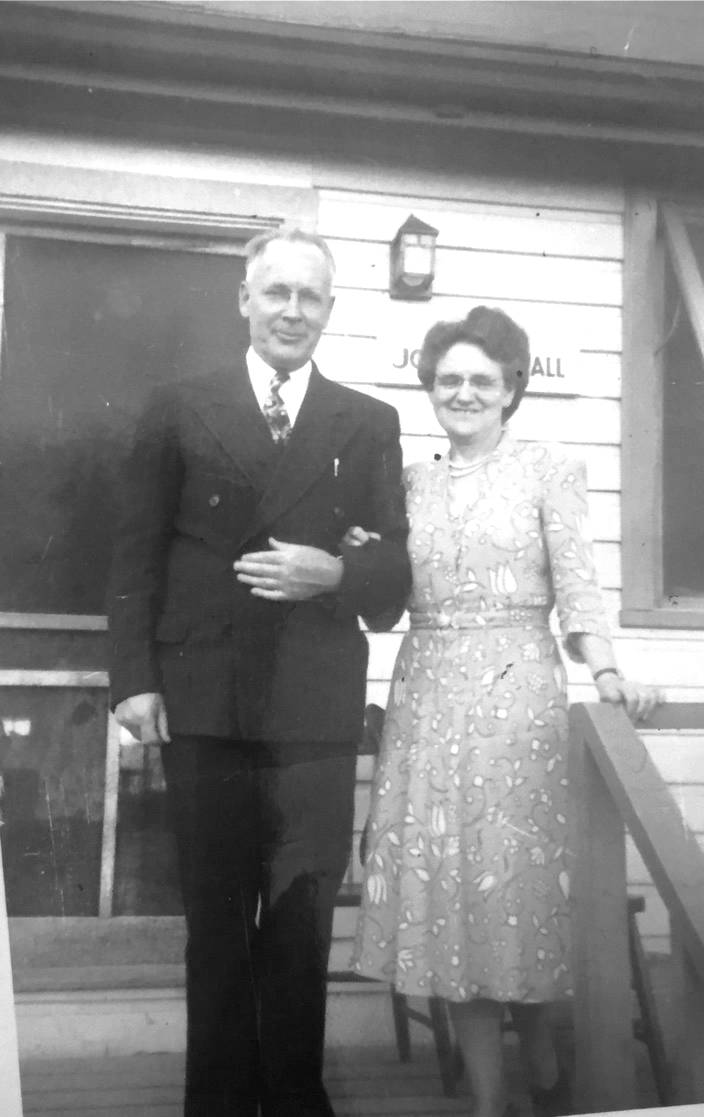
“Gordon and Grace McPhee at Omagh Bible School”
Oliver Tallman and George Johnson led the charge in the late ‘40s. (Oliver Tallman had been born on the campus of Maritime Bible and Literary College, West Gore, Nova Scotia. George Johnson had studied at Carman Bible School, Carman, Manitoba in the twenties.) Letters Patent were drawn in 1950 for Great Lakes Christian College, Beamsville, Ontario. Charles Gordon McPhee was appointed president in 1951. The school opened in 1952, offering high school and Bible College classes, with McPhee, president, Bruce Merritt, principal, Eugene Perry, teacher, and Roy Merritt and Keith Thompson, Bible teachers. McPhee had a major task confronting him.
In the early days of the college, C. G. McPhee traveled often in the U.S. to raise funds for G.L.C.C. He met and became friends with Tom Beam of Oklahoma City, OK. Beam’s business was manufacturing seat belts for trucks, and also had interests in the oil industry. His early attraction to GLCC was simply the college’s location in Beamsville—the only school located in a town having his namesake, “Beam”! For several years support came regularly to the college from Tom Beam, stopped, and then quietly after a time, began again. Near the end of Mr. Beam’s career, by now in the 1980s, his continuing gifts made possible the purchase of nineteen acres of land in Beamsville, property that joined the college campus, and extended to the corner of John St. and Bartlett Rd. This property was secured for the anticipated future needs of the college level program. As the hoped-for development faded, that asset saved the high school from closing during a difficult period in the nineties. Gordon McPhee’s influence lives on at Great Lakes even today!
Back to those earlier years! According to a diary kept by C. G., he and his wife, Grace, in early 1952 went to Oklahoma and Texas, fundraising for GLCC. While in Abilene, he visited the campus of Abilene Christian College. He wrote: “Enjoyed visiting with many students. Jeff Ellis was especially happy.” Then that fall of 1952, Doreen Begley (of Toronto) having also become a student at Abilene Christian, there we made plans for our wedding: we invited C. G. McPhee to perform our wedding service, which took place at the Strathmore church, in Toronto, on December 27.
In February, 1954. C. G. McPhee was again traveling for GLCC, also with his wife, Grace. They included a visit to Abilene Christian College to attend some of the Bible lectures of that year. As it was my last year of college at Abilene, C. G. took time to visit me and to “recruit” me as a prospect for GLCC. The McPhees were also able to visit my wife Doreen and our new-born daughter, Elizabeth, at the St. Ann hospital, in Abilene. Beth had arrived on the 25th of that month, the last night of the Bible lectures. Then, later, in the Spring, I received a letter from Brother McPhee, again urging my joining the GLCC teaching staff upon graduating. (The previous day I had received a letter that put an end to my hoped-for plans to preach and study in Connecticut!) He wrote, “Your MA degree in Bible will be important as we will soon develop our college Bible program.” With this encouragement, I with my wife and family arrived in Beamsville in late August, 1954, prepared to teach Bible and History, high school and college.
A month passed, and then the unthinkable happened: the GLCC board announced that C. G. McPhee would retire from his position as president! Sometime later, he stated: “It was deemed advisable to terminate my connection with the school as president and return to church work completely. This I have done for 40 years. I believe the best years of my life as a Gospel preacher lie ahead of me.”
The years passed. Bruce Merritt became president, serving until 1961. His brother, Roy, in 1969, became Dean of the Great Lake’s new Faculty of Bible and Missions. In 1970, the carriage hall of theformer Gibson estate, that had been converted to the dining hall/ kitchen, dormitory, and staff apartment for school use, was restructured as the Bible building for the Bible college. Offices and a free-standing classroom were added. The complex was designated “McPhee Hall” in honour of Charles Gordon McPhee!
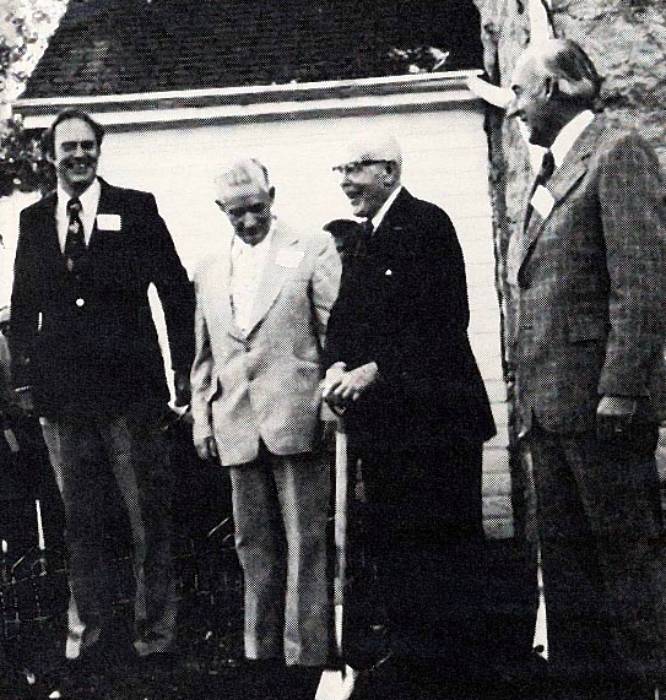
“Dedication of McPhee Hall: (L to R) Geoff Ellis, Oliver Tallman, C. G. McPhee, and Roy Merritt.”
The latest development of interest in this recital: the archives of the Canadian Churches of Christ Historical Society were moved in August, 2018, from Meaford to Beamsville, and relocated on the campus of the Great Lakes Christian High School, to the refurbished ($30,000) former staff apartment, of McPhee Hall!
C. G. McPhee retired in 1966, at age 74, in St Catharines, where our association continued, especially on the golf course at St Anns!
Charles Gordon McPhee passed away to his award in heaven on November 27, 1979, 87 years of age.
It was my privilege to present the eulogy at Gordon’s funeral. Included was this recollection: “…this quality of sadness was no stranger to Gordon McPhee, for he ministered to many, many families in just such circumstances. While he did not carry his emotions on his sleeve and was not what you would call a sentimentalist, he did care deeply about other’s grief. An indelible memory takes me back to my first staff meeting at GLCC in ’54, held under his chairmanship. Word of the death of a friend in Meaford came while the meeting was in progress. Tears filled his eyes. The meeting was temporarily adjourned. After a time for composure to be regained and arrangements to be made, we went back to work. Here was a man of compassion, sympathetic to the burdens people bear.
Grimsby ON
Doreen Margaret Ellis in her ninetieth year, passed peacefully Saturday evening, September 4th at West Lincoln Memorial Hospital. Doreen was born January 23, 1932, in Toronto to Lloyd and Isabelle (Roy) Begley. She was the oldest child of three, with sister Carol MacLean, and brother Donald Begley predeceasing her.
She is survived by her beloved husband Geoffrey and by her two sisters-in-law, Joan Ellis (David) and Sandra Begley (Donald). Geoffrey and Doreen were blessed with three children: Elizabeth Forsyth (Brent), Rebecca Courson (Steve) and Mark (Julia Jones); with eight grandchildren: Brittney (Peter Springer), Brent Jr. (Suellen) and Bryce (Kristen) Forsyth; Katrina (Kevin Trussler), Christopher (Heather) and Adam (Christina) Courson; David (Amy) and Jonathan (Ashley) Ellis; with twelve great grandchildren: Marlo, Hudson, Carter, Hannah, Callie, Maggie, Kate, Camden, Charlie, Aubrey, Walker and baby Chase. Doreen will also be missed by her many loved nieces and nephews.
Doreen attended Abilene Christian College in 1952 and was married to Geoffrey in Toronto, December 27, 1952. The Ellises moved to Beamsville in 1954 to work with Great Lakes Christian College, where Doreen worked as a Phys. Ed. Instructor and athletic coach. A lifelong sports enthusiast, Doreen was a nationally ranked high school basketball and volleyball referee. She later served as secretary for the Beamsville branch of the CIBC. She then moved to Waterloo, Ontario where her husband served in the ministry, and she continued to work with the CIBC.
Doreen was known far and wide for her warm hospitality and loving nature. Many adopted her as their second mother and were blessed by her ability to make each one feel special. We praise God for granting her rest, but she will be sorely missed by her family and a host of friends who were positively impacted by her Christian spirit.
Our sincere thanks to Dr. DePetrillo, Jill H., her many PSWs and the kind nurses at WLMH. Special thanks to Lynn MacKenzie for her constant love and support. In lieu of flowers, donations may be made to Great Lakes Bible College or Great Lakes Christian High School.
Online condolences at www.tallmanfuneralhomes.ca
Grimsby ON
Why would not every active Christian be a frequent reader and avid student of Revelation?
For Jesus said, “Blessed is the one who reads aloud the words of the prophecy of this book” (Rev. 1:3a). And, “Blessed is the one who keeps the words of the prophecy of this book” (22:7b).
But, you say, it is filled with visions that are beyond me!”
Jesus is it’s author: “The revelation of Jesus Christ which God gave him to show his servants…” (1:1). “I, Jesus, have sent my angels to testify to you about these things for the churches” (22:16a).
John is Christ’s amanuensis (secretary), in this case, the one favoured to see first hand and record the many visions that abound in Revelation. (John was one of the twelve apostles, who was especially close to Jesus, who cared for his mother, Mary, after Jesus’ departure, and who spent the last quarter of his long life in Ephesus, serving as an elder.) “He made it known by sending his angel to his servant John, who bore witness to the word of God and the testimony of Jesus Christ, even to all that he saw” (1:1b-2).
While Revelation deals with earthly matters, many of its visions are about events happening in heaven, among the angels, and is thus challenging to comprehend..
The setting for this writing, at the end of the first century, was a time of unprecedented persecution of Christians, who were declared criminals by the ruling Roman state, who frequently tortured and killed them in grotesque ways. The Romans refined its terrorism to a degree not seen before or since – crucifixion. Both an immediate and an eternal response are given: immediate, the failure and defeat of the Roman state —“things that must soon take place” (1:1; 22:6); and eternal: “Behold, he is coming in the clouds, and every eye will see him, even those who pierced him, and all the tribes of the earth will wail on account of him” (1:7).
John, who recorded the visions of this book, describes his experience: “I, John, your brother and partner in the tribulation and the kingdom and the patient endurance that are in it, was on the island called Patmos [a prisoner] on account of the word of God and the testimony of Jesus” (1:9).
An insight that offers great reward in gaining increasing understanding of the Revelation is to identify its dependence upon Old Testament allusions—over 500 have been identified! There are 184 direct quotations from OT books in Revelation: 49 from Isaiah, 34 from Daniel, 31 from Ezekiel, 21 from Exodus, 23 from Psalms, 16 from Jeremiah, and 10 from Zechariah. Considerable attention is given in Revelation to Daniel, chapter seven, in this connection. One can spend a lifetime profitably perusing the meaning and implications of these references!
The group to which Revelation was originally addressed were the seven churches of “Asia”, found at Ephesus, Smyrna, Pergamum, Thyatira, Sardis, Philadelphia, and Laodicea. That these churches numbered seven, suggests that they are representative of all churches, signifying that Revelation has a universal appeal. These congregations had their strengths and weaknesses, their successes and failures. They were known intimately by Christ, faced the brutal challenges of the day, and were on their way to heaven – if they would keep the faith. We should see the unfolding panorama of Revelation’s vision through their eyes—believing that this look into the ages, with the ultimate victory of King Jesus at its climax, was received by them (and in turn by us) with gratitude, strengthening resolve, and great joy!
Finally, to recognize how Revelation is structured is of great importance for gaining an understanding of this book. To begin: Revelation presents a “book within a book”! It is all about the Scroll that “no one could open – no one in heaven, on earth, and under the earth” (5:3). The scroll was in the hand of God – it was a seven sealed book, written on both the inside and outside of its pages. No book before or since had a richer provenance!
(The scroll was the form of ancient books up to the time of Christianity’s beginnings, when the codex form began to be introduced. Scrolls were formed with each page’s two opposite edges joined with the next and rolled in a continued collection. The codex form—pages joined at only one edge—began then to be produced, the form universally present today. That the book that is at the heart of Revelation is in the form of a scroll, is not unusual, but that it was locked tight with not one but seven seals is of great significance in the unfolding message of Revelation.)
The existence of the book (“scroll”) is introduced with great attention in Revelation—in chapter 5. The earlier chapter 4 relates John’s invitation into heaven where he saw the throne of God, the presence of God, the four living creatures, and the twenty-four elders. As noted above, this special scroll was “in the right hand of him who was seated on the throne”—God! A “strong angel” was proclaiming with a loud voice, “Who is worthy to open the scroll and break its seals?” For truly, “no one in heaven or on earth, or under the earth was able to open the scroll or to look into it” (5:3). John is moved to tears “because no one was found worthy to open the scroll or look into it” (5:4). Solution! One of the elders said to John, “Weep no more; behold, the Lion of the tribe of Judah, the Root of David, has conquered, so that he can open the scroll and its seven seals” (5 :5).
The act of taking of the scroll from the right hand of God by the Lamb of God, “standing as though it had been slain,” caused the living creatures and the twenty-four elders to sing “a new song.” They were joined by “the voice of many angels, numbering myriads of myriads and thousands and thousands, and every creature in heaven and on the earth and under the earth and in the sea,” worshiping God and the Lamb—in a great anthem of heavenly praise—all prompted by the knowledge that the Lamb would open the seven-sealed book!
Of course, not until the seventh seal is broken can the book be opened! Chapters 6 and 7 describe the opening of six of the seals by the Lamb. Each of the first four seals broken was responded to by the action of one of the four living creatures that surround the throne of God, with major consequences, on earth. This was watched by John. The fifth seal opened allowed John to see the souls of those who had been martyred assembled under the throne of God. The opening of the sixth seal allowed John to see the wrath of God visited upon the earth to those who ruled the earth and martyred the faithful. Yet the book is still closed!
Chapter 8 announces the opening of the seventh seal—but the book is not opened just yet! Rather, its opening is introduced with an appropriate fanfare—the blasts of seven trumpets by seven angels! Each trumpet blast in sequence introduces a further vision of the unfolding works of God. When the seventh trumpet is sounded, the book is ready to be opened! Yet, between the sixth and seventh trumpet blasts is presented yet another major vision, the Little Scroll and the Two Witnesses, (10, 11).
When, finally, the seventh angel blows the seventh trumpet, the book is ready for opening! Loud voices in heaven say, “The kingdom of the world has become the kingdom of our Lord and of his Christ, and he shall reign forever and ever” (11:15). The twenty-four elders applaud God’s victory (11:16-18).
“Then God’s temple in heaven was opened and the ark of his covenant was seen within his temple…” (11:19a). At chapter 12, the contents of the scroll—the fate of the earth and the triumph of the Lord— begin to unfold.
Thus, the second half of Revelation gives the content of the seven-sealed book. As the opening of the seven seals and the blowing of the seven trumpets—that dramatically prepared us for the opening of this special book that originated in heaven—each produced a vision, even so the opening of the seven sealed book produced, not a written revelation, but rather a further series of visions! Some twenty visions are presented, introduced by John saying, “I saw” or “I heard.”
The defeat of Rome and earthly evil, the overthrow of the rebellion in heaven, and the ultimate triumph of Christ and his followers, are the emphases of “The Book.” While the detailed interpretation of the many signs of Revelation, are persistently challenging, the overall meaning is graphically clear—to the rejoicing and gratitude of all who faithfully follow the Lord Jesus, their Saviour and King. The message of the precious book, the scroll, written on both sides of its pages, is—VICTORY!
May this overview of the structure of Revelation, along with the review of its features, encourage us to be faithful, grateful, lifetime students of the greatest book in the world, Christ’s Revelation!
Grimsby, Ontario
(1 Corinthians and Ephesians)
Would you rather be smart or wise?
The one aspires to being as sharp as a tack!
The other reaches for values and discernment.
Yet, it is not an either/or matter. Intelligence and wisdom should partner.
Moderns assume that we possess both—in large measure! After all, have we not perfected vast, lightning speed computing technologies; have we not developed globally encompassing communications and transportation systems, etc., etc.?
Today, more than ever, it seems, that humans laud their “smarts” and parade their special “values.”
However, isn’t it a little curious that it is human conduct that is propelling the globe we live on in a crash course to disaster?
Certainly, true wisdom rests rests upon accurate intelligence, and a certain humility.
There is the three-legged stool of stability.
Wise people, even the most intelligent, recognize the inherent flaw of the race, its proneness to sin. This human failing distorts intelligence, and reduces wisdom. The challenge is to strive for a balance: intelligence, wisdom, and humility.
It is significant that the Christian scriptures flag the presence of presumptive “knowledge,” while featuring enduring values. A check will be made in First Corinthians for the former and in Ephesians for the latter.
1. Smart
One of the challenges facing the “Smart” is the temptation to feeling superior. It is one thing to maintain intelligence with humility, and another to just be a “smart Aleck.” This is the central challenge to all who would prepare their hearts for fellowship with Christ, the Saviour—penitance. The Christian walk begins with an admission of guilt. Fellowship with the Saviour begins when one repents of their sin. The story of the cross resonates with those who hearts are broken over their own sinfulness.
Paul’s challenge: “For it is written: ‘I will destroy the wisdom of the wise, and the discernment of the discerning I will thwart’ [Isaiah 29:14]. Where is the one who is wise? Where is the scribe? Where is the debater of this age? Has not God made foolish the wisdom of the world?… For the foolishness of God is wiser than human wisdom, and the weakness of God is stronger than men” (1 Corinthians 1:19–20, 25, ESV).
The point that Paul is making is, “For the word of the cross is folly to those who are perishing, but to us who are being saved it is the power of God” (1:18).
Paul explains his approach: “…when I came to you brothers, I did not come proclaiming to you the testimony of God with lofty speech or wisdom. For I decided to know nothing among you except Jesus Christ and him crucified. And I was with you in weakness and in fear and much trembling, and my speech and my message were not in plausible words of wisdom, but in demonstration of the Spirit and of power, so that your faith might not rest in the wisdom of men but in the power of God” (1 Corinthians 2:1–5).
Thus, Paul concludes, “Let no one deceive himself. If anyone among you thinks that he is wise in this age, let him become a fool that he may become wise. For the wisdom of this world is folly with God. For it is written, ‘He catches the wise in their craftiness,’ [Job 5:13] and again, ‘The Lord knows the thoughts of the wise, that they are futile’” [Psalm 94:11] (1 Corinthians 3:18–20).
Two millennia have passed since Paul composed these words. In the interim, human intelligence has mapped the marvelously integrated macro universe and discovered the remarkably linked microscopic systems that propel our planet’s life. But rather than standing back in awe and appreciation, humans have generally concluded that awareness equals ownership, and burgeoning pride has resulted. Truly, the thoughts of the “wise,” in this sequence, are “futile.”
Paul concluded his assessment of the misguided of his day and pointed to the value of godly wisdom: “Where is the one who is wise? Where is the scribe? Where is the debater of this age? Has not God made foolish the wisdom of this world? For since in the wisdom of God, the world did not know God through wisdom, it pleased God through the folly of what we preach to save those who believe” (1:20–21).
2. Wise
Wisdom is the ultimate virtue of the human experience, “the ability to discern or judge what is true, right, or lasting” knowledge. The attraction of the Bible is the identification of God as the Lord of wisdom. Nothing achieved by human wisdom has surpassed the portrayal of the wisdom of God in the Scriptures. Wisdom upholds the values that elevate the human experience.
But in fact, wisdom is not featured as a primary value in our day. Being smart is. Ancient insights have given way to modern revisionist values. In the West, reconstructed ethics demand unquestioned acceptance. And ubiquitous communication devices support—with lightning speed—the spread of these recently reinvented standards.
Paul’s prayer nevertheless remains valid, “…that the God of our Lord Jesus Christ, the Father of glory, may give you the Spirit of wisdom and of revelation in the knowledge of him, having the eyes of your heart enlightened, that you might know what is the hope to which he has called you, what are the riches of his glorious inheritance in the saints, and what is the immeasurable greatness of his power toward us who believe…” (Ephesians 1:17–19a).
Paul’s conclusion in his day holds true for today: “Look carefully then how you walk, not as unwise but as wise, making the best use of the time, because the days are evil. Therefore, do not be foolish, but understand what the will of the Lord is” (5:15–17).
Understanding what the will of the Lord is and doing it is both smart and wise—in this age and in any age. For “in him we have redemption through his blood, the forgiveness of our trespasses, according to the riches of his grace, which he lavished upon us, in all wisdom and insight” (1:7–8).
The truly smart will seek to be wise—according to the values of God, our Creator!
The grace of the Scriptures is their portrayal of God as the all knowing, all wise Creator. The Bible, God’s gift to mankind, is replete with truth, addresses wisdom, and provides the remedy for sin. The smart will seek to understand it, the wise to be shaped by it, and the sinner to be cleansed by its remedy!
Grimsby, Ontario
John the Apostle intrigues me!
John was little more than a teen-ager when he became a disciple of Jesus, becoming one of the first to do so (cf. John 1:35–42). John’s mother was Salome, a sister to Mary; making John a cousin to Jesus.
John’s father was Zebedee of Bethsaida, which was located at the north end of the Sea of Galilee. Zebedee had a successful fishing business and his sons James and John worked alongside of him. They combined forces with another family of fishermen, the sons of John, Andrew and Simon, also known as Peter. Jesus invited all four of these young men to become “fishers of men.”
What emerges in the Gospels is an early picture of John’s independent assertiveness. Thus, we are not surprised to learn that his nickname, along with his brother, James, was “Boanerges,” “sons of thunder.”
John was chosen, along with his brother James, to be an apostle of Christ. It is believed that he was the youngest of the apostles. John, along with his brother James, and Peter, became especially close to Jesus during his earthly ministry. These three alone witnessed Jesus’ raising of Jairus’ daughter; they were present at Jesus’ transfiguration. It was John and Peter whom Jesus sent to prepare for the last supper (Luke 22:8). These three were alone with Jesus, sharing his agony at Gethsemane.
Of the twelve apostles, John was the only one to remain at the cross to witness Jesus’ death. It was at the foot of the cross that John received Jesus’ dying charge to care for his mother, Mary, (Jn. 19:23-27). And John was the first one of the apostles to see the empty tomb, outdistancing Peter in their race to get there.
John bore the shock and sadness of his brother’s martyrdom at the hands of Herod who had James executed with a sword, Acts 12:2.
It is believed that John was the author of the Gospel that bears his name, along with three letters of the New Testament, and the Revelation. John identifies himself six times in his Gospel as “the disciple whom Jesus loves” as that work draws to a close. These are found at the Last Supper, 13:23; at the cross, 19:26; at the empty tomb, 20:2; at the Sea of Galilee, 21:2; at Jesus’ prediction of John’s natural death, 21:20, and in identifying this one as the author of the Gospel, 21:24.
Tradition tells us that John departed Palestine taking Mary with him to Ephesus, shortly after the Roman army’s destruction of the temple in AD 70. If the tradition is true, (and a tomb in Mary’s name exists there in the ancient ruins), Mary would have been in her mid to late 80s when she passed.
While the greater part of the New Testament was written in mid-first century, John’s writings were composed in the late decades of that century. By this time Christianity had spread throughout the Roman empire, and its teachings were being called into question by heresies. John challenged these false teachings and their advocates. This shift in emphasis is evident in the contrast between John’s Gospel and the Synoptics. Only four events recorded in the earlier Gospels are repeated in John.
Turning to the Gospel of John, we note that it is little more than half finished when in chapter 13 Jesus gathers with his disciples for the Last Supper. John surprises us when he leaves out Christ’s institution of the Lord’s Supper1. Instead, he alone tells the story of how Jesus dressed himself as a servant and washed the feet of his own disciples. This was unthinkable and unacceptable to Peter who declared “You are not going to wash my feet!”. Yet that is what Jesus proceeded to do. On his way to the cross, Jesus humbled himself. He knelt and served before he suffered and died. This is what the Lord’s Supper is all about and the foundation of His new commandment.
“A new commandment I give to you, that you love one another; just as I have loved you, you also are to love one another. By this all people will know that you are my disciples if you love one another” (John 13:34–35).*
We also note that John chapters 13–17, sum up Jesus’ final instructions to his apostles. These are not by extension applicable to all disciples, unless it is clear that Jesus is making a general declaration. For example, “But the Helper, Holy Spirit, whom the Father will send in my name, will teach you all things and bring to your remembrance all that I have said to you” (14:26)—was the special gift to the apostles. John is, of course, here affirming the source, the accuracy, and the authority for this his Gospel record.
John was prominent in the life of the early church. According to the record in Acts, he is the second one named in the list of the apostles gathered in the upper room in Jerusalem after Jesus’ departure to heaven (Acts 1:13). It was John and Peter, who healed the lame man at the temple. And they together subsequently appeared before the Jewish authorities (Acts 3:1-11; 4:1–22). Peter and John were chosen by the Twelve to expedite the conversion of the Samaritans (Acts 8:14–17). And Paul cites John as one of the pillars of the church in his letter to the Galatians (Gal. 2:9).
John spent the last quarter of his life in Ephesus, surrounded by Gentiles. This was the largest city next to Rome at the time! Here he served as an “elder”. His self reference in II and III John is from the “Elder.” And while John doesn’t name himself in his longer letter, he repeatedly refers to those to whom he is writing as “dear friends”—six times, and as “little children”—nine times. He knew his readers and they knew him! He would have known and been known by the “Seven churches of Asia” addressed by Jesus in the Revelation. It is during this period that he was imprisoned for a time on the nearby island of Patmos. While there, he experienced being with angels while he witnessed the great heavenly conflict and the supreme victory of Christ, that he records in the Revelation! At the end of his life he was spared the martyrs death shared by his eleven fellow apostles.
John is truly an intriguing person!
But what is the point of this recitation? To be grateful and moved by God’s gift of John the Apostle. He was the prime Witness of the First Century!
What is our point to day? High gratitude for God’s gift, John the witness of the First Century!
Addendum:
John identifies three settings for Jesus with his apostles on the eve of his crucifixion:
(1) in the upper room—Chapters 13–14 (arranged for by Peter and John, Luke 22:8);
(2) moving though the streets of the city, during which Jesus continued to teach—Chapters 15–16 (for Jesus had said, “Rise, let us go from here,” 14:31b);
(3) and Jesus’ “high priestly prayer”—Chapter 17 (possible prayed in the shadow of the temple, for “When Jesus had spoken these words, he went out with his disciples across the Kidron Valley, where there was a garden where he and his disciples entered,” 18:1).
Grimsby, Ontario
1. With reference to the Lord’s Supper, see chapter six, where John records the Feeding of the Five Thousand, followed by Jesus’ teaching to “eat my body, drink my blood,”. This is a deep discussion of the meaning of the Lord’s Supper.
Paul’s Fourth Missionary Journey:
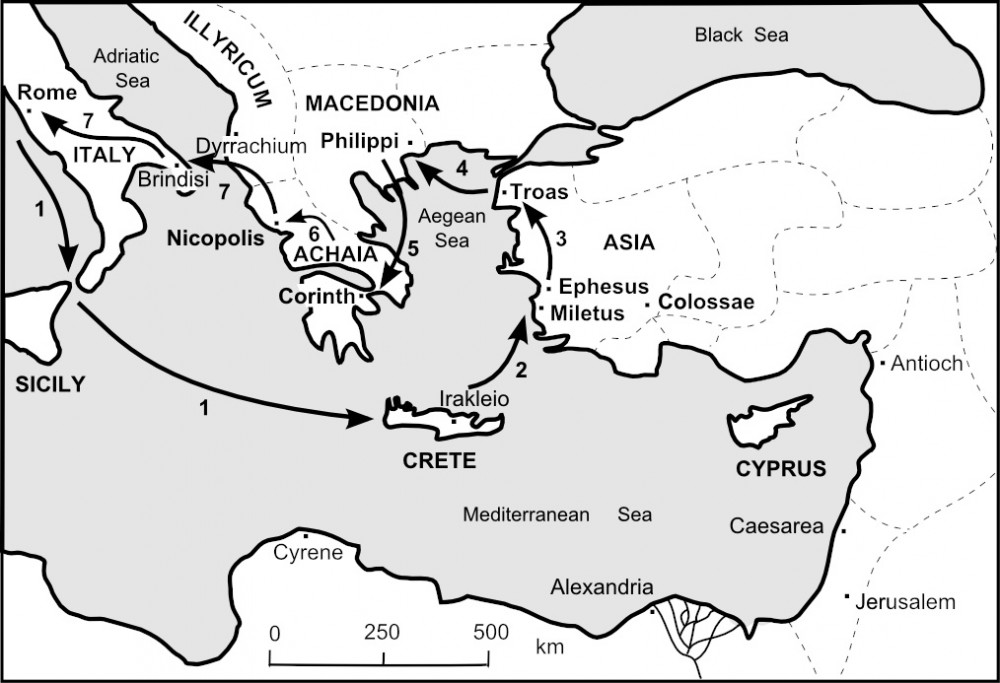
Paul was acquitted before emperor Nero, ca. AD 62 (see 2 Timothy 4:16-17; Acts 28:16, 30-31). Paul may have then left on a mission to Spain, cf. Romans 15:24, 28, but no evidence of such a journey has been found. Paul’s possible fourth missionary journey may have gone like this:
1 – To Crete, which Paul had passed by on his voyage to Rome, and where after some undisclosed time spent on the Island he left Titus to continue the ministry there, Titus 1:5.
2 – To Miletus, where Paul left Trophimus who was ill, and to Ephesus, where he left Erastus, 2 Timothy 4:20, and possibly to Colossae, Philippians 1:22 (cf. Tychicus, 2 Timothy 4:12).
3 – To Troas, where Paul left Carpus and his coat, and possibly his books and parchments, 2 Timothy 4:13.
4 – To Macedonia, 1 Timothy 1:3.
5 – To Achaia, 1 Timothy 3:14; 4:13
6 – To Nicopolis, Titus 3:12.
7 – To Rome, (Mamertine) prison. 2 Timothy 1:8, 16–17; 2:9; (beheaded, ca. AD 67) 2 Timothy 4:6.
The Island of Crete
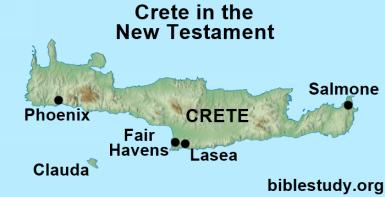
The Island of Crete (formerly known as Candia when a colony of Venice) is in the southern portion of the Aegean Sea which is a branch of the Mediterranean Sea. Crete is 160 miles long and 35 miles wide at its widest point, with 3,219 square miles in total area. It features lowland hills to the east and a central mountainous ridge to the west with one mountain of over 8,000 feet. The central Messara Valley is a rich alluvial plain. Homer spoke of the 100 cities of Crete (Illiad 2.649), the Hellenistic period identified 40 towns, and the Roman period 20. Philo identified a Jewish community on Crete.
Paul first saw Crete from the deck of a ship that was “coasting” along the south shore westward from Salmone to Lasea. He was a prisoner of the Roman centurion, Julian, being transported from Caesarea to Rome. They had changed ships at Myra in Lycia, boarding a grain transport from Alexandria. Sailing with difficulty, “under the lee of Crete…we came to a place called Fair Havens.” Against Paul’s advice, the owner and the pilot of the ship along with the centurion determined to winter at Phoenix. But they were struck by a strong northeaster, driving them out to sea… (see Acts 27).
It is quite possible that there were already believers on the Island when Paul and Titus arrived. Cretan Jews attended the Pentecost feast in Jerusalem and heard Peter’s inaugural Gospel sermon (see Acts 2:11). Were some of these among the 3,000 who obeyed the Gospel on that day? Titus was written ca. AD 63, some thirty years after that Pentecost. During that period Christianity had spread throughout the Roman world, including nearby Achaia with Corinth and the Peloponnese. One of the problems that plagued the Gentile church were Judaizing teachers. These appeared to be already present in Crete when the missionaries arrived (see Titus 1:13, 14; 3:9). Thus their mission included both evangelism and church building.
So we ponder, did Paul see the Island beckoning for the Gospel as he “coasted” by? Did this prompt him to return to Crete shortly after he won his freedom in Rome to proclaim the Lord Jesus there?
Titus
Titus is mentioned in the NT thirteen times. He was a long-time friend, fellow-believer, and co-worker in the Gospel with Paul. He accompanied Paul on his mission to Crete, and remained there to complete the work begun.
In ca. AD 50, Titus accompanied Paul and Barnabas at that decisive council of “elders and apostles” that met in Jerusalem to consider if Gentile believers were required to keep the Law (see Acts 15:1-21). Paul wrote to the Galatians concerning this meeting, “I took Titus along with me” (Galatians 2:1). And Titus became sort of a case study, as Paul said, “But even Titus…was not forced to be circumcised” (vs. 3).
Titus was important to Paul in his relation with the church at Corinth. In his second letter to this church, Paul acknowledged that he anticipated word concerning them from Titus when he arrived in Troas, but Titus was not there (2 Corinthians 2:12–13). Paul went on to Macedonia where he was under great stress. The subsequent arrival of Titus was a godsend for Paul, “But God, who comforts the downcast, comforted us by the coming of Titus, and not only by his coming but also by the comfort with which he comforted you, as he told us of your longing, your mourning, your zeal for me, so that I rejoiced still more” (2 Corinthians 7:6, 7). Thus Titus was a source of encouragement to the Corinthian church in this difficult time: Paul wrote, “And besides our own comfort, we rejoiced still more at the joy of Titus, because his spirit has been refreshed by all of you. For whatever boasts I made to him about you, I was not put to shame. But just as everything we said to you is true, so also our boasting before Titus has proved true. And his affection for you is even greater, as he remembers the obedience of you all, how you received him with fear and trembling” (2 Cor. 7:13b–15).
Paul had undertaken a major effort of charity—in which the poor Jewish believers of Judea would receive charitable assistance from the Gentile believers of Macedonia and Greece. Paul wrote, “Accordingly, we urged Titus that as he has had started, so he should complete among you this act of grace” (2 Corinthians 8:6). Later in his Letter to the Corinthians in this regard, Paul again spoke of the value of Titus: “But thanks be to God who put into the heart of Titus the same earnest care I have for you. For he not only accepted our appeal, but being himself very earnest he is going to you of his own accord. With him we are sending the brother who is famous among all the churches…. As for Titus, he is my partner and fellow worker for your benefit” (vs. 16–17, 23). In closing his letter to the Corinthians, Paul wrote, “Did I take advantage of you through any of those whom I sent to you? I urged Titus to go…. Did Titus take advantage of you? Did we not act in the same spirit?” (2 Corinthians 12:17–18).
In Paul’s Letter to Titus, he refers to Titus, “…my true child in a common faith” (Titus 1:4). After completing his mission in Crete, Titus would be replaced by either Artemas or Tychicus, and Paul hoped to see Titus in Nicopolis over the winter (Titus 3:12).
In Paul’s last writing, he reported, “Titus has gone to Dalmatia” (i.e. Croatia; 2 Timothy 4:10c).
The Letter
Three highlights of spiritual grace that make this letter a gem:
1) The greeting, “Paul, a servant of God and an apostle of Jesus Christ, for the sake of the faith of God’s elect and their knowledge of the truth, which accords with godliness, in hope of eternal life, which God, who never lies, promised before the ages began, and at the proper time manifested in his word through the preaching with which I have been entrusted by the command of God the Father and Christ Jesus our Saviour” (Titus 1:1b–3).
2) The wonder, “For the grace of God has appeared, bringing salvation for all people, training us to renounce ungodliness and worldly passions, and to live self-controlled, upright, and godly lives in the present age, waiting for our blessed hope, the appearing of the glory of our great God and Saviour Jesus Christ, who gave himself for us to redeem us from all lawlessness and to purify for himself a people for his own possession who are zealous for good works” (Titus 2:11–14).
3) The work, “But when the goodness and loving kindness of God our Saviour appeared, he saved us, not because of the works done by us in righteousness, but according to his own mercy, by the washing of regeneration and renewal of the Holy Spirit, whom he poured out on us richly through Jesus Christ , our Saviour, so that being justified by his grace we might become heirs according to the hope of eternal life” (Tit. 3:4–7).
These three passages are each one continuous sentence in the original Koine Greek. In English they would be considered run-on sentences. (A number of translations break them into shorter sentences; the ESV, used here, maintains the original continuity.) But in the original they are a study of carefully crafted statements.
The letter includes qualifications for elders, marking of the Judaizers, and citing Christian duty according to age and citizenship. Paul emphasizes the importance of good works: 1:16, 2:7, 2:14, 3:1; 3:8; 3:14.
Grimsby, Ontario