
Introduction
Few passages in the New Testament have generated more discussion than James 2:14-26. Many approach the chapter assuming James is discussing the relationship between faith and works as though they were competing principles. However, a careful reading of the text reveals that James is addressing a different issue altogether.
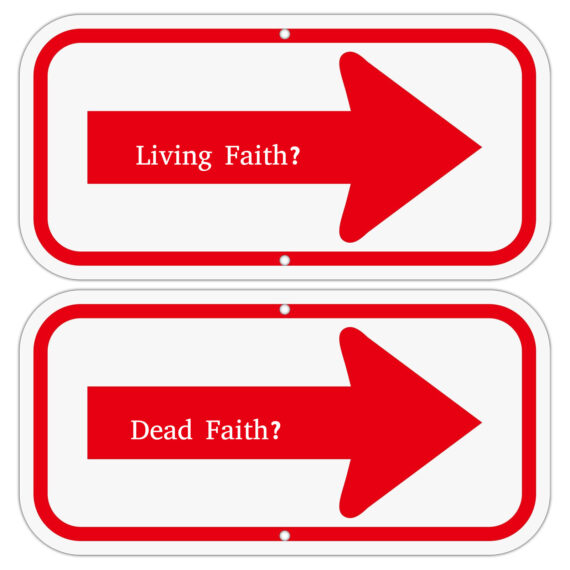
James is not contrasting faith and works. He is contrasting living faith and dead faith. His concern is not how faith originates but what genuine faith looks like when it enters the life of the believer. The entire argument unfolds around one central question:






What kind of faith saves?
A Claimed Faith
James begins: “What good is it, my brothers, if someone says he has faith but does not have works? Can that faith save him?” (James 2:14)
The grammatical setting is important. James does not ask: What if a man has no faith? Nor does he ask: What if a man lacks the capacity to believe? Instead, James speaks of a man who claims to have faith. The discussion begins with a profession.
The issue is whether the profession corresponds to reality.
The phrase “someone says” immediately places the focus on the difference between claimed faith and demonstrated faith.
Faith Tested by Life
James moves quickly from theory to practice. “If a brother or sister is poorly clothed and lacking in daily food, and one of you says to them, ‘Go in peace, be warmed and filled,’ without giving them the things needed for the body, what good is that?” (James 2:15-16)
Notice what James does. He takes faith out of the realm of abstract discussion and places it into everyday life. The person in the illustration speaks the right words. He expresses concern. He appears compassionate. Yet he does nothing. The problem is not the absence of speech. The problem is the absence of action. James is showing that faith cannot be evaluated merely by verbal claims.
Faith must be examined in the context of life itself.
Dead Faith
James reaches his first conclusion: “So also faith by itself, if it does not have works, is dead.” (James 2:17)
This statement is often misunderstood. James does not say faith and works are two independent requirements. Instead, he describes a particular kind of faith: “faith by itself.” The issue is not whether faith exists. The issue is whether that faith is alive.
James’s contrast throughout the chapter is not:
- Faith versus works, but:
- Living faith versus dead faith
Dead faith is faith isolated from life. Living faith is faith expressed through life.
The Impossible Challenge
James then introduces an imaginary objector:
“You have faith and I have works.” (James 2:18)
The objector attempts to separate faith and works into different categories. James refuses the separation. His reply is striking:
“Show me your faith apart from your works, and I will show you my faith by my works.”
The challenge exposes the weakness of the objector’s position. Faith cannot be displayed apart from life. No one can see an invisible claim. Faith becomes visible only through action. Works are not competitors with faith.
Works are the visible evidence of faith.
The Witness of the Demons
James now introduces one of the most powerful examples in the chapter: “You believe that God is one; you do well. Even the demons believe—and shudder!” (James 2:19)
This comparison deserves careful attention. James uses the same verb for both humans and demons. The comparison is deliberate. A person believes that God is one. The demons also believe that God is one. James is making an apple-to-apple comparison. The force of the argument depends upon both possessing belief. The demons are not presented as incapable of belief.
On the contrary, they possess belief. They recognize truth. They acknowledge reality. They even tremble before that reality. Their evil has not removed their capacity to believe. This observation is significant. James demonstrates that belief alone cannot be the defining characteristic of saving faith. If belief alone were sufficient, the demons would qualify. The issue is not whether belief exists. The issue is, what kind of faith it is. The demons believe, but they do not submit. They believe, but they do not obey. They believe, but they remain opposed to God.
Thus James demonstrates that faith cannot be reduced to intellectual assent.
Abraham: Faith Demonstrated
To illustrate living faith, James turns to Abraham. “Was not Abraham our father justified by works when he offered up his son Isaac on the altar?” (James 2:21)
James deliberately chooses the offering of Isaac. This event represents the visible manifestation of Abraham’s trust in God. The key statement follows: “You see that faith was active along with his works, and faith was completed by his works.” (James 2:22)
Notice the grammar. Faith remains the subject. Works do not replace faith. Works accompany faith. Works complete faith. James does not present works as a substitute for faith. He presents works as the maturity and fulfillment of faith. Abraham’s obedience revealed what had already existed within him.
The faith that trusted God became visible through action.
Rahab: A Second Witness
James immediately adds a second example. “And in the same way was not also Rahab the prostitute justified by works when she received the messengers and sent them out by another way?” (James 2:25)
The phrase “in the same way” is important. Rahab serves as a second witness to the same principle. Like Abraham, she acted upon what she believed. Her actions revealed the reality of her faith. James intentionally selects two very different individuals:
- Abraham, the patriarch.
- Rahab, the former prostitute.
Yet both demonstrate the same truth. Faith becomes visible through action.
The Final Analogy
James concludes with a memorable illustration: “For as the body apart from the spirit is dead, so also faith apart from works is dead.” (James 2:26)
This analogy summarizes the entire chapter. A body without spirit is not a different body. It is a dead body. Likewise, faith without works is not a different faith. It is a dead faith. James’s concern throughout the chapter has been life versus death. The issue is not the existence of faith as a claim. The issue is whether that faith possesses life. Works are to faith what breath is to the body. They are the evidence that life is present.
Conclusion
James 2 is not a debate between faith and works. It is an examination of the nature of faith itself. The chapter begins with a claim of faith and ends with a test of faith. James rejects a faith that remains isolated from life. He rejects a faith that exists only in words. He rejects a faith that consists merely of acknowledging propositions. The demons themselves prove that belief alone is insufficient. In contrast, Abraham and Rahab demonstrate living faith. Their faith acted. Their faith obeyed. Their faith entered life.
Therefore the central message of James 2 is clear: Faith without works is dead because genuine faith is never separated from life. Living faith expresses itself in action. Dead faith remains only a claim. The difference between the two is the difference between life and death.
Sault Ste. Marie, ON